
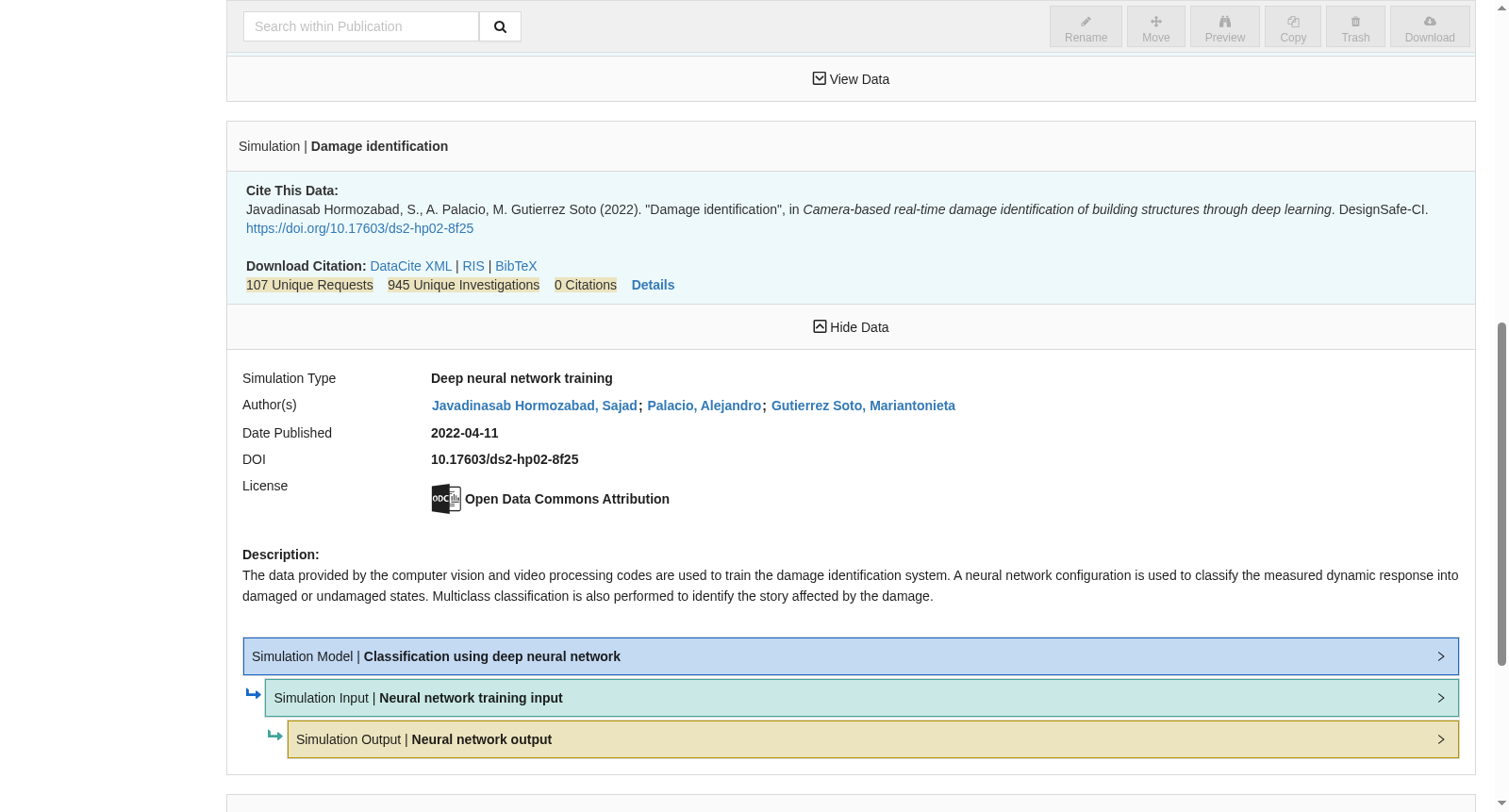
Damage identification
收藏DataCite Commons2025-06-02 更新2025-04-16 收录
下载链接:
https://www.designsafe-ci.org/data/browser/public/designsafe.storage.published/PRJ-3446/#detail-2796882219175308820-242ac118-0001-012
下载链接
链接失效反馈官方服务:
资源简介:
Real-time Damage Identification (DI) augment smart structures with instant damage information, which is essential to take safety actions and avoid spreading the damage throughout the building structure. Having the severity and location of the damage ready via real-time DI will allow for effective scheduling of preventive measures and action plans to isolate the damage and replace affected elements. Accordingly, real-time DI improves structural safety, especially against extreme events unknown at the design stage. This field needs innovative solutions to overcome the difficulties and limitations of model-based approaches and train supervised machine learning classifiers in the absence of measured damaged data. The present project is an image-based DI methodology using deep neural networks to provide real-time data-driven damage information for structural systems. The video and acceleration data are provided through experiments on a small-scale 3D moment-resisting 4-story frame structure subjected to dynamic loading. The dynamic response signals serve as the inputs to the proposed DI methodology. Two different data acquisition (DAQ) configurations are employed simultaneously to measure the dynamic response data to compare the accuracy: acceleration sensors and video recording. Video processing techniques, including global image thresholding and the Kanade-Lucas-Tomasi algorithm, track the floor levels to obtain displacement, velocity, and acceleration signals from recorded videos. Then, the signals received from either DAQ system are further processed to remove noises. Upon feeding the filtered dynamic response signals to a deep learner, the outputs provide real-time DI describing the damage presence and location. Regularization techniques, including dropout to avoid co-adaptation in hidden layers, resulted in accuracy improvements. The neural network is optimized through 10-fold cross-validation. The lateral stiffness is reduced by changing the cross-section of columns to simulate multiple damage levels in different stories. Accordingly, four-column arrangements for each story are investigated, resembling undamaged state and damaged states with minor, moderate, and major severities. The accuracy results obtained from the test dataset show the promising performance of the proposed non-destructive and model-free methodology for real-time DI. These compelling results can potentially transform the structural health monitoring (SHM) field into a new era by providing cost-effective early damage warning for various structural systems in an engineering context, without the need for complicated structural models and the uncertainties of simplified structural models during operation. By providing real-time data, the proposed DI methodology can also update the control strategy and optimize the vibration mitigation efficiency in smart structures with integrated structural control and health monitoring systems.
实时损伤识别(Damage Identification, DI)可为智能结构提供即时损伤信息,这是采取安全处置措施、阻止损伤在建筑结构内扩散的必要前提。通过实时损伤识别获取损伤的严重程度与位置信息,可助力高效规划预防措施与处置方案,以隔离损伤并更换受损构件。据此,实时损伤识别可提升结构安全性,尤其可应对设计阶段未被预见的极端荷载事件。该领域亟需创新解决方案,以突破基于模型的方法所存在的难点与局限,并在缺乏实测损伤数据的场景下训练监督式机器学习分类器。本项目提出一种基于图像的损伤识别方法,借助深度神经网络为结构系统提供实时数据驱动的损伤信息。本数据集通过对缩尺三维刚接4层框架结构开展动力加载试验获取视频与加速度数据,试验所得动力响应信号将作为所提损伤识别方法的输入数据。为对比精度,本研究同时采用两套不同的数据采集(Data Acquisition, DAQ)配置来获取动力响应数据:加速度传感器与视频录制系统。视频处理技术涵盖全局图像阈值法与卡纳德-卢卡斯-托马西(Kanade-Lucas-Tomasi)算法,通过追踪楼层平面获取录制视频中的位移、速度与加速度信号。随后,从两套数据采集系统获取的信号均将经过进一步降噪处理。将降噪后的动力响应信号输入至深度学习模型后,模型输出可实现实时损伤识别,涵盖损伤存在与否及其位置信息。正则化技术(包括用于避免隐藏层神经元共适应的丢弃法)有效提升了模型精度,本研究通过10折交叉验证对神经网络进行优化。研究通过改变柱截面尺寸降低侧向刚度,以此模拟不同楼层的多种损伤程度。据此,本研究针对每个楼层的4根柱布置方案展开试验,分别对应无损伤状态,以及轻微、中度、重度的损伤状态。测试集的精度结果表明,所提无模型、非侵入式的实时损伤识别方法性能优异。该出色成果可通过为各类工程结构系统提供高性价比的早期损伤预警,推动结构健康监测(Structural Health Monitoring, SHM)领域迈入全新阶段,无需依赖复杂的结构模型,也规避了运行阶段简化结构模型带来的不确定性。所提损伤识别方法通过提供实时数据,还可更新集成了结构控制与健康监测系统的智能结构的控制策略,优化振动抑制效率。
提供机构:
Designsafe-CI
创建时间:
2022-04-11
搜集汇总
数据集介绍
背景与挑战
背景概述
该数据集聚焦于利用深度学习和计算机视觉技术实现建筑结构的实时损伤识别,包含实验数据、视频处理和深度学习模型训练等内容。通过加速度传感器和视频记录两种数据采集方式,结合深度神经网络,实现了对建筑结构损伤的实时监测和分类,为结构健康监测领域提供了创新解决方案。
以上内容由遇见数据集搜集并总结生成



