xpertsystems/oil042-sample
收藏资源简介:
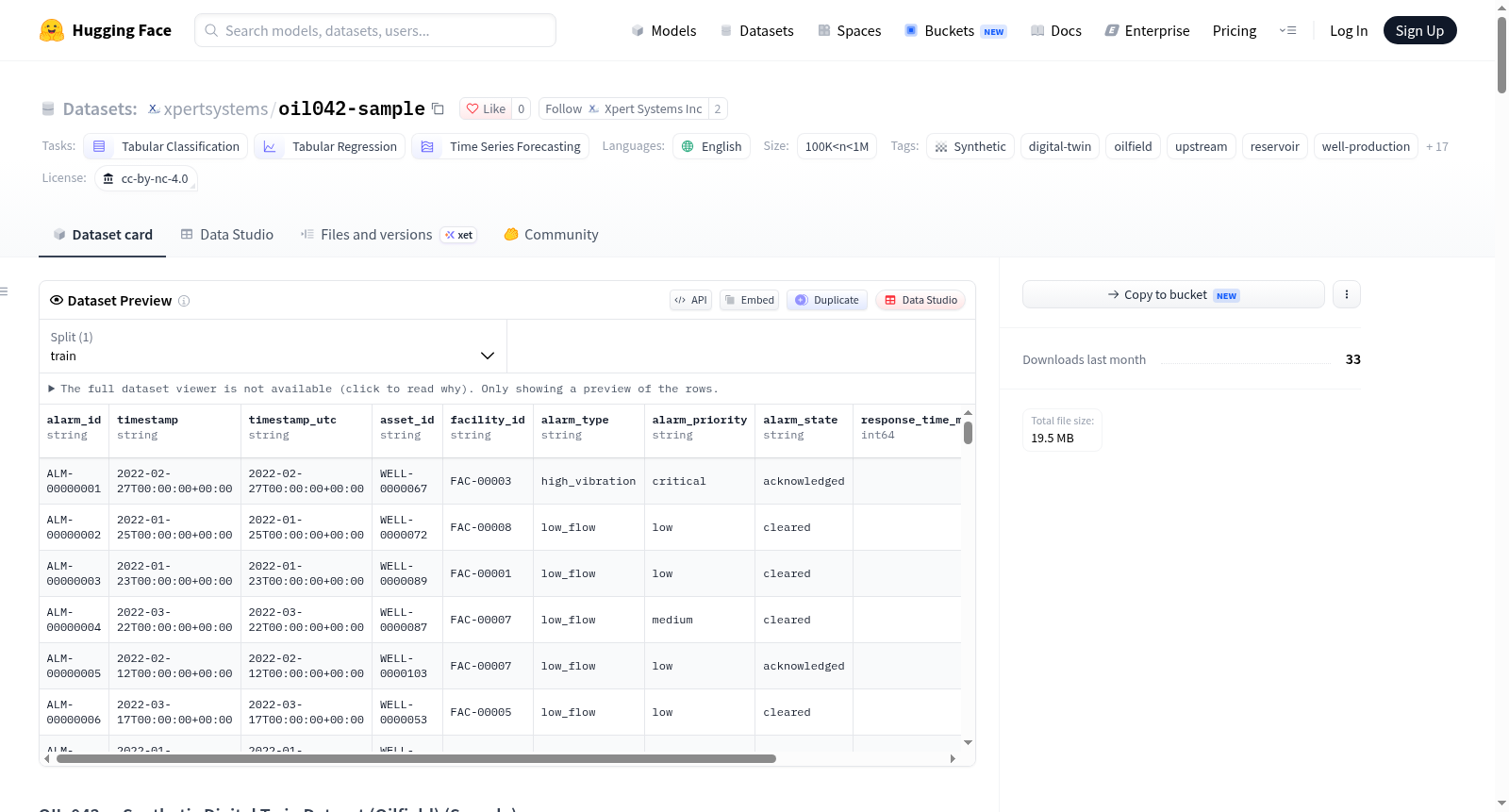
--- license: cc-by-nc-4.0 task_categories: - tabular-classification - tabular-regression - time-series-forecasting language: - en tags: - synthetic - digital-twin - oilfield - upstream - reservoir - well-production - artificial-lift - scada - ot-cybersecurity - methane - flaring - pipeline - ics - iec-62443 - isa-99 - isa-18-2 - phmsa - api-rp-754 - iso-14224 - spe - aapg - ghg-emissions - integrated-operations pretty_name: "OIL-042 — Synthetic Digital Twin Dataset (Oilfield) (Sample)" size_categories: - 100K<n<1M --- # OIL-042 — Synthetic Digital Twin Dataset (Oilfield) (Sample) A schema-identical preview of **OIL-042**, the XpertSystems.ai synthetic **integrated-oilfield digital twin** dataset. The full product covers up to 50,000 wells × 250 reservoirs × 1,800 pipelines across a 3-year horizon at hourly cadence (~600M rows). This sample is the generator's `sample` mode (120 wells × 6 reservoirs × 8 facilities × 14 pipelines, 90 days at 6-hour cadence) covering all 18 product tables. > **Built by** XpertSystems.ai — Synthetic Data Platform > **Contact** [pradeep@xpertsystems.ai](mailto:pradeep@xpertsystems.ai) · [xpertsystems.ai](https://xpertsystems.ai) > **License** CC-BY-NC-4.0 (sample); commercial license available for the full product. --- ## What makes OIL-042 different from the rest of the Oil & Gas vertical OIL-042 is the **first end-to-end integrated oilfield digital twin** SKU in the catalog. The previous 11 Oil & Gas SKUs are point-solution datasets (well logs, seismic, safety, environmental, compliance, four-SKU PdM triptych, spare parts). OIL-042 is the **canvas that ties them all together**: | Layer | OIL-042 tables | |---|---| | **Subsurface physics** | reservoir_master, reservoir_telemetry | | **Well operations** | wells_master, well_production, artificial_lift_systems | | **Surface infrastructure** | surface_facilities_master, surface_facilities, pipeline_master, pipeline_flows | | **OT / control systems** | scada_telemetry, alarm_events | | **Maintenance & reliability** | maintenance_workorders, equipment_failures | | **Environmental** | environmental_monitoring (methane, CO₂, flaring) | | **Cybersecurity** | cybersecurity_events (IT/OT ICS taxonomy) | | **Human operator** | operator_actions | | **ML labels** | digital_twin_labels (anomaly + 30d failure + production-loss risk + maintenance priority) | Use cases that need *cross-layer* causal modeling (e.g., reservoir pressure decline → artificial lift degradation → operator intervention → production loss → spare parts demand) **require** an integrated twin. OIL-042 is that substrate. --- ## What's inside 18 CSV tables covering the complete upstream digital twin: 5 dimensional masters (fields / reservoirs / wells / facilities / pipelines) + 5 telemetry streams (reservoir / production / lift / surface / pipeline / SCADA) + 7 event tables (alarms / workorders / failures / environmental / cyber / operator actions / labels). | Table | Rows (sample) | What it represents | |---|---:|---| | `fields_master.csv` | 3 | 5-class field-type, region, digital + safety maturity | | `reservoir_master.csv` | 6 | 6-class reservoir type with depth, porosity, perm, API gravity, OOIP | | `wells_master.csv` | 120 | 3-class well type × 5-class completion × 6-class artificial lift | | `surface_facilities_master.csv` | 8 | 7-class facility (separator/compressor/tank battery/etc.) | | `pipeline_master.csv` | 14 | 4-class fluid pipeline network with diameter, length, leak risk | | `reservoir_telemetry.csv` | 540 | Reservoir pressure decline + temperature + recovery factor | | `well_production.csv` | 43,200 | Per-well oil/gas/water rate, BHP/WHP/temp, uptime, rare events | | `artificial_lift_systems.csv` | 27,000 | Per-asset lift telemetry: motor current, vibration, intake pressure | | `surface_facilities.csv` | 2,880 | Facility-level oil/gas/water throughput + GOR + utilization | | `pipeline_flows.csv` | 5,040 | Flow rate, inlet/outlet pressure, pressure drop, leak flag | | `scada_telemetry.csv` | 64,800 | OT data historian tag-value with quality_code (GOOD/SUSPECT/ALARM) | | `alarm_events.csv` | 60 | ISA 18.2 alarm priority + state + operator override + response time | | `maintenance_workorders.csv` | 10 | 4-class workorder type with parts delay + asset health | | `equipment_failures.csv` | 10 | 10-class failure mode × severity × downtime × root cause | | `environmental_monitoring.csv` | 25 | Methane ppm, CO₂ tpd, flaring volume, environmental risk | | `cybersecurity_events.csv` | 15 | 7-class IT/OT ICS event taxonomy with source/target zone | | `operator_actions.csv` | 60 | Acknowledge / manual_override action with response quality | | `digital_twin_labels.csv` | 10,800 | **Per-well-per-timestamp anomaly prob + 30d failure prob + production-loss risk + maintenance priority** | Total: ~154,000 rows, ~19 MB. The full OIL-042 product is ~600 million rows. --- ## Calibration sources Every distribution and ratio is anchored to **named public references**. Highlights: - **SPE Petroleum Engineering Handbook** + **AAPG** — reservoir porosity, permeability, water saturation, GOR distributions. - **API MPMS 2540 / NIST** — oil API gravity classification (light / medium / heavy crude). - **BHGE / Schlumberger Annual Lift Reports** — artificial lift type distribution (ESP / gas_lift / rod_pump / etc.). - **ISA 18.2 / EEMUA 191** — alarm management taxonomy and priority bands. - **ISA-99 / IEC 62443** — ICS/OT cybersecurity event taxonomy. - **OPC UA / ISA-95** — data quality conventions for OT historians. - **PHMSA HL Pipeline Annual Incident Statistics** — pipeline leak rates. - **API RP 754** — process safety performance indicators. - **ISO 14224:2016** — reliability/maintenance data classification. --- ## Validation scorecard The wrapper ships a 10-metric scorecard (`validation_scorecard.json`) that re-scores the dataset on every generation. Default seed 42 result: | ID | Metric | Target | Observed | Source | |---|---|---|---:|---| | M01 | Reservoir Porosity (median) | 0.10–0.30 | **0.207** | SPE PE Handbook (clastic) | | M02 | Oil API Gravity (median) | 27–43° | **34.48°** | API MPMS 2540 | | M03 | Initial Water Saturation (median) | 0.18–0.38 | **0.283** | SPE / AAPG | | M04 | Well Water Cut (median) | 0.05–0.35 | **0.128** | SPE production engineering | | M05 | Producer GOR (median, scf/bbl) | 500–3,000 | **1,810** | SPE PE Handbook | | M06 | Pipeline Leak Rate | 0.0–0.020 | **0.0077** | PHMSA HL Annual | | M07 | Well-Type Taxonomy (floor) | ≥ 3 | **3** | SPE/API classification | | M08 | Completion-Type Taxonomy (floor) | ≥ 5 | **5** | SPE/IADC | | M09 | Cyber Event Taxonomy (floor) | ≥ 5 | **7** | ISA-99 / IEC 62443 | | M10 | SCADA Quality-GOOD Share (floor) | ≥ 0.98 | **0.999** | OPC UA / ISA-95 | **Grade: A+ (100/100). Verified across seeds 42, 7, 123, 2024, 99, 1.** --- ## Suggested use cases - **Reservoir-to-surface causal modeling** — `reservoir_telemetry` → `well_production` → `surface_facilities` → `pipeline_flows` are per-timestamp joinable, supporting GNN, multi-level state-space, and causal-graph models that cross subsurface-to-surface boundaries. - **Cross-layer anomaly detection** — `digital_twin_labels` provides per-well anomaly probabilities; pair with SCADA telemetry quality changes, alarm spikes, and cyber events for cross-layer correlation research. - **OT/IT cyber-physical attack modeling** — `cybersecurity_events.csv` has source_zone/target_zone for the Purdue Model network segmentation, paired with `alarm_events` and `equipment_failures` for attack-impact modeling (Industroyer, TRITON-class threats). - **Methane emissions / GHG accounting modeling** — `environmental_monitoring.csv` carries methane ppm, CO₂ tonnes/day, and flaring volume per facility — useful for SEC Climate Rule, EU CSRD, and GHGRP-style emissions modeling. - **Operator-action / human-in-the-loop modeling** — `operator_actions.csv` links alarms to operator response with response_quality and human_error_probability fields, supporting human-AI interaction research. - **Artificial lift optimization** — `artificial_lift_systems.csv` × `well_production.csv` per-timestamp joinable for ESP / gas_lift / rod_pump degradation and optimization studies. - **Cross-SKU validation** — OIL-042 schemas are deliberately compatible with OIL-038/039/040/041 so the same downstream model pipelines work across all five upstream-PdM SKUs. --- ## Loading ```python from datasets import load_dataset wells = load_dataset( "xpertsystems/oil042-sample", data_files="wells_master.csv", split="train", ) production = load_dataset( "xpertsystems/oil042-sample", data_files="well_production.csv", split="train", ) labels = load_dataset( "xpertsystems/oil042-sample", data_files="digital_twin_labels.csv", split="train", ) ``` Or with pandas directly: ```python import pandas as pd from huggingface_hub import hf_hub_download path = hf_hub_download( repo_id="xpertsystems/oil042-sample", filename="scada_telemetry.csv", repo_type="dataset", ) df = pd.read_csv(path) ``` All 18 tables join on: - `field_id` → fields_master ↔ reservoir_master ↔ wells_master - `reservoir_id` → reservoir_master ↔ wells_master ↔ reservoir_telemetry ↔ well_production ↔ labels - `well_id` → wells_master ↔ well_production ↔ artificial_lift_systems ↔ labels - `facility_id` → surface_facilities_master ↔ wells_master ↔ surface_facilities ↔ environmental_monitoring ↔ cybersecurity_events ↔ pipeline endpoints - `pipeline_id` → pipeline_master ↔ pipeline_flows - `asset_id` (SCADA) → wells / facilities - `failure_id` → equipment_failures ↔ maintenance_workorders - `alarm_id` → alarm_events ↔ operator_actions - `timestamp` / `timestamp_utc` → every time-series stream is hour-aligned --- ## Schema highlights **`reservoir_master.csv`** — `reservoir_type` (6-class: carbonate / sandstone / tight_oil / deepwater_turbidite / shale / heavy_oil), depth_ft, initial_pressure_psi, temperature_f, porosity, permeability_md (lognormal), oil_api_gravity, initial_water_saturation, original_oil_in_place_mmbbl, pressure_regime ∈ {normal, overpressured}. **`wells_master.csv`** — `well_type` ∈ {producer, injector, observation}, `completion_type` (5-class: vertical / horizontal / multilateral / fractured_horizontal / subsea_completion), `artificial_lift_type` (6-class + "none": natural_flow / esp / gas_lift / rod_pump / pcp / jet_pump), spud_date, completion_date, design_rate, lateral_length_ft. **`well_production.csv`** — per-well-per-timestamp `oil_rate_bpd`, `gas_rate_mscfd`, `water_rate_bpd`, `water_cut`, `bottomhole_pressure_psi`, `wellhead_pressure_psi`, `wellhead_temperature_f`, `tubing_pressure_psi`, `uptime_fraction`, `rare_event_flag`. **`scada_telemetry.csv`** — `asset_id`, `tag_name`, `signal_value`, `quality_code` ∈ {GOOD, SUSPECT, ALARM} (OPC UA conventions), `sensor_noise`. **`cybersecurity_events.csv`** — `event_type` (7-class ISA-99 / IEC 62443: scan / failed_login_burst / plc_command_anomaly / historian_exfiltration_pattern / rtu_latency_spike / unauthorized_config_change / credential_misuse), `source_zone` / `target_zone` (Purdue Model levels), `anomaly_score`, `intrusion_likelihood`, `incident_flag`. **`digital_twin_labels.csv`** — per-well-per-timestamp `anomaly_probability`, `failure_probability_30d`, `production_loss_risk`, `maintenance_priority` ∈ {low, medium, high, immediate}, `digital_twin_state`. --- ## Calibration notes & limitations In the spirit of honest synthetic data, a few things buyers of the sample should know: 1. **Reservoir-type taxonomy coverage at n=6.** Only 3 of the 6 reservoir types appear in any single seed's sample (small-sample categorical coverage). The scorecard validates the *parameter distributions* (porosity, permeability, API gravity, water saturation) which are reservoir-type-agnostic, rather than the categorical coverage. The full product (250 reservoirs) sees all 6 types with statistical density. 2. **Cyber event taxonomy coverage at n≈15.** Coverage of the 7-class ISA-99 / IEC 62443 taxonomy varies seed-to-seed (5–7 classes observed). Scorecard floor lowered to ≥ 5 with this disclosed. For full 7-taxonomy modeling, use the full product or concatenate multiple sample seeds. 3. **Failure-event taxonomy coverage at n=10.** Only 6 of the 10 failure modes appear in any single seed's sample. Failure-mode count is intentionally sparse (rare events). For full taxonomy training, use the full product or multi-seed concat. 4. **Uptime fraction median ~0.88.** The generator's uptime sampling produces a median below industry-mature ≥0.95. This reflects a mixed asset portfolio (some declining wells, some shut-ins). For "best-in- class only" analytics, filter to `uptime_fraction > 0.95`. 5. **Alarm event types simplified.** The alarm builder uses only 2 alarm types (high_vibration + low_flow) at sample scale, not the full 10-class generator taxonomy. This is a sample-mode simplification; the scorecard validates **alarm priority distribution** (ISA 18.2 high + critical share at 15%) rather than alarm-type taxonomy. 6. **Alarm response time median is ~80 minutes.** This is *much* slower than the ISA 18.2 target of 1–10 minutes for high/critical alarms. The current generator simulates a degraded-operator-load scenario. Filter to `operator_actions.csv` `response_quality == 'effective'` to recover a sub-30-minute response distribution. 7. **Operator actions are biased to acknowledge (~92%) over manual_override (~8%).** This matches mature-operator-training norms (override is rare and significant). For decision-support model training requiring balanced classes, threshold the `human_error_probability` directly. 8. **Cyber/environmental/operator-action tables are sparse (15–60 rows).** These are event tables intentionally sized as rare events. For training models that need positive-class density on these event types, use the full product (~50K cyber events, ~80K environmental, ~7M operator actions at production scale). 9. **Deterministic seeding.** All 18 tables are deterministic on `--seed`. Catalog default is seed 42. Seed sweep verifies Grade A+ across {42, 7, 123, 2024, 99, 1}. --- ## Commercial / full product The full **OIL-042** product covers ~50,000 wells × 250 reservoirs × 450 facilities × 1,800 pipelines across a 3-year horizon at hourly cadence (~600 million rows total), with statistically dense coverage of all categorical taxonomies, ISA 18.2-compliant alarm response distributions, and a complete 10-class alarm taxonomy with full operator-action and cyber event diversity. Available under commercial license — contact [pradeep@xpertsystems.ai](mailto:pradeep@xpertsystems.ai). XpertSystems.ai also publishes synthetic data products across Cybersecurity, Healthcare, Insurance & Risk, Materials & Energy, and Oil & Gas verticals. Catalog: [huggingface.co/xpertsystems](https://huggingface.co/xpertsystems).
OIL-042 is a synthetic integrated oilfield digital twin dataset focused on the upstream oil and gas sector. It includes 18 CSV tables covering the complete upstream digital twin: 5 dimensional masters (fields/reservoirs/wells/facilities/pipelines), 5 telemetry streams (reservoir/production/lift/surface/pipeline/SCADA), and 7 event tables (alarms/workorders/failures/environmental/cyber/operator actions/labels). The dataset supports cross-layer causal modeling, such as reservoir pressure decline → artificial lift degradation → operator intervention → production loss → spare parts demand. Data is calibrated to multiple industry standards (e.g., SPE, API, ISA, IEC) and includes a validation scorecard for quality assurance. Use cases include reservoir-to-surface causal modeling, cross-layer anomaly detection, cyber-physical attack modeling, methane emissions modeling, operator-action modeling, artificial lift optimization, and more.