
河西走廊三角城放射性碳测年、碳化种子和木炭鉴定数据集
收藏国家青藏高原科学数据中心2023-08-17 更新2024-03-06 收录
下载链接:
https://data.tpdc.ac.cn/zh-hans/data/fff9cbab-b9f5-4087-a90b-81470e4daaf1
下载链接
链接失效反馈官方服务:
资源简介:
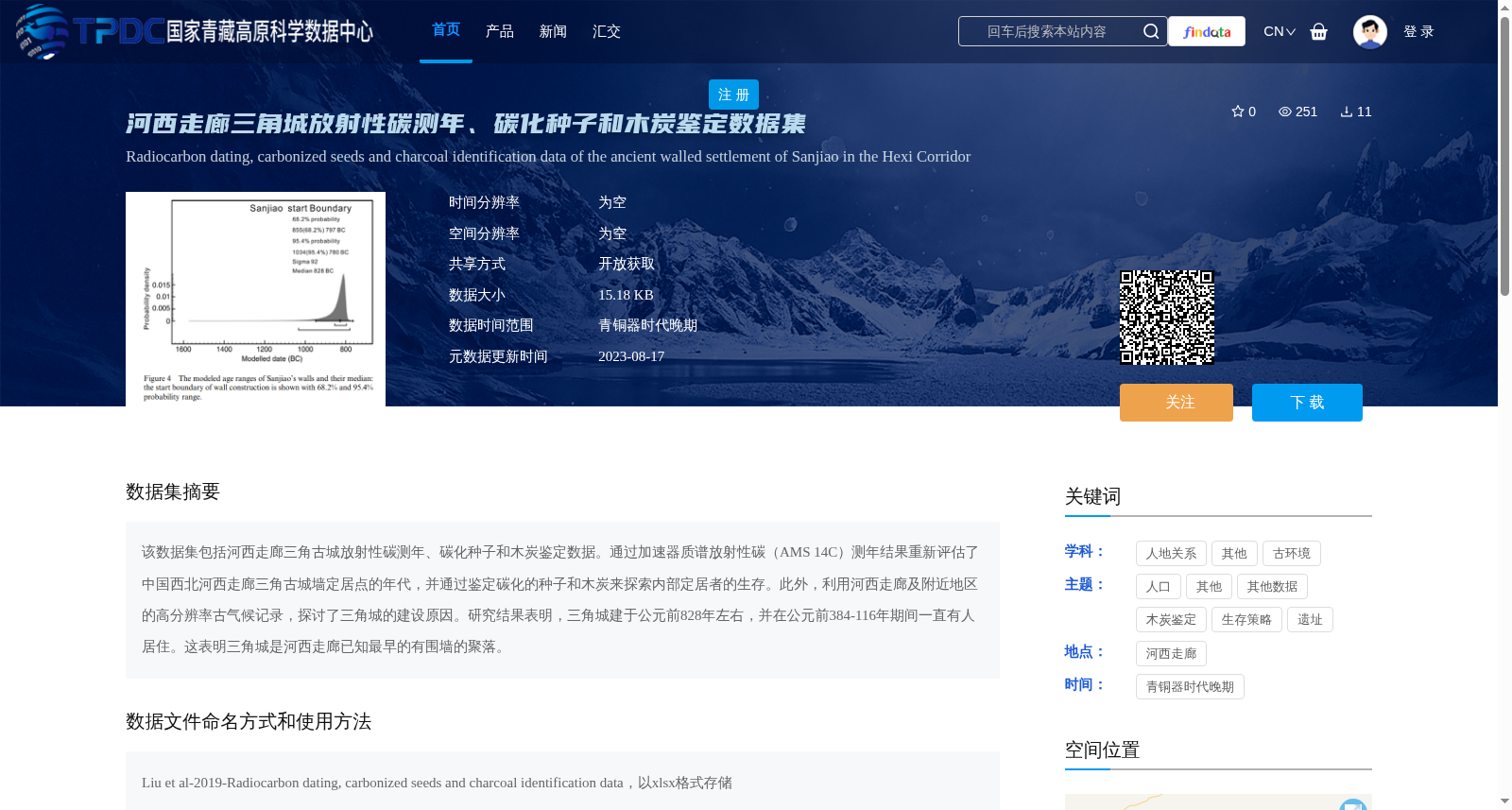
该数据集包括河西走廊三角古城放射性碳测年、碳化种子和木炭鉴定数据。通过加速器质谱放射性碳(AMS 14C)测年结果重新评估了中国西北河西走廊三角古城墙定居点的年代,并通过鉴定碳化的种子和木炭来探索内部定居者的生存。此外,利用河西走廊及附近地区的高分辨率古气候记录,探讨了三角城的建设原因。研究结果表明,三角城建于公元前828年左右,并在公元前384-116年期间一直有人居住。这表明三角城是河西走廊已知最早的有围墙的聚落。
This dataset comprises radiocarbon dating, charred seed identification, and charcoal identification data from the Sanjiao Ancient City in the Hexi Corridor. The chronology of the walled settlement at Sanjiao Ancient City in the Hexi Corridor (Northwest China) was re-assessed via accelerator mass spectrometry radiocarbon (AMS ¹⁴C) dating results, while the subsistence of local settlers was explored through the identification of charred seeds and charcoal. Furthermore, the drivers behind the construction of Sanjiao Ancient City were examined using high-resolution paleoclimate records from the Hexi Corridor and its adjacent areas. Research findings demonstrate that Sanjiao Ancient City was founded around 828 BCE, and remained continuously inhabited from 384 BCE to 116 BCE. This confirms that Sanjiao Ancient City is the earliest documented walled settlement in the Hexi Corridor.
提供机构:
刘峰文
创建时间:
2023-08-13
搜集汇总
数据集介绍
背景与挑战
背景概述
该数据集包含河西走廊三角古城的放射性碳测年、碳化种子和木炭鉴定数据,用于重新评估古城年代(建于公元前828年左右,持续居住至公元前384-116年)和探索定居者的生存策略。数据集支持开放获取,数据大小为15.18 KB,时间范围为青铜器时代晚期,空间位置位于河西走廊,旨在通过古气候记录分析古城建设原因。
以上内容由遇见数据集搜集并总结生成


