
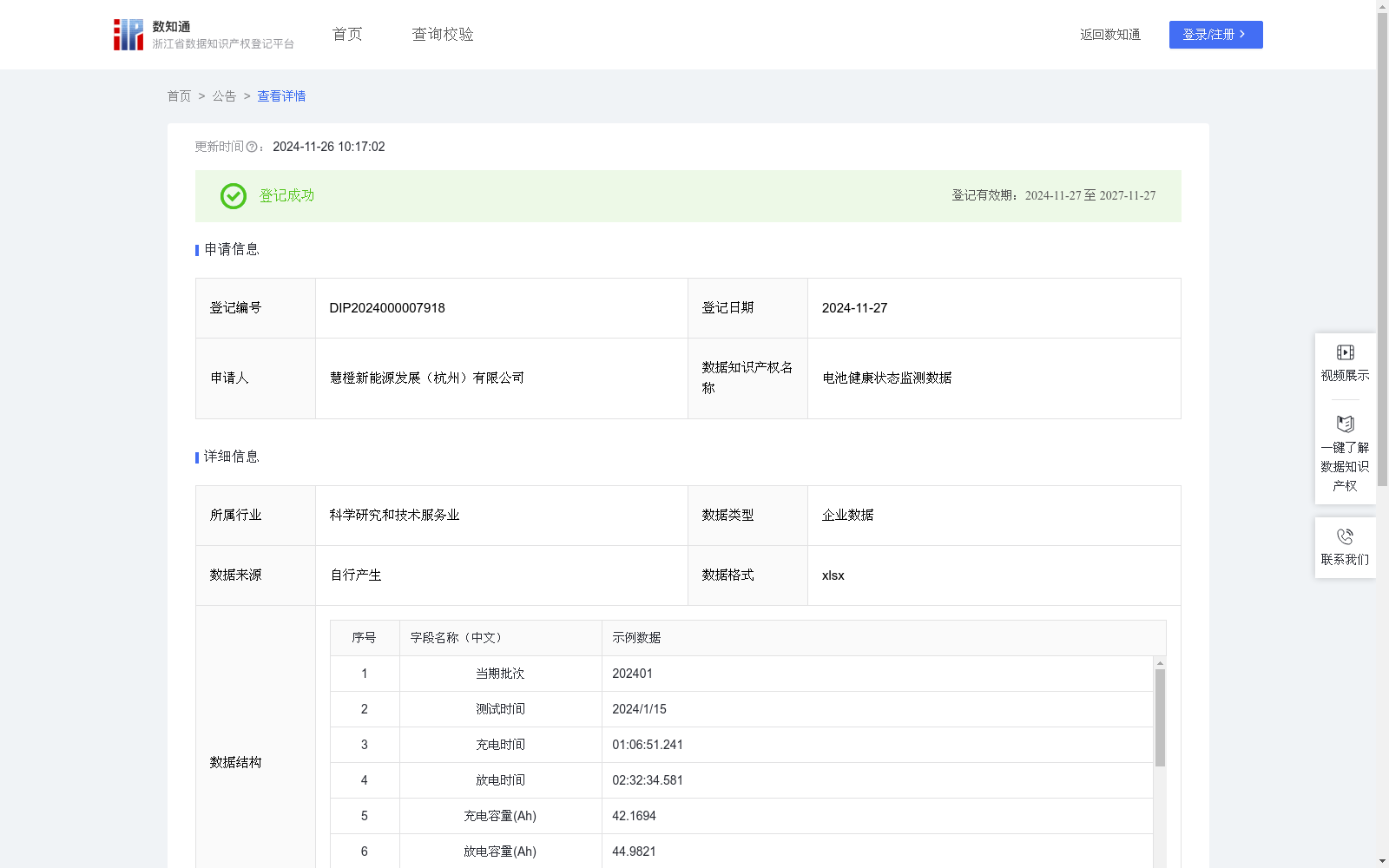
电池健康状态监测数据
收藏浙江省数据知识产权登记平台2024-11-26 更新2024-11-27 收录
下载链接:
https://www.zjip.org.cn/home/announce/trends/89135
下载链接
链接失效反馈官方服务:
资源简介:
电池健康状态监测数据源自对锂电池运行过程中充放电特性、温度变化、性能指标和健康状态等关键数据采集,并计算SOH和同比衰减率等数据,为二轮车电池的性能评估、寿命预测和优化管理提供全面的数据支持。系统的核心功能包括电池性能监测、健康状态评估、性能预测、异常检测和优化管理,旨在帮助电动二轮车制造商、电池供应商或换电站运营商提高电池使用效率,延长寿命,并为产品改进提供数据依据。相关数据不仅提升了电动二轮车的可靠性和安全性,还为换电模式的推广和电池全生命周期管理提供了重要的技术支撑。算法规则包括以下几个方面:1.数据采集:锂电池的运行数据进行采集,包括充电时间、放电时间、充电容量、放电容量、最高温度、最低温度等。2.数据处理:通过算法计算可知,容量保持率 = 放电容量/标准容量 ;充放电效率 = 放电容量 / 充电容量 * 100%;温度稳定性 = 1 - (最高温度 - 最低温度) / 额定工作温度范围;SOH= 容量保持率 * 充放电效率 * 温度稳定性;同比衰减率 = (上期SOH - 本期SOH) / 上期SOH * 100%。3.数据应用:根据容量保持率、充放电效率、温度稳定性、SOH以及同比衰减率,为锂电池健康运行提供数据支撑,便于管理部门对电池资产进行全面评估。通过持续分析SOH和其他指标,及时发现潜在问题,根据电池健康状态,为用户提供最佳的充放电方案。这些数据应用为智能化电池管理系统提供支持和数据保障,有助于提高电池资产管理的效率和精确度,同时为客户提供更高质量的服务。通过这种数据驱动的方法,公司能够在竞争激烈的新能源市场中保持领先地位,并为行业的可持续发展做出贡献。
Battery health state monitoring data is collected from key parameters during the operation of lithium-ion batteries, including charge-discharge characteristics, temperature variations, performance indicators and health states, with calculated metrics such as State of Health (SOH) and year-over-year decay rate. This dataset offers comprehensive data support for performance evaluation, life prediction and optimized management of batteries for two-wheeled electric vehicles.
The core functions of the supporting system include battery performance monitoring, health state assessment, performance prediction, anomaly detection and optimized management. It aims to help electric two-wheeler manufacturers, battery suppliers or battery swap station operators improve battery utilization efficiency, extend service life, and provide data basis for product improvement.
Such data not only enhances the reliability and safety of electric two-wheelers, but also provides critical technical support for the promotion of the battery swapping mode and the full life cycle management of batteries.
The algorithm rules cover the following aspects:
1. Data Collection: Collect operating data of lithium-ion batteries, including charging time, discharging time, charging capacity, discharging capacity, maximum temperature, minimum temperature, etc.
2. Data Processing: Calculate the following metrics via algorithms:
- Capacity retention rate = Discharging capacity / Standard capacity
- Charge-discharge efficiency = (Discharging capacity / Charging capacity) × 100%
- Temperature stability = 1 − (Maximum temperature − Minimum temperature) / Rated operating temperature range
- SOH = Capacity retention rate × Charge-discharge efficiency × Temperature stability
- Year-over-year decay rate = (Previous-period SOH − Current-period SOH) / Previous-period SOH × 100%
3. Data Application: Leverage capacity retention rate, charge-discharge efficiency, temperature stability, SOH and year-over-year decay rate to provide data support for the healthy operation of lithium-ion batteries, enabling management departments to conduct comprehensive assessments of battery assets. Through continuous analysis of SOH and other indicators, potential issues can be detected in a timely manner, and optimal charge-discharge schemes can be provided for users based on the battery health state.
These data applications provide support and data guarantees for intelligent battery management systems, helping to improve the efficiency and accuracy of battery asset management while delivering higher-quality services to customers. By adopting this data-driven approach, enterprises can maintain a leading position in the highly competitive new energy market and contribute to the sustainable development of the industry.
提供机构:
浙江慧橙云能科技有限公司
创建时间:
2024-09-05
搜集汇总
数据集介绍
以上内容由遇见数据集搜集并总结生成


