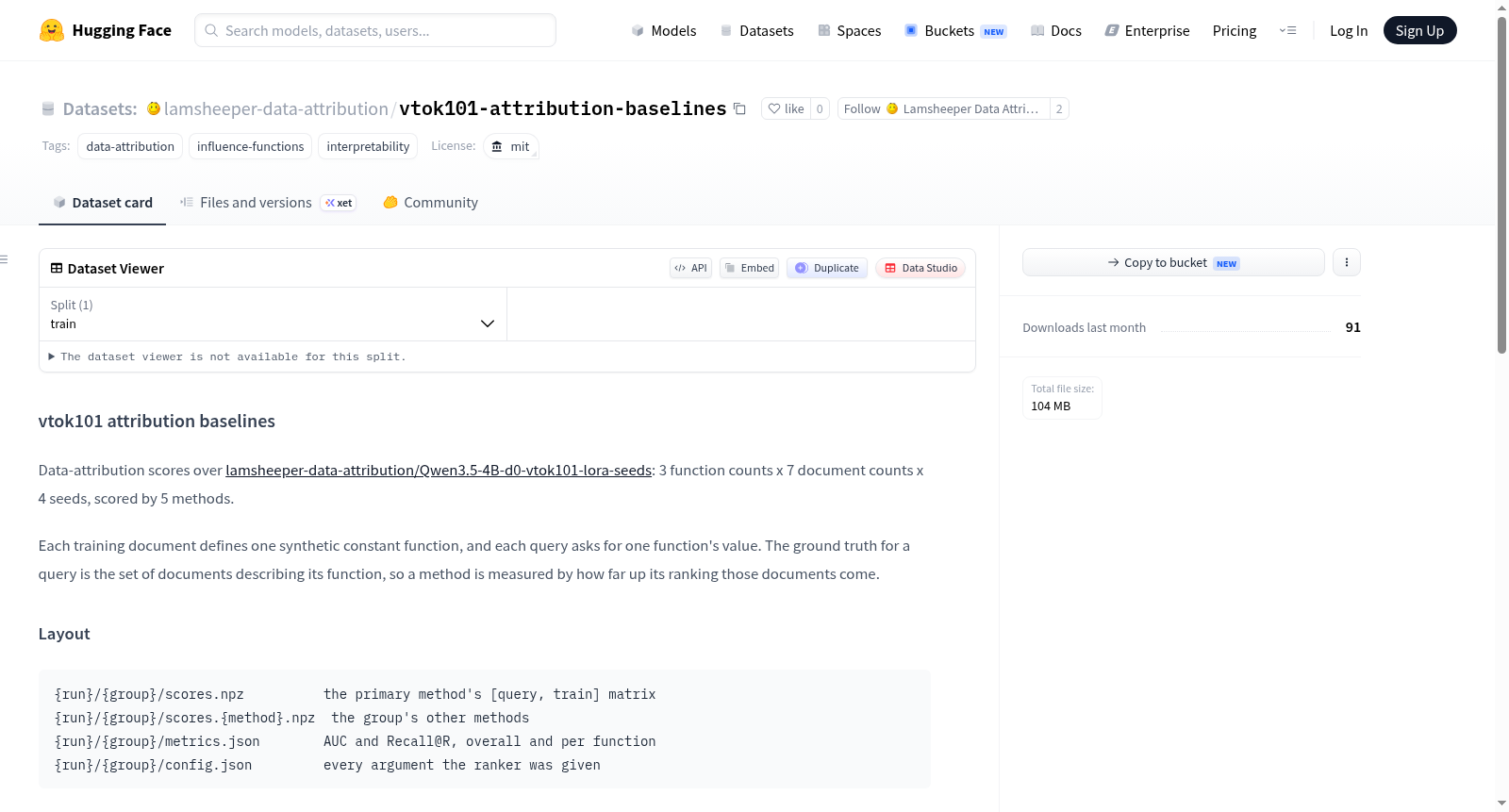
vtok101-attribution-baselines
收藏资源简介:
该数据集是 vtok101 归因基线(attribution baselines)的评分结果,用于评估数据归因方法在合成常数函数任务上的表现。数据集包含 3 种函数计数、7 种文档计数和 4 种随机种子共 84 种组合,每种组合下由 5 种方法(包括 EK-FAC 影响函数、梯度点积、梯度余弦相似度、TRAK 和 LogRA)对查询-训练文档对进行评分。每个训练文档定义了一个合成常数函数,每个查询询问某个函数的值,真实标签是描述该函数的所有文档集合。评分结果以 float16 类型的矩阵存储于 scores.npz 文件中,形状为 [查询数, 训练文档数],同时存储训练文档和查询的 UID、函数标签以及模型回答正确性。此外,每个组合还提供 metrics.json(包含 AUC 和 Recall@R 指标)和 config.json(运行参数)。数据集适用于数据归因方法的评估与比较,以及模型可解释性研究。
This dataset is the scoring results of the vtok101 attribution baselines, used to evaluate the performance of data attribution methods on the synthetic constant function task. The dataset contains 84 combinations of 3 function counts, 7 document counts, and 4 random seeds. For each combination, five methods (including EK-FAC influence function, gradient dot product, gradient cosine similarity, TRAK, and LogRA) score query-training document pairs. Each training document defines a synthetic constant function, each query asks for the value of a certain function, and the true label is the set of all documents describing that function. The scoring results are stored as a float16 matrix in the scores.npz file with shape [number of queries, number of training documents], along with the UIDs of training documents and queries, function labels, and model answer correctness. Additionally, each combination provides metrics.json (containing AUC and Recall@R metrics) and config.json (run parameters). The dataset is suitable for evaluating and comparing data attribution methods, as well as for model interpretability research.
vtok101 attribution baselines 数据集概述
数据集简介
该数据集包含针对 lamsheeper-data-attribution/Qwen3.5-4B-d0-vtok101-lora-seeds 模型的数据归因(data-attribution)评分结果。数据集采用 MIT 许可证,标签包括数据归因、影响函数和可解释性。
数据规模与结构
数据集涵盖 3 种函数数量 × 7 种文档数量 × 4 种随机种子 的配置组合,每种配置由 5 种方法 进行评分。每个训练文档定义一个合成常数函数,每个查询要求获取某一函数的值。查询的真实标签为描述其函数的文档集合,方法性能通过其在排序中将这些文档置于前列的程度来衡量。
文件结构
数据集按以下路径组织:
{run}/{group}/scores.npz— 主要方法的[查询数, 训练数]评分矩阵{run}/{group}/scores.{method}.npz— 同一组内的其他方法评分{run}/{group}/metrics.json— 总体及按函数划分的 AUC 和 Recall@R 指标{run}/{group}/config.json— 排序器接收的所有参数配置
其中 run 格式为 f{函数数}_{文档数}d_sd{种子},与适配器仓库的子文件夹命名一致;group 为 ekfac、trak 或 logra。
scores.npz 内容
scores— float16 类型的[n_query, n_train]矩阵train_uids— 每个列的语料库 UIDtrain_func— 每个训练文档描述的函数query_uids— 每行的查询 UIDquery_func— 每个查询询问的函数query_correct— 模型是否正确回答该查询
评分采用 float16 格式,因为这些数据仅用于排序,且相邻分数之间的差距远大于精度范围。
归因方法
- ekfac 组:包含 if-ekfac(EK-FAC 影响函数)、grad-dot(无曲率)和 grad-sim(余弦相似度)。三种方法在一次计算中同时生成,仅对计算后的表示处理方式不同。
- trak 组:trak 方法,采用因子化随机投影的对偶形式。
- logra 组:logra 方法,使用块对角 Fisher 的投影梯度。
Fisher 矩阵计算中排除了 padding 部分,注意力机制在 sdpa 下运行。这两项选择及其重要性详见源仓库的 filter/DATTRI_PARITY.md 文件。
贡献方式
lamsheeper-data-attribution 组织内的成员可补充缺失数据,通过克隆仓库、运行测试脚本并执行启动命令即可参与,工作者通过该仓库的文件列表进行协调。