
EEG Dataset for natural image recognition through Visual Stimuli
收藏DataCite Commons2025-05-01 更新2025-05-17 收录
下载链接:
https://data.mendeley.com/datasets/g9shp2gxhy
下载链接
链接失效反馈官方服务:
资源简介:
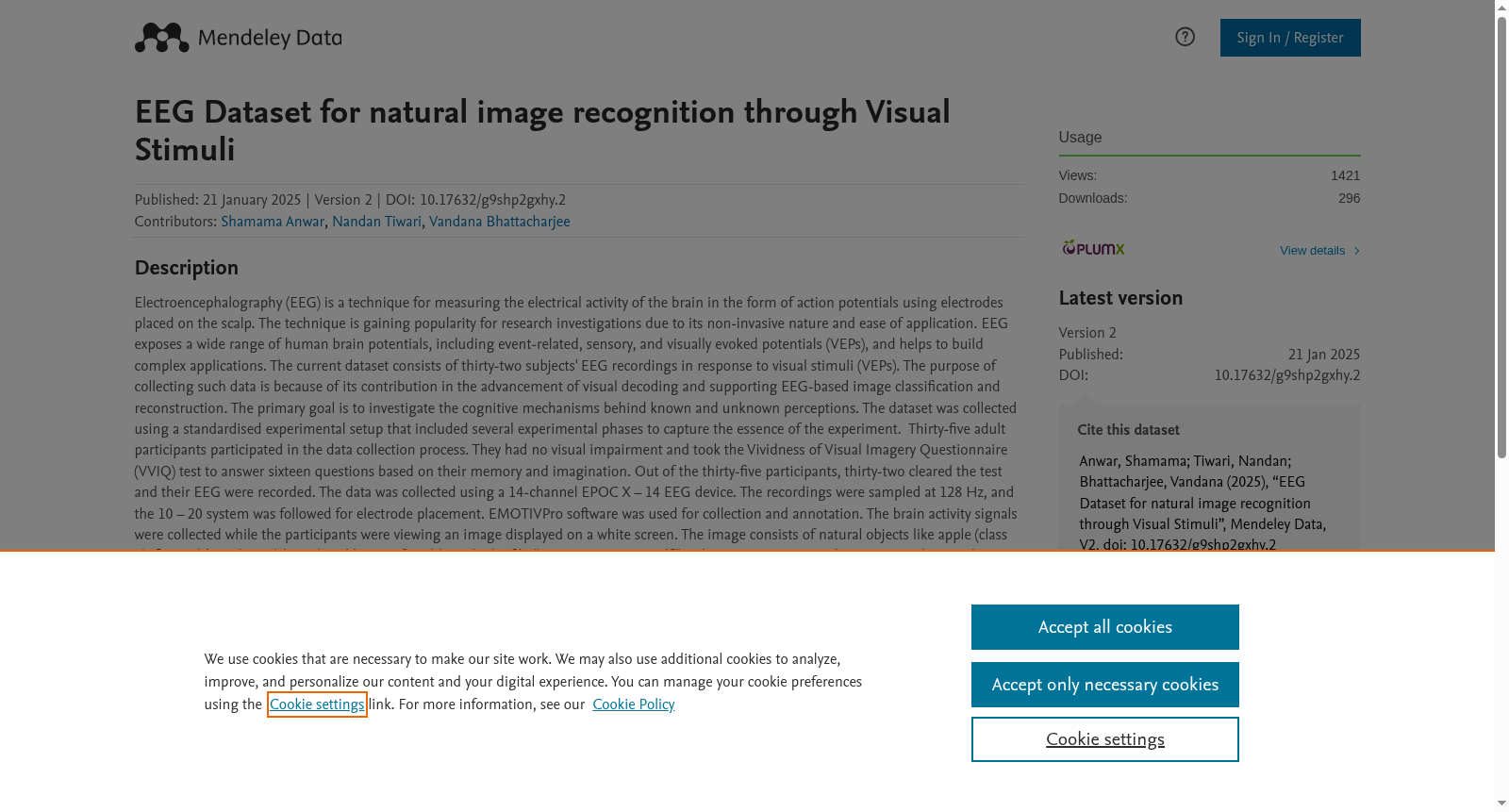
Electroencephalography (EEG) is a technique for measuring the electrical activity of the brain in the form of action potentials using electrodes placed on the scalp. The technique is gaining popularity for research investigations due to its non-invasive nature and ease of application. EEG exposes a wide range of human brain potentials, including event-related, sensory, and visually evoked potentials (VEPs), and helps to build complex applications. The current dataset consists of thirty-two subjects' EEG recordings in response to visual stimuli (VEPs). The purpose of collecting such data is because of its contribution in the advancement of visual decoding and supporting EEG-based image classification and reconstruction. The primary goal is to investigate the cognitive mechanisms behind known and unknown perceptions. The dataset was collected using a standardised experimental setup that included several experimental phases to capture the essence of the experiment. Thirty-five adult participants participated in the data collection process. They had no visual impairment and took the Vividness of Visual Imagery Questionnaire (VVIQ) test to answer sixteen questions based on their memory and imagination. Out of the thirty-five participants, thirty-two cleared the test and their EEG were recorded. The data was collected using a 14-channel EPOC X – 14 EEG device. The recordings were sampled at 128 Hz, and the 10 – 20 system was followed for electrode placement. EMOTIVPro software was used for collection and annotation. The brain activity signals were collected while the participants were viewing an image displayed on a white screen. The image consists of natural objects like apple (class A), flower (class F), car (class C) and human face (class P). The file “VVIQuestionnaire.pdf” is the questionnaire used to ascertain the visual imagination of the participants. The other file “Participant_info.csv” contains the details of the participants (age, gender, image class viewed, and Participant ID) and their VVIQ score. The names of the participants have been purposely removed for reasons of anonymity and a unique participant ID has been assigned to each participant. These IDs are further used to represent the EEG of the participants. Each class folder further contains two subfolders: A1, A2 (for class A); C1, C2 (for class C); P1, P2 (for class P); and F1, F2 (for class F). All these folders contain the data acquired from the different participants who were shown these images as a csv and edf file. This file structure makes data easier to access and analyse based on the class of visual stimuli images and experimental design employed.
脑电图(Electroencephalography, EEG)是一种通过放置于头皮的电极,以动作电位形式采集大脑电活动的技术。该技术因具备非侵入性与操作简便的优势,在科研领域愈发受到青睐。脑电图可采集涵盖事件相关电位、感觉电位与视觉诱发电位(Visually Evoked Potentials, VEPs)在内的多类人脑电位信号,为复杂应用的开发提供支撑。本数据集收录了32名受试者在视觉刺激下的脑电图记录,此类刺激可诱发视觉诱发电位(VEPs)。采集此类数据的目的在于推动视觉解码技术的发展,并为基于脑电图的图像分类与重建任务提供支撑。本数据集的核心目标是探究已知与未知感知背后的认知机制。本数据集通过标准化实验范式采集完成,该范式包含多阶段实验流程,以充分捕捉实验核心信息。本次数据采集共招募35名成年受试者,所有受试者均无视觉障碍,并完成了视觉表象鲜明度问卷(Vividness of Visual Imagery Questionnaire, VVIQ)测试,需基于自身记忆与想象力回答16道问题。35名受试者中,共有32名通过该测试,其脑电图数据被纳入本次采集范围。本次数据采集使用14通道EPOC X-14脑电设备完成。脑电记录的采样率为128Hz,电极放置遵循10-20系统标准。数据的采集与标注均通过EMOTIVPro软件完成。数据采集过程中,受试者需观看白色屏幕上展示的图像,以同步采集其脑电活动信号。图像包含四类自然物体:苹果(类别A)、花朵(类别F)、汽车(类别C)与人脸(类别P)。文件"VVIQuestionnaire.pdf"为用于评估受试者视觉想象力的问卷文本。另一文件"Participant_info.csv"则收录了受试者的详细信息,包括年龄、性别、观看的图像类别与受试者编号,以及其VVIQ测试得分。为保护受试者隐私,所有参与者的姓名均已被移除,并为每位受试者分配唯一编号,该编号用于对应其脑电图数据。每个类别文件夹下均包含两个子文件夹:对应类别A的A1、A2子文件夹;对应类别C的C1、C2子文件夹;对应类别P的P1、P2子文件夹;以及对应类别F的F1、F2子文件夹。上述所有子文件夹中均存储了对应受试者的脑电数据,数据以CSV与EDF格式保存。该文件结构可便于研究者基于视觉刺激图像类别与所用实验范式,快速访问并分析数据。
提供机构:
Mendeley Data
创建时间:
2024-08-14
搜集汇总
数据集介绍
背景与挑战
背景概述
该数据集包含32名参与者的EEG记录,响应于视觉刺激(自然图像),旨在支持视觉解码和EEG-based图像分类研究。数据采集使用14通道EEG设备,采样率128 Hz,遵循标准实验设置和10 – 20电极放置系统。
以上内容由遇见数据集搜集并总结生成



