Scandium-Dataset
收藏资源简介:
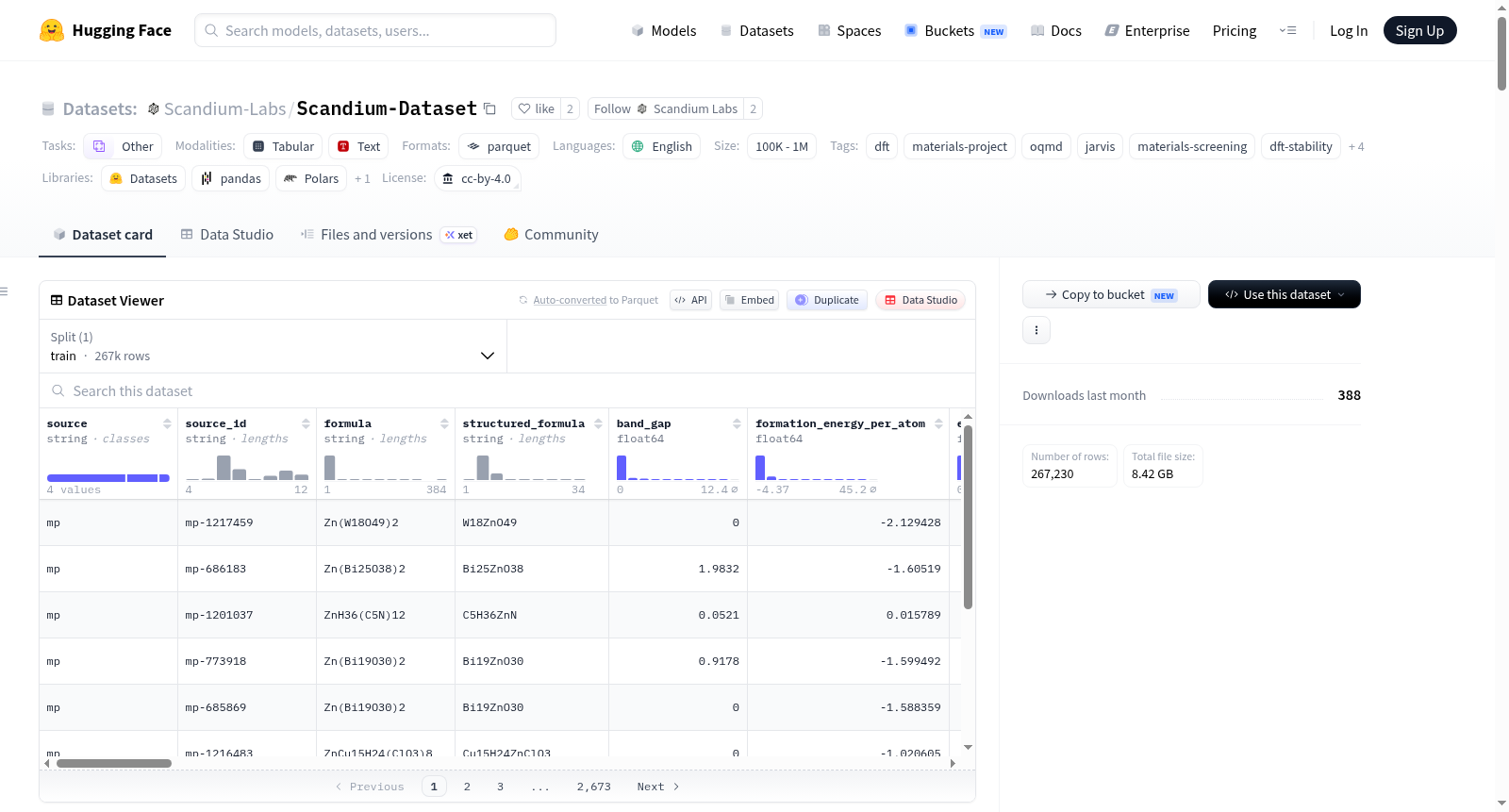
Scandium-Dataset是一个用于电池材料发现早期筛选阶段的、经过质量评分的开源计算材料数据集。它整合了来自Materials Project、OQMD和JARVIS-DFT三个第一性原理计算数据库的267,230种无机晶体材料的计算结果,并包含了498个来自OBELiX数据库的具有实验测量锂离子电导率的材料数据。数据集的核心目的是提供热力学和结构筛选的基础数据,包括形成能、带隙、空间群、体积、密度、晶体结构(pymatgen序列化)等属性,以及基于成分的固态电解质家族分类和锂/钠离子迁移势垒的代理计算(覆盖率约23%)。数据根据严格的质量门控系统分为Strict Gold、Gold、Validated、Raw和Experimental Gold等多个等级。数据集以Parquet格式存储,包含47个字段,总大小约184 MB。它适用于相稳定性筛选、结构家族分类、带隙预测、材料信息学基准测试以及无机晶体结构通用性质预测器的预训练。需要注意的是,数据集不包含离子电导率、迁移激活能(NEB)、电化学稳定性窗口等下游性质,因此不适用于直接的固态电解质性能排序或电化学稳定性评估。此外,数据集许可不统一,包含CC BY 4.0、CC0和OQMD非商业许可的条目,使用时需注意合规性。数据在材料家族分布上存在不平衡,主要偏向金属间化合物和层状氧化物。
Scandium-Dataset is an open-source computational materials dataset with quality scoring, designed for early screening stages in battery material discovery. It integrates computational results from 267,230 inorganic crystal materials sourced from three first-principles databases: Materials Project, OQMD, and JARVIS-DFT, and includes data for 498 materials with experimentally measured lithium-ion conductivity from the OBELiX database. The core purpose of the dataset is to provide foundational data for thermodynamic and structural screening, including properties such as formation energy, band gap, space group, volume, density, crystal structure (pymatgen serialization), as well as composition-based solid-state electrolyte family classification and proxy calculations for lithium/sodium ion migration barriers (coverage approximately 23%). Data is categorized into multiple quality levels, such as Strict Gold, Gold, Validated, Raw, and Experimental Gold, based on a rigorous quality gating system. The dataset is stored in Parquet format, containing 47 fields, with a total size of about 184 MB. It is suitable for phase stability screening, structural family classification, band gap prediction, materials informatics benchmarking, and pre-training of general property predictors for inorganic crystal structures. It is important to note that the dataset does not include downstream properties such as ionic conductivity, migration activation energy (NEB), or electrochemical stability window, thus it is not suitable for direct solid-state electrolyte performance ranking or electrochemical stability assessment. Additionally, the datasets licenses are not uniform, including entries under CC BY 4.0, CC0, and OQMD non-commercial licenses, requiring attention to compliance during use. The data exhibits imbalance in material family distribution, primarily biased towards intermetallic compounds and layered oxides.