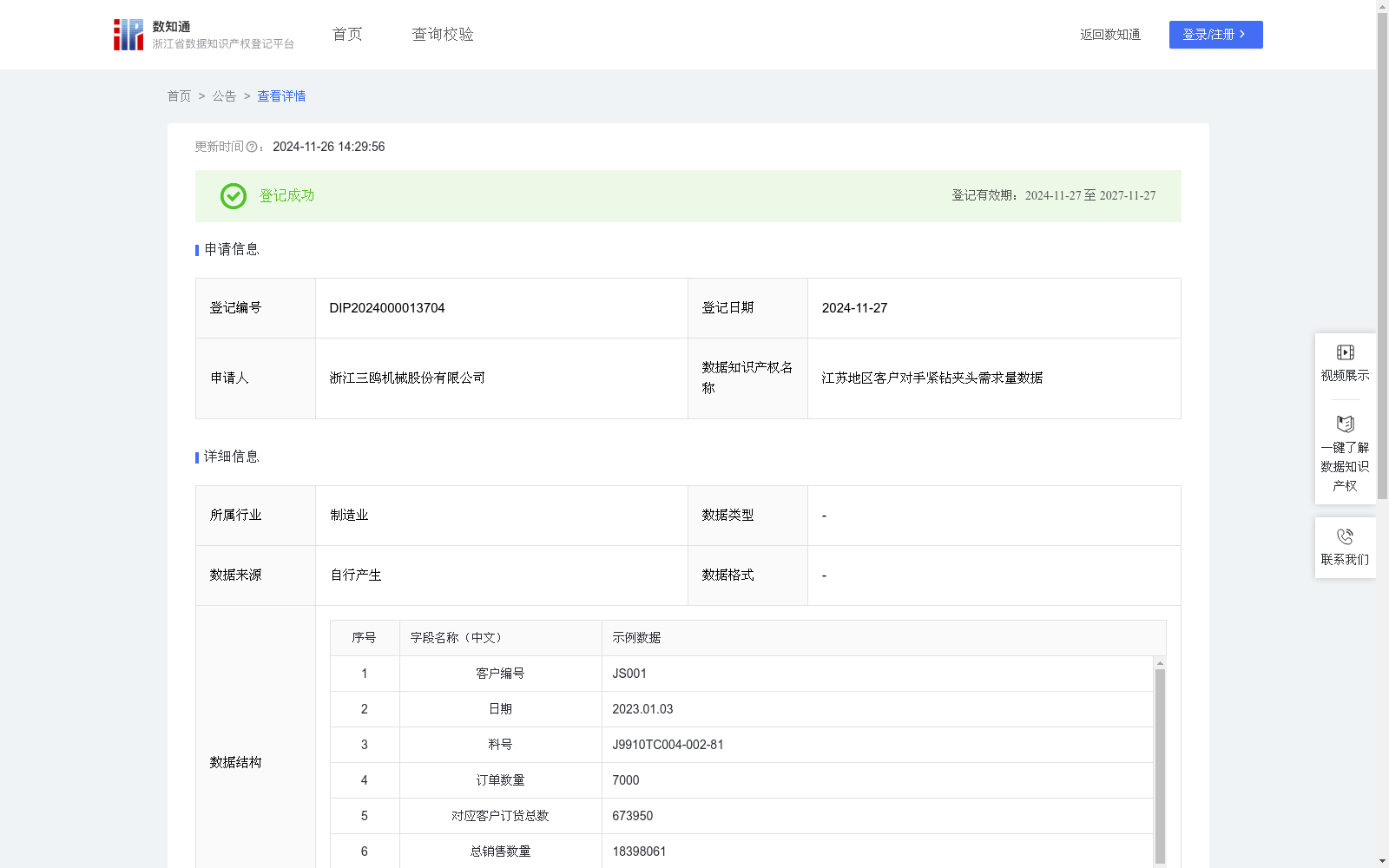
江苏地区客户对手紧钻夹头需求量数据
收藏资源简介:
通过收集和分析江苏地区客户对手紧钻夹头销售相关数据,了解客户对手紧钻夹头的购买力水平和消要偏好,从而了解该产品是否畅销,从而为本行业的所有企业制定生产策略,更好地为客户提供个性化的商品和服务。1.数据采集:采集手紧钻夹头江苏地区,客户编号、日期、料号、订单数量等数据。2.数据处理:(1)对应客户订货总数,通过SUMIF函数对数据统计范围内同客户编码的订单数量求和,例如本条客户编号为“TZ001”,对应客户订货总数为数据统计范围内为客户编号为“TZ001”的订单数量总和;(2)总销售数量,为数据统计范围内所有“订单数量”和;(3)销售占比=对应客户订货总数/总销售数量;(4)客户分级,分级运用ABCDEF分类法,对占比大于等于3%以上,给予“A类消费”分层;占比在小于3%到大于等于2.5%区间,则给予“B类消费”分层;占比在小于2.5%到大于等于2%区间,则给予“C类消费”分层;占比在小于2%到大于等于1.5%区间,则给予“D类消费”分层;占比在小于1.5%到大于等于1%区间,则给予“E类消费”分层;占比在小于1%以下,则给予“F类消费”分层。
This dataset is constructed by collecting and analyzing sales-related data of keyless drill chucks from customers in Jiangsu Province, aiming to understand customers' purchasing power levels and consumption preferences for keyless drill chucks, verify the market popularity of this product, and provide references for all enterprises in the industry to formulate production strategies so as to better offer personalized products and services to customers. 1. Data Collection: Collect data including customer ID, date, part number, order quantity and other relevant sales data of keyless drill chucks from customers in Jiangsu Province. 2. Data Processing: (1) Total customer order quantity: Use the SUMIF function to sum the order quantities of customers with the same customer code within the data statistics range. For example, if the customer ID of a certain record is "TZ001", the total order quantity of this customer is the sum of order quantities of customers with the code "TZ001" within the data statistics range; (2) Total sales quantity: The sum of all "order quantity" values within the data statistics range; (3) Sales proportion = Total order quantity of the corresponding customer / Total sales quantity; (4) Customer stratification: Adopt the ABCDEF classification method for customer grading. Specifically, customers with a sales proportion ≥3% are classified as "Class A Consumers"; those with a proportion less than 3% and greater than or equal to 2.5% are classified as "Class B Consumers"; those with a proportion less than 2.5% and greater than or equal to 2% as "Class C Consumers"; those with a proportion less than 2% and greater than or equal to 1.5% as "Class D Consumers"; those with a proportion less than 1.5% and greater than or equal to 1% as "Class E Consumers"; and those with a proportion less than 1% as "Class F Consumers".