
基于视觉感知的物流仓库库存动态监测数据
收藏浙江省数据知识产权登记平台2025-07-14 更新2025-07-15 收录
下载链接:
https://www.zjip.org.cn/home/announce/trends/148530
下载链接
链接失效反馈官方服务:
资源简介:
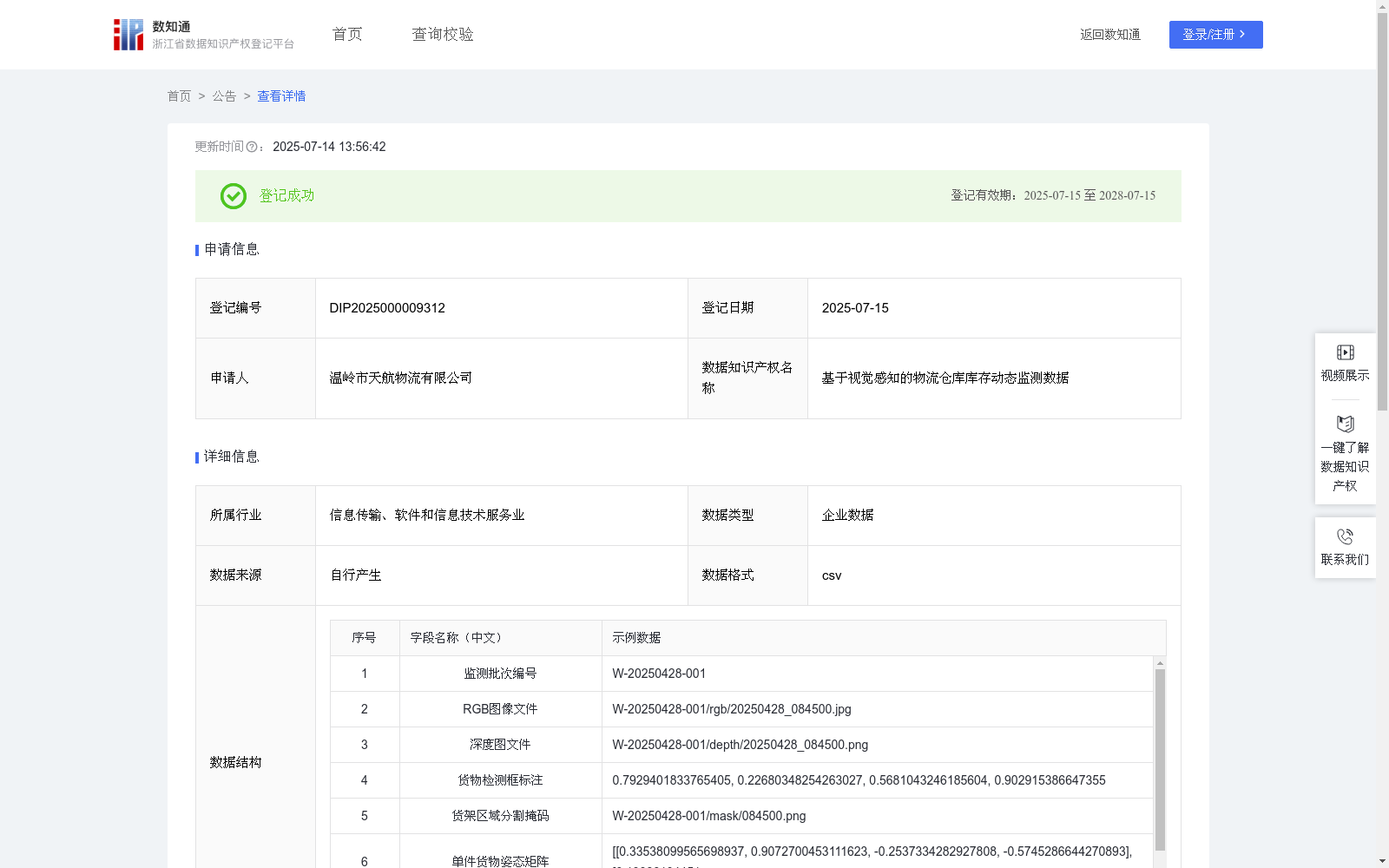
该数据适用于物流仓储、智能制造等领域,可实时检测物品位置、数量变化及异常移动,解决传统人工盘点效率低、误差大问题。用户可通过该数据构建智能库存管理系统,实现库存可视化、异常报警与库存自动更新功能。本系统基于RGB与深度图双模态数据进行库存动态监测,所有图像数据按监测批次编号W-XXX层级组织存储,其中XXX表示当天采集批次编号。RGB图像和深度图像由深度相机采集得到,货物检测框标注、货架区域分割掩码、单件货物姿态矩阵、检测结果标注、环境光强度参数均由专业数据标注人员记录。RGB图像输入YOLOv8模型进行货物检测,输出检测框,并根据预测置信度分数过滤掉低于0.5的检测结果;货物检测框标注记录每件货物的类别标签及其在图像中的位置坐标。深度图文件用于生成对应的三维点云,通过ICP(Iterative Closest Point)算法估算每件货物的空间姿态矩阵T∈SE(3),其中T表示物体的位移和平移信息组成的刚性变换矩阵。货架区域掩码提供仓库图像中的有效货架区域二值分割,避免背景干扰影响检测精度。环境光照强度参数记录环境照度L_env,单位为lux,系统根据设定的目标照度L_target,动态调整可见光图像的曝光补偿系数γ,其中γ=I_target/I_env,用于规范图像输入质量。异常检测规则定义如下:若同一货位连续两次检测到空位,或单件货物姿态矩阵偏移Δθ超过15度,则对应标记为异常(1),否则为正常(0);其中姿态变化角度Δθ的计算公式为 Δθ = arccos((trace(R_t * R_{t-1}^T) - 1) / 2),R_t为当前帧单件货物姿态的旋转矩阵,R_{t-1}为前一帧的旋转矩阵。所有时序特征,包括货物检测框序列bbox_seq和单件货物姿态矩阵序列pose_seq,输入到基于双向长短期记忆网络(Bi-LSTM)的分类器中,输出异常概率P_abnormal,异常概率计算公式为 P_abnormal = σ(W·[bbox_seq, pose_seq] + b),其中σ表示Sigmoid激活函数,W为模型权重,b为偏置项。当P_abnormal > 0.8时系统判定当前检测结果标签为1(0表示正常,1表示异常)。最终根据P_abnormal的判定结果,将检测结果标签标记为0或1。所有数据文件的时间戳编号遵循标准命名规则,例如084500表示08时45分00秒采集开始的30秒时间段。
This dataset is applicable to logistics warehousing, intelligent manufacturing and other fields, enabling real-time detection of item positions, quantity changes and abnormal movements, and solving the problems of low efficiency and large errors in traditional manual inventory counting. Users can build an intelligent inventory management system using this dataset, realizing functions including inventory visualization, abnormal alarm and automatic inventory update. This system conducts dynamic inventory monitoring based on RGB and depth map dual-modal data. All image data are organized and stored in a hierarchical naming structure of W-XXX, where XXX represents the daily collection batch number. Both RGB images and depth images are collected by depth cameras. Annotations such as cargo detection bounding boxes, shelf area segmentation masks, single-item cargo pose matrices, detection result labels and ambient light intensity parameters are recorded by professional data annotators. RGB images are input into the YOLOv8 model for cargo detection, with detection bounding boxes outputted, and detection results with a confidence score lower than 0.5 are filtered out. The cargo detection bounding box annotations record the category label of each cargo and its position coordinates in the image. Depth map files are used to generate corresponding 3D point clouds. The Iterative Closest Point (ICP) algorithm is employed to estimate the spatial pose matrix T∈SE(3) for each cargo, where T represents the rigid transformation matrix composed of the object's displacement and translation information. The shelf area mask provides binary segmentation of valid shelf regions in warehouse images, avoiding background interference that affects detection accuracy. The ambient light intensity parameter records the ambient illuminance L_env, with the unit of lux. The system dynamically adjusts the exposure compensation coefficient γ of the visible light image according to the set target illuminance L_target, where γ=I_target/I_env, to standardize the quality of input images. The anomaly detection rules are defined as follows: If the same cargo slot is detected as empty for two consecutive times, or the attitude matrix offset Δθ of a single cargo exceeds 15 degrees, the corresponding result is marked as abnormal (1); otherwise, it is marked as normal (0). The calculation formula for the attitude change angle Δθ is Δθ = arccos((trace(R_t · R_{t-1}^T) - 1) / 2), where R_t is the rotation matrix of the single cargo's attitude in the current frame, and R_{t-1} is the rotation matrix of the previous frame. All temporal features, including the cargo detection bounding box sequence bbox_seq and the single-item cargo pose matrix sequence pose_seq, are input into a classifier based on Bidirectional Long Short-Term Memory (Bi-LSTM) to output the anomaly probability P_abnormal. The calculation formula for the anomaly probability is P_abnormal = σ(W·[bbox_seq, pose_seq] + b), where σ represents the Sigmoid activation function, W is the model weight, and b is the bias term. When P_abnormal > 0.8, the system determines that the current detection result label is 1 (0 represents normal, 1 represents abnormal). The detection result label is finally marked as 0 or 1 based on the judgment result of P_abnormal. The timestamp numbering of all data files follows standard naming rules. For example, 084500 indicates a 30-second time period starting collection at 08:45:00.
提供机构:
温岭市天航物流有限公司
创建时间:
2025-06-25
搜集汇总
数据集介绍
以上内容由遇见数据集搜集并总结生成



