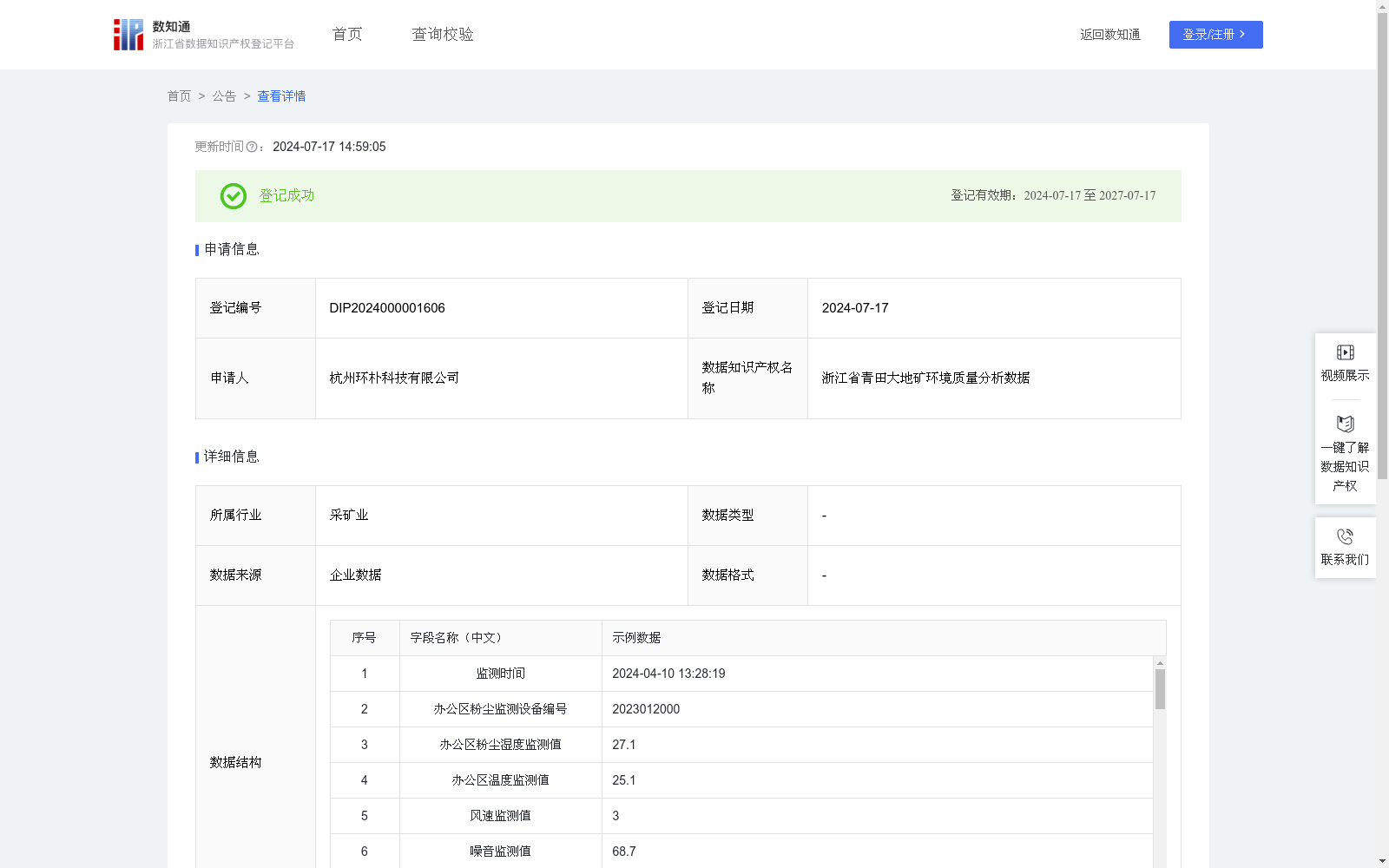
浙江省青田大地矿环境质量分析数据
收藏资源简介:
通过分析青田大地矿的综合环境质量指数,高EQI提示需要采取减污措施,低EQI则表示环境管理得当,为环保监管提供了量化评估工具,以符合国家或地方的环保标准,实现经济效益与环境保护的和谐共生。(1)数据采集:采集青田大地矿不同区域的温度、湿度、风速、噪音、PM2.5、PM10和总悬浮颗粒数等数据。 (2)数据处理:先将从办公区域、道路和采矿场地这三个不同区域的数据进行标准化处理,根据不同参数对于环境质量的重要程度进行权重分配,利用以下公式计算整个矿场综合的环境质量指数(EQI),计算公式为: 针对每个参数,计算其在整个矿场范围内的最小值和最大值,然后标准化每个参数值到0-1区间内。 量值标准化公式:βi=100*(Ai-MINAi)/(MAXAi-MINAi),其中Ai分别表示矿场不同区域的温度、湿度、风速、噪音等字段的监测值,βi分别表示不同区域温度、湿度、风速、噪音等数据的环境质量指数;Ω=AVERAGE(0.05*β1+0.05*β2+0.1β3+0.25*β4+0.25*β5+0.2*β6+0.1*β7),Ω1-3代表的不同区域的综合环境质量指数,EQI=AVERAGE(Ω1,Ω2,Ω3) (3)应用场景:EQI为环保监管提供了量化的评估工具,通过量化监测,预防环境风险,减少法律与健康成本,提升企业形象 ,助力可持续性发展,实现经济效益与环境保护的和谐共生。
This dataset centers on the Comprehensive Environmental Quality Index (EQI) of Qingtian Dadi Mine. A high EQI signals the need for pollution reduction measures, while a low EQI indicates proper environmental management has been implemented. It serves as a quantitative assessment tool for environmental supervision, enabling compliance with national or local environmental protection standards and achieving the harmonious coexistence of economic benefits and environmental protection. (1) Data Collection: Collect monitoring data including temperature, humidity, wind speed, noise, PM2.5, PM10 and total suspended particle count from various regions of Qingtian Dadi Mine. (2) Data Processing: First, standardize the data collected from three distinct regions: office areas, roads and mining sites. Assign weights based on the relative importance of each parameter to environmental quality. The comprehensive environmental quality index (EQI) of the entire mine is calculated via the following procedures and formulas: 1. For each parameter, calculate its minimum and maximum values across the entire mine, then normalize each parameter value to the 0-1 interval. 2. Normalization formula: βᵢ = 100 × (Aᵢ - MINAᵢ) / (MAXAᵢ - MINAᵢ), where Aᵢ denotes the monitored values of parameters such as temperature, humidity, wind speed, noise, etc. in different regions of the mine, and βᵢ represents the environmental quality index corresponding to data like temperature, humidity, wind speed, noise, etc. in different regions; 3. Calculate the regional comprehensive environmental quality index: Ω = AVERAGE(0.05×β1 + 0.05×β2 + 0.1×β3 + 0.25×β4 + 0.25×β5 + 0.2×β6 + 0.1×β7), where Ω₁, Ω₂, Ω₃ represent the comprehensive environmental quality indexes of the three aforementioned regions respectively; 4. Calculate the overall EQI of the mine: EQI = AVERAGE(Ω₁, Ω₂, Ω₃) (3) Application Scenarios: The EQI provides a quantitative assessment tool for environmental supervision. Through quantitative monitoring, it helps prevent environmental risks, reduce legal and health costs, enhance corporate image, promote sustainable development, and ultimately achieve the harmonious coexistence of economic benefits and environmental protection.