
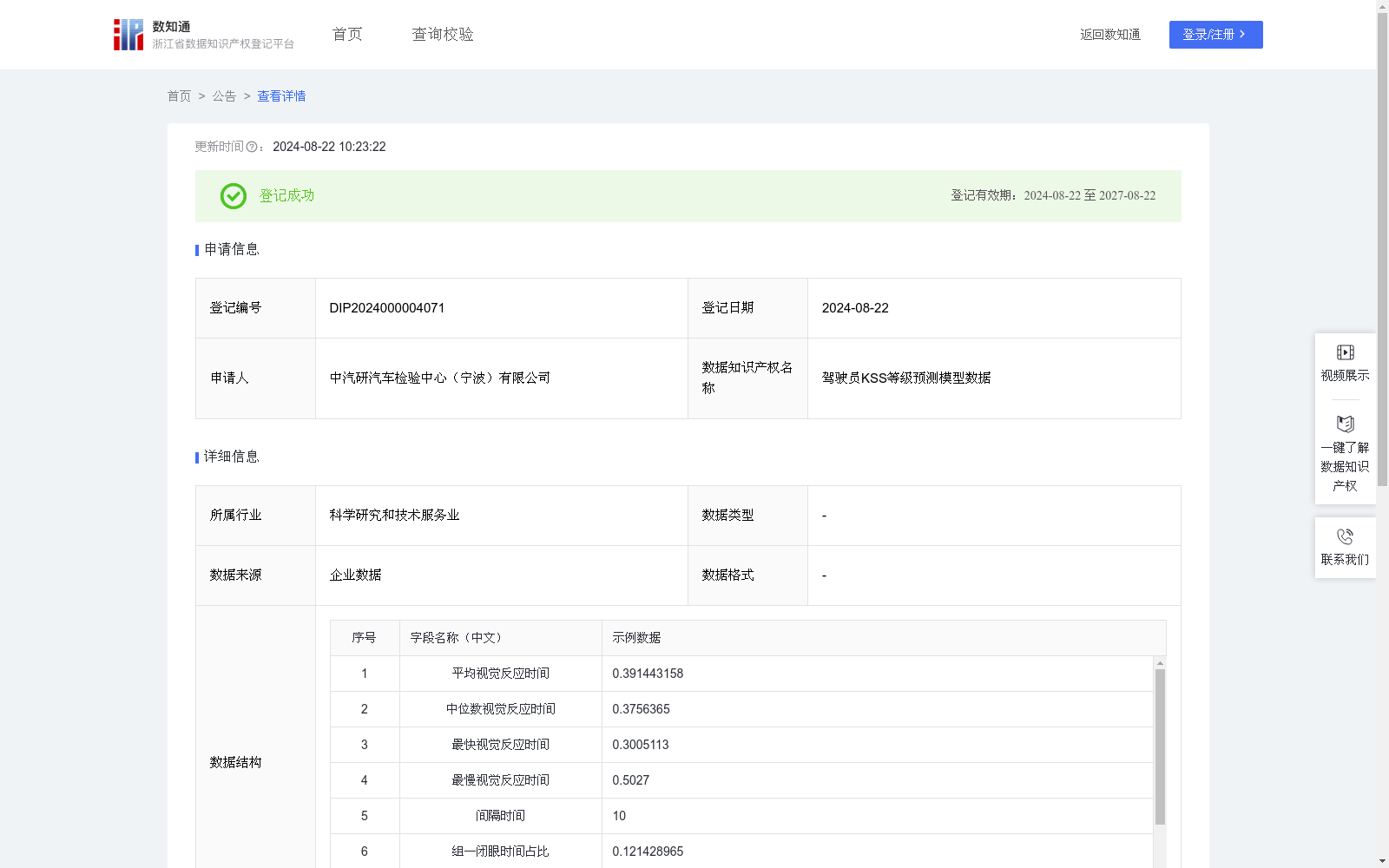
驾驶员KSS等级预测模型数据
收藏浙江省数据知识产权登记平台2024-08-22 更新2024-08-23 收录
下载链接:
https://www.zjip.org.cn/home/announce/trends/53917
下载链接
链接失效反馈官方服务:
资源简介:
对驾驶员的生理状态和驾驶行为进行研究至关重要,特别是在评估疲劳驾驶风险方面。通过在固定试验范式下对不同KSS嗜睡等级的驾驶员采集眼动、脑电和行为特征等生理数据,我们能够更准确地识别疲劳状态。这些数据不仅对交通安全至关重要,也对医学、心理学等领域的研究具有重要价值。 通过特征提取和统计学分析,我们可识别出与KSS嗜睡等级高度相关的生理指标。这些指标不仅有助于评估疲劳程度,还能为其他研究领域提供数据支持,如医学治疗和心理健康维护。 进一步地,将这些生理指标与KSS量表相对应,我们能够构建出适用于大众的客观生理数据集。利用机器学习技术,特别是支持向量分类(SVC)模型,可以建立有效的KSS等级预测模型。这不仅有助于筛选出对疲劳更敏感的驾驶员,还能针对性地提供培训,以提高他们的驾驶技能和警觉性。 此外,这些数据对于开发和测试驾驶员疲劳和警觉性警告系统(DDAW)同样重要。通过深入分析,可以优化DDAW系统,提高其准确性和实用性。通过对数据进行清洗、数据预处理和特征数据提取。试验范式将包含精神运动警戒任务、卡洛林斯卡嗜睡测试、α衰减测试 、视觉P300测试、听觉P300测试、100毫米视觉模拟量表的嗜睡量表和中文卡罗林斯卡困倦量表。特征提取:
1、闭眼时间占比(PERCLOS)是指在一段时间内闭眼时间所占比例。计算公式如下:
眼动跟踪仪可以将人眼状态分为眨眼、注视、扫视三种状态。
2、脑电特征
微分熵(DE)是香农信息熵-∑_x▒p(x)log(p(x)) 在连续变量上的推广形式。
DE=-∫_a^b▒p(x) log(p(x))dx
其中,p(x)表示连续信息的概率密度函数,[a,b]表示信息取值的区间,对于一段特定长度的近似服从高斯分布N(μ,σ^2 )的EEG,其微分熵为:
等于其在特定频段上的能量谱的对数。脑电数据进行频域特征计算,得到不同kss等级睁眼闭眼状态下,对应Alpha频段能量的对比图,将疲劳等级根据KSS评分划分为1~3、4~5、6、7、8~9五个类别。
Research on drivers' physiological states and driving behaviors is critically important, particularly for evaluating the risk of fatigued driving. We collect physiological data including eye movement, electroencephalogram (EEG) and behavioral characteristics from drivers at different KSS sleepiness levels under a fixed experimental paradigm, which enables more accurate identification of fatigue states. These data are not only crucial for traffic safety, but also hold significant research value in fields such as medicine and psychology.
Through feature extraction and statistical analysis, we can identify physiological indicators that are highly correlated with KSS sleepiness levels. These indicators not only help assess the degree of fatigue, but also provide data support for other research areas, such as medical treatment and mental health maintenance.
Furthermore, by correlating these physiological indicators with the KSS scale, we can construct an objective physiological dataset suitable for the general public. Using machine learning techniques, especially the Support Vector Classification (SVC) model, we can establish an effective KSS level prediction model. This not only helps screen out drivers who are more sensitive to fatigue, but also provides targeted training to improve their driving skills and alertness.
In addition, these data are equally important for the development and testing of Driver Drowsiness and Alertness Warning (DDAW) systems. In-depth analysis can optimize DDAW systems and enhance their accuracy and practicality. Data cleaning, preprocessing and feature extraction will be performed on the dataset. The experimental paradigm will include the psychomotor vigilance task, Karolinska Sleepiness Test, alpha attenuation test, visual P300 test, auditory P300 test, the 100-mm Visual Analogue Scale (VAS) for sleepiness, and the Chinese Karolinska Sleepiness Scale. Feature extraction includes:
1. Percentage of Eyelid Closure over the Pupil over Time (PERCLOS): refers to the proportion of time the eyes are closed over a certain period. The calculation formula is as follows:
Eye trackers can classify human eye states into three categories: blink, fixation, and saccade.
2. EEG features:
Differential entropy (DE) is an extension of Shannon information entropy $-\sum_x p(x)\log p(x)$ to continuous variables.
$$DE = -\int_a^b p(x) \log p(x) dx$$
where $p(x)$ represents the probability density function of continuous information, and $[a,b]$ denotes the value range of the information. For a segment of EEG approximately following a Gaussian distribution $N(\mu, \sigma^2)$, its differential entropy can be expressed as:
It is equivalent to the logarithm of the energy spectrum of the EEG in a specific frequency band. We calculate frequency-domain features from EEG data to obtain a comparative graph of Alpha band energy under awake and drowsy states corresponding to different KSS levels. The fatigue levels are divided into five categories: 1–3, 4–5, 6, 7, and 8–9 based on KSS scores.
提供机构:
中汽研汽车检验中心(宁波)有限公司
创建时间:
2024-07-24
搜集汇总
数据集介绍
特点
该数据集包含605条记录,每月更新,主要用于预测驾驶员的KSS等级,涉及视觉反应时间、闭眼时间占比等生理指标。通过机器学习技术,特别是支持向量分类(SVC)模型,数据集支持疲劳驾驶风险的评估和相关警告系统的开发。
以上内容由遇见数据集搜集并总结生成


