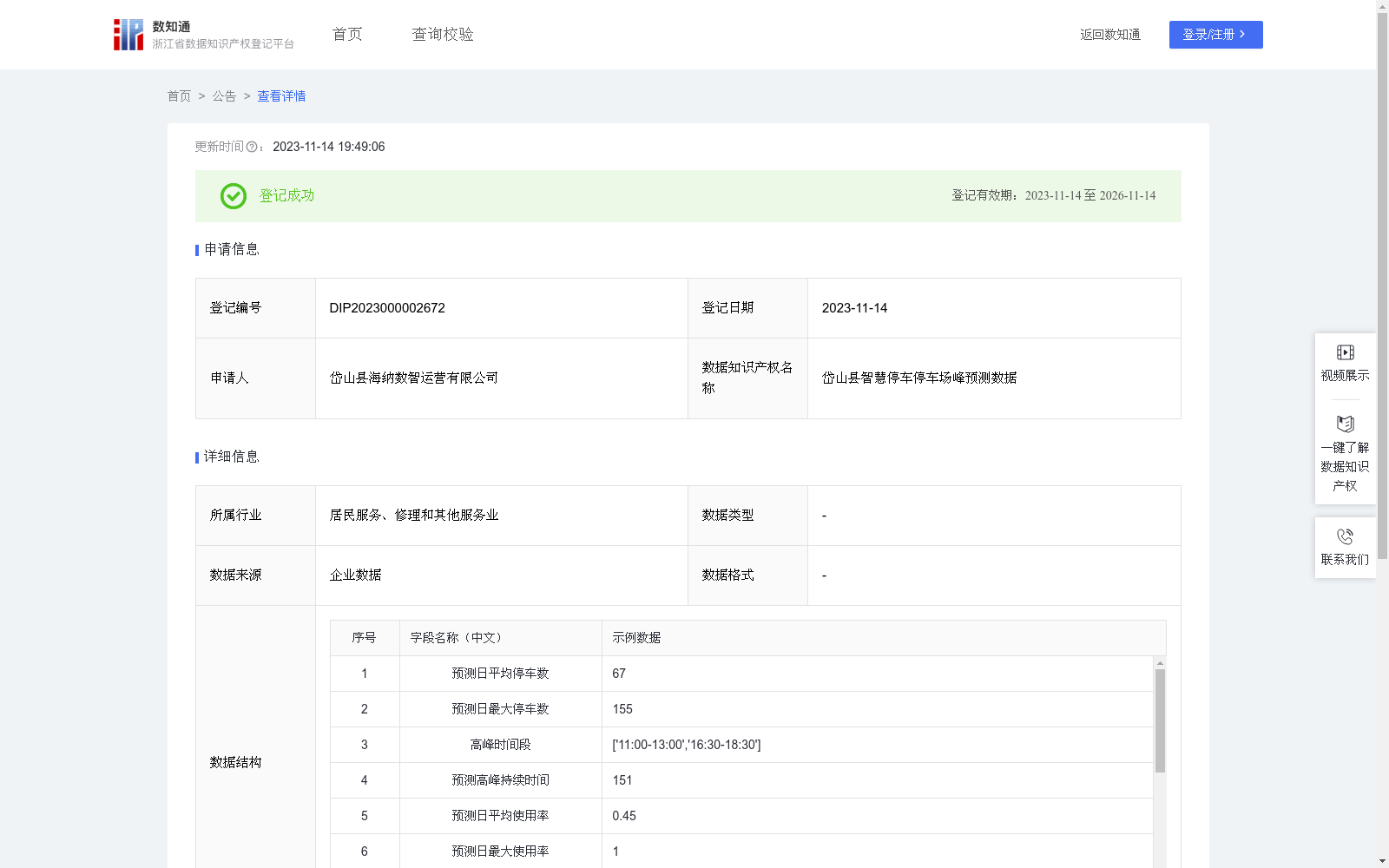
岱山县智慧停车停车场峰预测数据
收藏资源简介:
停车场管理者可以利用停车高峰预测来优化停车场的资源分配和管理,提前调配停车位,提高停车场的利用率和服务质量;城市规划部门可以得到数据支持,帮助他们合理规划停车设施的建设和布局,以满足不同区域和时间段的停车需求。个人用户可以利用停车高峰预测来规划自己的出行,选择合适的时间和地点停车,避免在高峰时段遇到停车困难。首先收集并分析历史停车数据,包括停车数量、使用率、高峰时间及持续时间等信息。根据历史停车数据,设定三个变量:星期数、特殊日期类型、天气,并构建线性回归预测模型。然后使用模型预测未来的日平均停车数、日最大停车数、日平均使用率、日最大使用率、达峰时间等指标,并根据均方误差预测正确率。
Parking lot managers can leverage parking peak prediction to optimize resource allocation and management, pre-deploy parking spaces, and enhance parking lot utilization and service quality. Urban planning departments can obtain data support to rationally plan the construction and layout of parking facilities, so as to meet parking demands in different regions and time periods. Individual users can utilize parking peak prediction to plan their trips, select suitable parking times and locations, and avoid parking difficulties during peak hours. First, collect and analyze historical parking data, including information such as parking volume, utilization rate, peak hours and their durations. Based on the historical parking data, three variables are determined: day of the week, special date type, and weather, and a linear regression prediction model is built. Subsequently, the model is used to predict future indicators including daily average parking volume, daily maximum parking volume, daily average utilization rate, daily maximum utilization rate, and peak arrival time, and the prediction accuracy is evaluated using mean squared error (MSE).