大像素双层溴化镧康普顿相机原型的标定数据和实验探测数据
收藏资源简介:
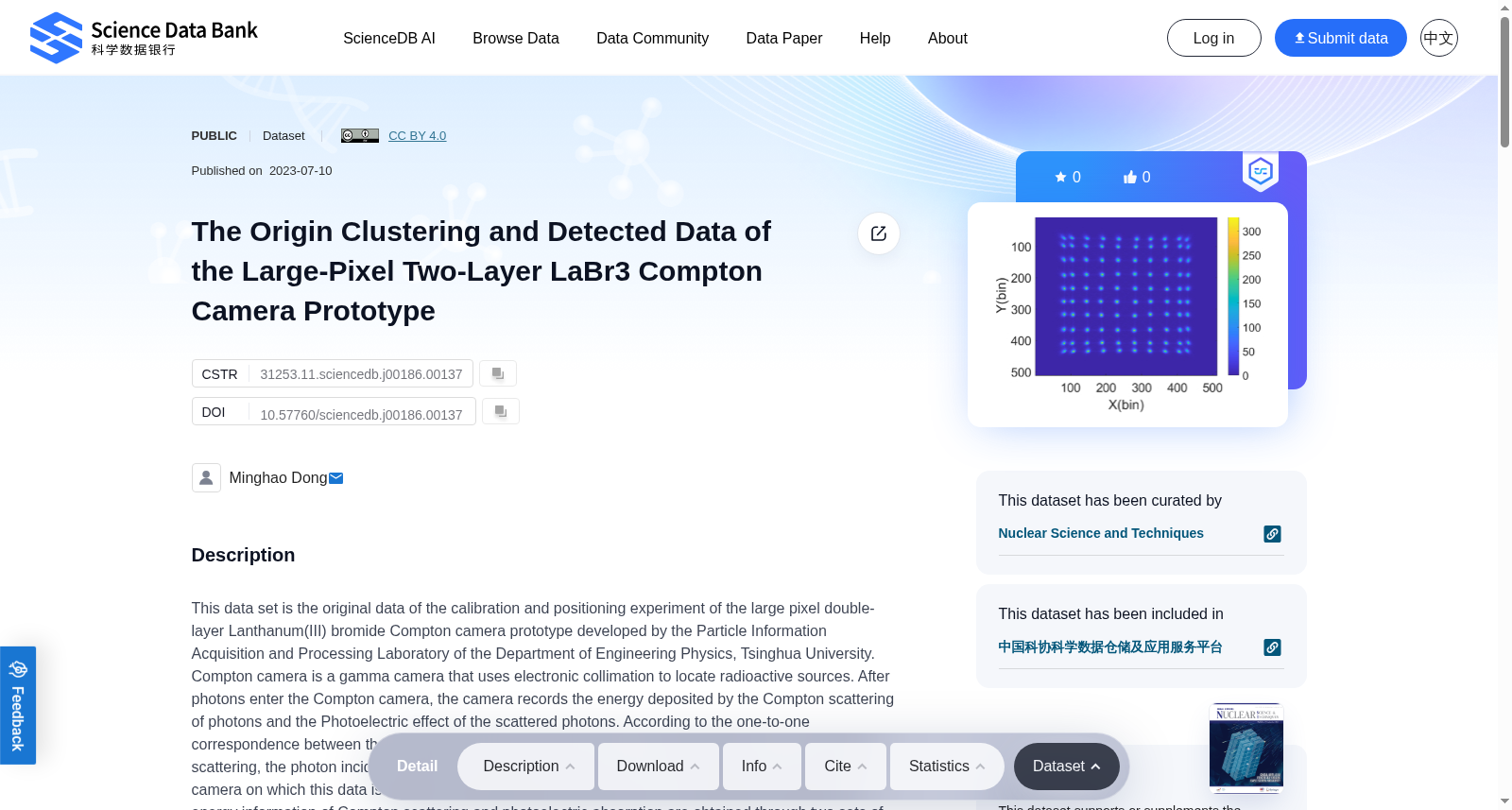
This data set is the original data of the calibration and positioning experiment of the large pixel double-layer Lanthanum(III) bromide Compton camera prototype developed by the Particle Information Acquisition and Processing Laboratory of the Department of Engineering Physics, Tsinghua University. Compton camera is a gamma camera that uses electronic collimation to locate radioactive sources. After photons enter the Compton camera, the camera records the energy deposited by the Compton scattering of photons and the Photoelectric effect of the scattered photons. According to the one-to-one correspondence between the scattering angle and the energy of the scattered photons in the Compton scattering, the photon incidence position can be limited to a cone (i.e. the Compton cone). The Compton camera on which this data is based is a double-layer Compton camera. The location and deposition energy information of Compton scattering and photoelectric absorption are obtained through two sets of detector units. The detector unit consists of 10 × The Lanthanum(III) bromide crystal array, silicon Photomultiplier tube, organic glass visible light refracting plate and corresponding encoding circuit (resistance weight network circuit) are composed. The length and width of Lanthanum(III) bromide crystal are all 5 mm, the thickness of the first layer (scattering layer) is 5 mm, and the thickness of the second layer (absorption layer) is 10 mm; The silicon Photomultiplier tube is 8 × 8 arrays; Organic glass is used to disperse visible photons generated by scintillators; The encoding circuit converts 64 voltage signals generated by the silicon Photomultiplier tube into 4 voltage signals for output according to the spatial position relationship. The data in this dataset is arranged in a folder list, with each folder representing a measurement. The data is stored in the "Energy. txt" file within the folder; The output signal in the file is in the form of a list of data, with 9 integers representing one photon event per line. The specific meanings are timestamp, scattering layer 4-channel voltage signal address, and absorption layer 4-channel voltage signal address. By using the four voltage signals of the detector unit, the photon action position can be obtained using the center of gravity weight method; Meanwhile, the sum of the four signals serves as the total energy of photon deposition. The calibration data in this dataset was experimentally obtained on December 12, 2022 at the factory of Jinhong Crystal Materials (Shanghai) Co., Ltd. Three point-like isotropic radiation sources, 137Cs, 22Na, and 57Co, were used and measured at a distance of 5 cm from both sets of detector units. All three radiation sources measured 20 million events. The experimental data in this dataset was obtained from December 6-10, 2022 at the factory of Jinhong Crystal Materials (Shanghai) Co., Ltd. The measurement object was a 137Cs source; In the experiment, a Compton camera was assembled with a scattering layer 5 cm away from the absorption layer, with its center on the same axis; The radiation source is 5 cm away from the surface of the scattering layer along this axis direction. The experiment measured three sets of data: the radiation source is located on the axis, 5 cm to the left of the axis, and above the right of the axis (with a horizontal distance of 5 cm and a vertical distance of 5 cm). The output voltage signal of this dataset has a baseline drift error of less than 200 channels, and the resistance value of the decoding circuit has an error of one thousandth; After calibration calculation, the energy resolution of two groups of Lanthanum(III) bromide array detector units is 7.65% and 8.44% @ 511 keV.
本数据集为清华大学工程物理系粒子信息获取与处理实验室研发的大像素双层溴化镧(III)(Lanthanum(III) bromide)康普顿相机(Compton camera)原型机的标定与定位实验原始数据。康普顿相机是一种利用电子准直技术实现放射源定位的γ相机。当光子进入康普顿相机后,相机会记录光子发生康普顿散射以及散射光子的光电效应所沉积的能量。根据康普顿散射中散射角与散射光子能量的一一对应关系,可将光子入射位置限定为一个锥面(即康普顿锥)。 本数据集依托的康普顿相机为双层结构,通过两组探测器单元获取康普顿散射与光电吸收的发生位置及沉积能量信息。探测器单元由10×10的溴化镧(III)晶体阵列、硅光电倍增管(silicon Photomultiplier tube)、有机玻璃可见光折射板及对应编码电路(电阻加权网络电路)组成。其中,溴化镧(III)晶体的长宽均为5 mm;第一层(散射层)厚度为5 mm,第二层(吸收层)厚度为10 mm。硅光电倍增管为8×8阵列;有机玻璃用于使闪烁体产生的可见光光子发生散射;编码电路可根据空间位置关系,将硅光电倍增管产生的64路电压信号转换为4路电压信号输出。 本数据集的数据以文件夹列表形式排布,每个文件夹代表一次测量。数据存储于文件夹内的"Energy.txt"文件中;文件内的输出信号以数据列表形式呈现,每行含9个整数,代表一次光子事件,其具体含义依次为:时间戳、散射层4通道电压信号地址、吸收层4通道电压信号地址。通过探测器单元的4路电压信号,可利用重心加权法得到光子作用位置;同时,4路信号的总和即为光子沉积的总能量。 本数据集的标定数据于2022年12月12日在金鸿晶体材料(上海)有限公司厂区内通过实验获取,采用137Cs、22Na及57Co三种点状各向同性放射源,在与两组探测器单元相距5 cm的位置进行测量,每种放射源均采集2000万次事件。 本数据集的实验数据于2022年12月6日至10日在金鸿晶体材料(上海)有限公司厂区内获取,测量对象为137Cs放射源。实验中组装的康普顿相机,其散射层与吸收层间距为5 cm,二者中心共轴;放射源沿该轴方向距离散射层表面5 cm。本次实验共采集三组数据:放射源分别位于轴线上、轴线左侧5 cm处、轴线右侧上方(水平距离5 cm,垂直距离5 cm)处。 本数据集的输出电压信号存在基线漂移误差(小于200通道),解码电路的电阻误差为千分之一;经标定计算,两组溴化镧(III)阵列探测器单元的能量分辨率在511 keV下分别为7.65%与8.44%。