
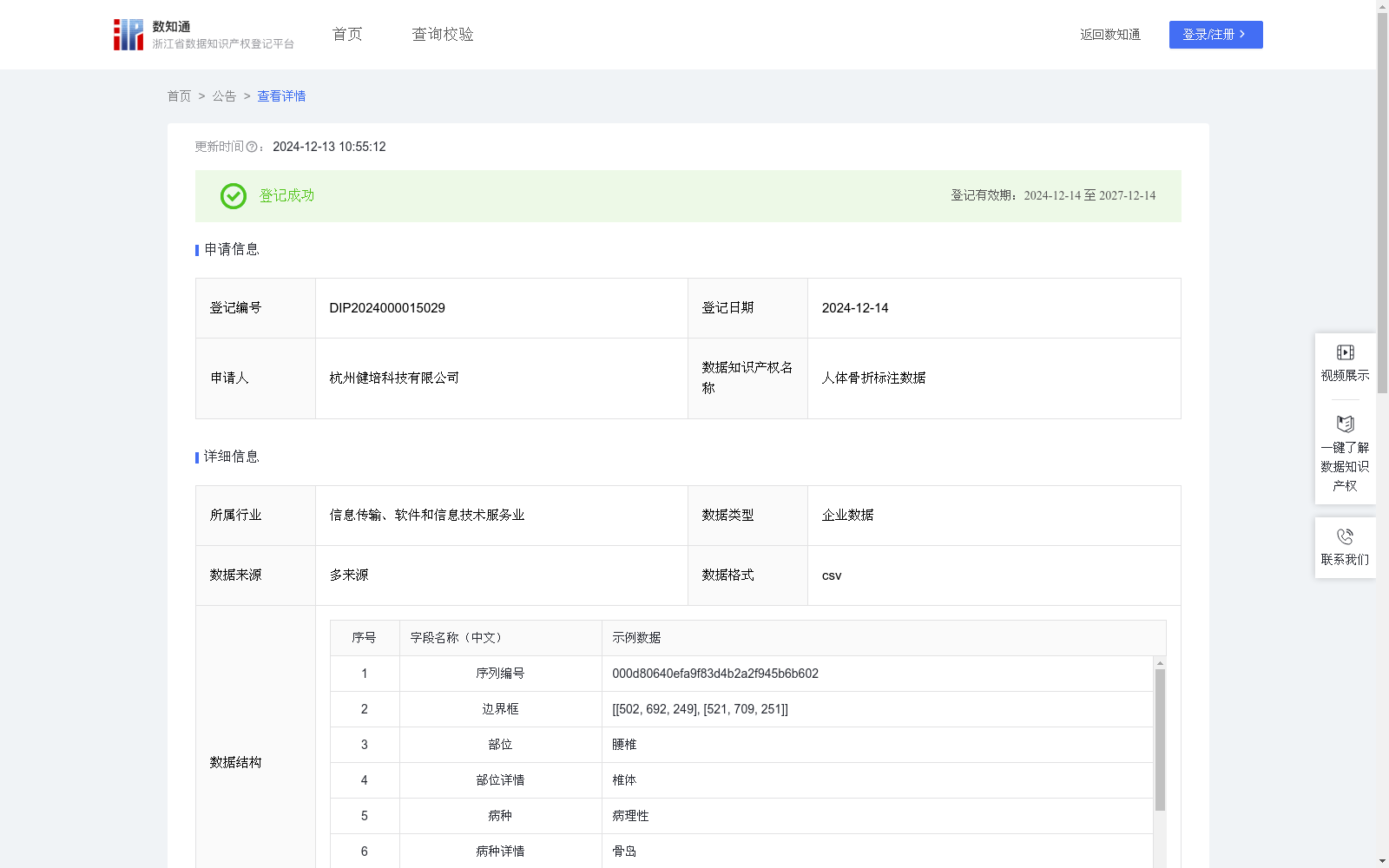
人体骨折标注数据
收藏浙江省数据知识产权登记平台2024-12-13 更新2024-12-14 收录
下载链接:
https://www.zjip.org.cn/home/announce/trends/101788
下载链接
链接失效反馈官方服务:
资源简介:
医学影像诊断:骨折标注数据在医学影像领域有着重要应用,通过标注X射线、CT扫描、核磁共振等医学影像,可以帮助医生更准确地识别和诊断骨折情况。
人工智能辅助筛查:随着人工智能技术的发展,骨折标注数据被用于训练AI模型,以实现对骨折的自动识别和筛查,提高诊断效率和准确性。
临床研究与教育:骨折标注数据集可以用于医学教育和临床研究,帮助医学生和年轻医生通过实际案例学习骨折的识别和处理。
计算机辅助检测(CADe)和诊断(CADx)工具开发:大量的骨折标注数据是构建全自动CADe和CADx工具的基础,这些工具可以用于骨骼损伤的筛查、诊断和决策支持。数据采集:要求CT影像数据符合以下条件:1.CT扫描探测器大于等于16排;2.CT影像符合DICOM 3.0标准;3.CT影像重建层厚3mm及以下;4.CT影像需为胸部的完整影像,且清晰无伪影。
采集过程:平扫:定位像扫描:1.胸部正位定位像,确定扫描范围和层次;2.扫描体位和方式:仰卧位,两臂上举抱头;横断面螺旋扫描;3.扫描范围:扫描范围肺尖至肺底;4.扫描视野(FOV):875px×875px-1000px×1000px(视受检者体形而定,需包括胸壁皮肤)。对比增强扫描:1.增强扫描时,扫描体位、方式、参数、层厚等通常与平扫一致。2.对比剂用量:常规增强,压力注射器静脉注射非离子型对比剂60~80ml,注射速率2.0~3.0ml/s;儿童按体重用量为1.0~1.5ml/kg,或参照药品说明书使用。3.扫描时相比普通增强延迟20-30秒行动脉期扫描、60-70秒行静脉期扫描。数据脱敏:使用的数据是获得医院相关伦理委员会批准或者豁免的临床脱敏数据,患者的隐私保护满足国家法律法规和监管部门规定等文件的要求。为保证患者隐私安全和患者利益,数据遵循相关法律法规和规范性文件的要求进行了脱敏处理,并保持数据的可追溯性。
数据预处理:数据清洗:按层厚、体位、是否存在缺陷、是否符合入排标准四个方面进行。1.层厚:要求层厚不大于3mm,若同一检查下有多个序列则取符合要求的最小层厚序列;2.体位:要求图像为横断位,即CT影像的方向余弦与横断位标准方向余弦之间差值的二阶范数不大于0.001;3.是否存在缺陷:CT影像的扫描范围应包括肺尖与肋膈角之间的全部,且不能进行任何修改编辑,每个病例的影响应当保持连续完整,不得出现缺层、错层且图像清晰;4.是否符合入排标准:由高年资医生,按照每个病例是否符合入排标准,进行手动筛选。统一图像方向:读取CT影像的方位信息,将图像三维像素矩阵统一为LPI方向的三维矩阵。归一化:读取数据的像素信息,结合骨窗的窗宽、窗位进行归一化操作,减少干扰。
数据标注:骨折CT数据标注采取“两标一审”的标注方式,每一例数据由二位标注医生背靠背分别进行一轮标注,标注完成后,对标记结果进行合并。将合并后的结果分配给审核医生进行审核。
Medical Image Diagnosis: Fracture annotation data plays a critical role in the field of medical imaging. By annotating medical images including X-rays, CT scans, and magnetic resonance imaging (MRI), clinicians can more accurately identify and diagnose fractures.
AI-assisted Screening: With the advancement of artificial intelligence technologies, fracture annotation data is utilized to train AI models for automatic fracture recognition and screening, thereby improving diagnostic efficiency and accuracy.
Clinical Research and Education: Fracture annotation datasets can be applied in medical education and clinical research, assisting medical students and junior physicians in learning fracture recognition and management through real clinical cases.
Development of Computer-Aided Detection (CADe) and Computer-Aided Diagnosis (CADx) Tools: Large-scale fracture annotation data serves as the fundamental basis for developing fully automated CADe and CADx tools, which can be used for skeletal injury screening, diagnosis, and decision support.
Data Collection: CT image data must meet the following requirements:
1. The CT scan detector has 16 or more rows;
2. The CT images comply with the DICOM 3.0 standard;
3. The reconstructed slice thickness of CT images is ≤3 mm;
4. The CT images must be complete chest images with clear quality and no artifacts.
Acquisition Process:
Plain Scan: Localizer Scan
1. Posteroanterior chest localizer scan to determine the scanning range and levels;
2. Scan position and method: Supine position, both arms raised and resting on the head; axial spiral scan;
3. Scan range: From the apex of the lung to the costophrenic angle;
4. Scan Field of View (FOV): 875px × 875px to 1000px × 1000px (determined by the patient's body habitus, must include the chest wall skin).
Contrast-Enhanced Scan:
1. During contrast-enhanced scanning, the scan position, method, parameters, slice thickness, etc. are generally consistent with those of the plain scan;
2. Contrast agent dosage: For routine enhancement, 60~80 mL of non-ionic contrast agent is intravenously injected via a power injector at a rate of 2.0~3.0 mL/s; for pediatric patients, the dosage is 1.0~1.5 mL/kg based on body weight, or refer to the drug package insert;
3. Scan timing: Perform arterial phase scan 20-30 seconds after the start of contrast agent injection, and venous phase scan 60-70 seconds after the start.
Data De-identification: The utilized data are clinically de-identified data approved or exempted by the hospital's relevant ethics committee. Patient privacy protection complies with the requirements of national laws, regulations, and regulatory documents. To ensure patient privacy and interests, the data has been de-identified in accordance with relevant laws, regulations, and normative documents, while maintaining data traceability.
Data Preprocessing:
Data Cleaning: Conducted from four aspects: slice thickness, scan position, presence of defects, and compliance with inclusion and exclusion criteria.
1. Slice thickness: The slice thickness must be ≤3 mm; if multiple sequences are available for the same examination, the sequence with the minimum compliant slice thickness shall be selected;
2. Scan position: The images must be axial slices, i.e., the 2-norm of the difference between the direction cosines of the CT images and the standard axial direction cosines shall be ≤0.001;
3. Presence of defects: The scan range of CT images must cover the entire area from the lung apex to the costophrenic angle, and no modification or editing is allowed. Each case's images shall remain continuous and complete, with no missing or misaligned slices, and the images must be clear;
4. Compliance with inclusion and exclusion criteria: Manually screened by senior clinicians based on whether each case meets the inclusion and exclusion criteria.
Unified Image Orientation: Read the orientation information of CT images and unify the 3D pixel matrix of the images into a 3D matrix in the Left-Posterior-Inferior (LPI) orientation.
Normalization: Read the pixel information of the data and perform normalization operations combined with the window width and window level of the bone window to reduce interference.
Data Annotation: Fracture CT data annotation adopts the "two-annotations-one-review" workflow. Each case is annotated once by two annotating clinicians in a back-to-back manner. After the annotation is completed, the marked results are merged. The merged results are assigned to a reviewing clinician for verification.
提供机构:
杭州健培科技有限公司
创建时间:
2024-11-08
搜集汇总
数据集介绍
特点
人体骨折标注数据集由杭州健培科技有限公司提供,包含61952条CSV格式的数据,适用于医学影像诊断、AI辅助筛查、临床研究及教育等领域。数据经过严格的采集和预处理,确保了高质量和适用性。
以上内容由遇见数据集搜集并总结生成



