
HadSST3.1:Hadley全球海表温度观测分析资料(1870-2019)
收藏地球大数据科学工程2024-03-04 收录
下载链接:
https://data.casearth.cn/sdo/detail/653fb244819aec161b809387
下载链接
链接失效反馈官方服务:
资源简介:
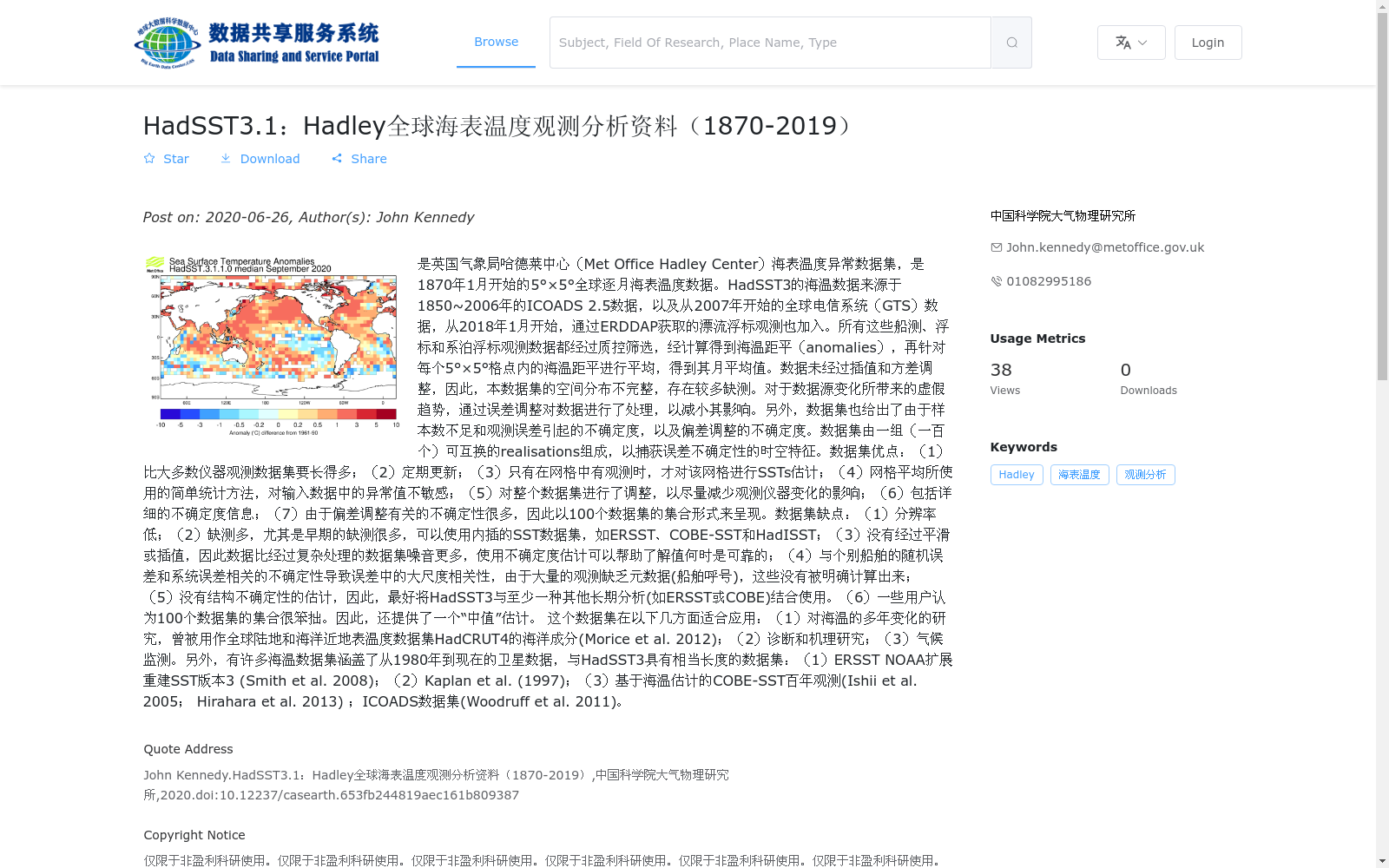
是英国气象局哈德莱中心(Met Office Hadley Center)海表温度异常数据集,是1870年1月开始的5°×5°全球逐月海表温度数据。HadSST3的海温数据来源于1850~2006年的ICOADS 2.5数据,以及从2007年开始的全球电信系统(GTS)数据,从2018年1月开始,通过ERDDAP获取的漂流浮标观测也加入。所有这些船测、浮标和系泊浮标观测数据都经过质控筛选,经计算得到海温距平(anomalies),再针对每个5°×5°格点内的海温距平进行平均,得到其月平均值。数据未经过插值和方差调整,因此,本数据集的空间分布不完整,存在较多缺测。对于数据源变化所带来的虚假趋势,通过误差调整对数据进行了处理,以减小其影响。另外,数据集也给出了由于样本数不足和观测误差引起的不确定度,以及偏差调整的不确定度。数据集由一组(一百个)可互换的realisations组成,以捕获误差不确定性的时空特征。数据集优点:(1)比大多数仪器观测数据集要长得多;(2)定期更新;(3)只有在网格中有观测时,才对该网格进行SSTs估计;(4)网格平均所使用的简单统计方法,对输入数据中的异常值不敏感;(5)对整个数据集进行了调整,以尽量减少观测仪器变化的影响;(6)包括详细的不确定度信息;(7)由于偏差调整有关的不确定性很多,因此以100个数据集的集合形式来呈现。数据集缺点:(1)分辨率低;(2)缺测多,尤其是早期的缺测很多,可以使用内插的SST数据集,如ERSST、COBE-SST和HadISST;(3)没有经过平滑或插值,因此数据比经过复杂处理的数据集噪音更多,使用不确定度估计可以帮助了解值何时是可靠的;(4)与个别船舶的随机误差和系统误差相关的不确定性导致误差中的大尺度相关性,由于大量的观测缺乏元数据(船舶呼号),这些没有被明确计算出来;(5)没有结构不确定性的估计,因此,最好将HadSST3与至少一种其他长期分析(如ERSST或COBE)结合使用。(6)一些用户认为100个数据集的集合很笨拙。因此,还提供了一个“中值”估计。
这个数据集在以下几方面适合应用:(1)对海温的多年变化的研究,曾被用作全球陆地和海洋近地表温度数据集HadCRUT4的海洋成分(Morice et al. 2012);(2)诊断和机理研究;(3)气候监测。另外,有许多海温数据集涵盖了从1980年到现在的卫星数据,与HadSST3具有相当长度的数据集:(1)ERSST NOAA扩展重建SST版本3 (Smith et al. 2008);(2)Kaplan et al. (1997);(3)基于海温估计的COBE-SST百年观测(Ishii et al. 2005; Hirahara et al. 2013) ;ICOADS数据集(Woodruff et al. 2011)。
This is the HadSST3 sea surface temperature (SST) anomaly dataset from the Met Office Hadley Centre, which provides global 5°×5° monthly SST data starting from January 1870. The sea temperature data of HadSST3 is sourced from ICOADS 2.5 data from 1850 to 2006, as well as Global Telecommunication System (GTS) data starting from 2007. Since January 2018, drifting buoy observations obtained via ERDDAP have also been added to the dataset. All ship-borne, buoy and moored buoy observation data have undergone quality control screening. Sea surface temperature anomalies are calculated, and monthly mean values are derived by averaging the SST anomalies within each 5°×5° grid cell. The dataset has not undergone interpolation or variance adjustment, so its spatial coverage is incomplete with numerous missing values. For spurious trends caused by changes in data sources, error adjustments have been applied to mitigate their impacts. In addition, the dataset provides uncertainties arising from insufficient sample sizes and observation errors, as well as uncertainties associated with bias adjustment. The dataset consists of a set (one hundred) of interchangeable realisations to capture the spatiotemporal characteristics of error uncertainties.
Advantages of the dataset:
(1) It has a longer temporal span than most in-situ observational datasets;
(2) It is updated regularly;
(3) SST estimates are only generated for grid cells with available observations;
(4) The simple statistical methodology used for grid averaging is insensitive to outliers in the input data;
(5) The entire dataset has been adjusted to minimize the impact of changes in observation instrumentation;
(6) It includes detailed uncertainty information;
(7) Due to the substantial uncertainties associated with bias adjustment, it is presented as an ensemble of 100 datasets.
Disadvantages of the dataset:
(1) Low spatial resolution;
(2) A large number of missing values, particularly in the early time period. Interpolated SST datasets such as ERSST, COBE-SST and HadISST can be used as alternatives;
(3) No smoothing or interpolation has been applied, so the data is noisier than datasets that have undergone more complex processing. Uncertainty estimates can assist in determining when the values are reliable;
(4) Uncertainties related to random and systematic errors of individual vessels lead to large-scale correlations within the error fields. As a large number of observations lack metadata (vessel call signs), these correlations are not explicitly quantified;
(5) No estimates of structural uncertainty are provided, so it is recommended to use HadSST3 in conjunction with at least one other long-term SST analysis, such as ERSST or COBE-SST;
(6) Some users find the 100-member ensemble cumbersome. Accordingly, a "median" estimate is also provided.
This dataset is suitable for the following applications:
(1) Studies of long-term sea temperature changes, and it was previously used as the marine component of the global land and marine near-surface temperature dataset HadCRUT4 (Morice et al., 2012);
(2) Diagnostic and mechanistic studies;
(3) Climate monitoring.
In addition, there are numerous SST datasets that cover satellite-derived data from 1980 to the present, with temporal spans comparable to that of HadSST3:
(1) NOAA Extended Reconstructed SST Version 3 (ERSST) (Smith et al., 2008);
(2) Kaplan et al. (1997);
(3) Century-length observational SST dataset COBE-SST (Ishii et al., 2005; Hirahara et al., 2013);
(4) The International Comprehensive Ocean-Atmosphere Data Set (ICOADS) (Woodruff et al., 2011).
提供机构:
中国科学院大气物理研究所
搜集汇总
数据集介绍
背景与挑战
背景概述
HadSST3.1是英国气象局哈德莱中心发布的全球海表温度观测分析数据集,覆盖1870年至2019年,提供5°×5°空间分辨率的逐月海温距平数据。该数据集基于船测、浮标等观测数据,经过质控和误差调整以减少仪器变化影响,但空间分布不完整且存在较多缺测,同时以100个realisations集合形式提供详细不确定度信息。它适用于海温多年变化研究、气候监测等应用,具有长期性和定期更新优点,但分辨率较低且未插值处理。
以上内容由遇见数据集搜集并总结生成


