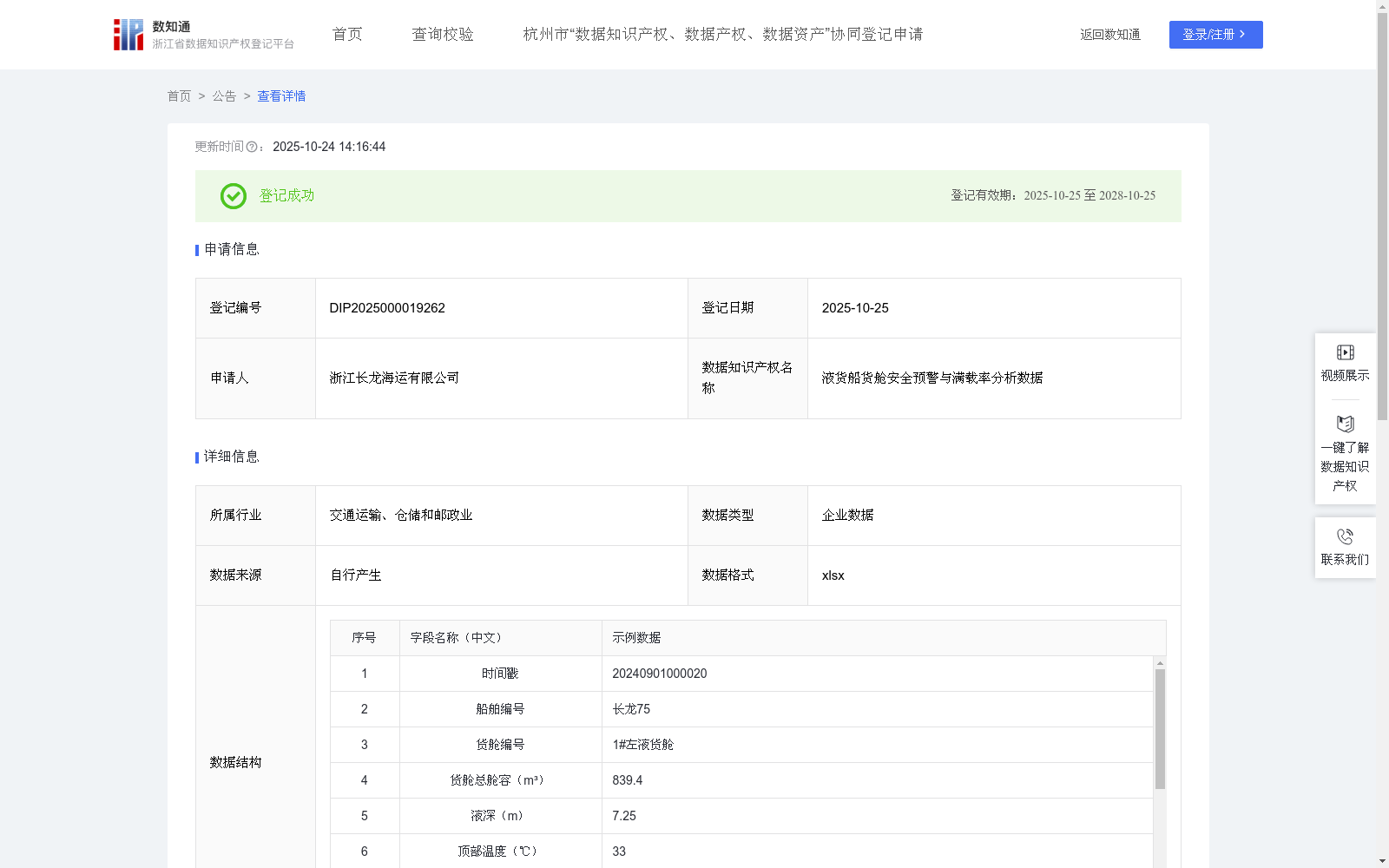
液货船货舱安全预警与满载率分析数据
收藏资源简介:
一、适用条件、范围与对象 适用于配备高精度舱内传感器(压力、温度、容积)和稳定通信(5G/卫星)的液货船,覆盖航行与装卸全程实时监控与历史分析。主要面向轮机管理人员、岸基监控、船队管理及安全效率分析人员。 二、数据应用价值 实时安全预警:基于规则动态监测温度与压力,秒级告警并定位风险,支持应急响应,显著提升安全性、降低事故与污染风险。 运营优化:提供精准满载率,辅助配载决策,提升舱容利用与船舶周转,降低单航次成本。 决策支持:全景可视化货舱状态,增强突发响应与运营策略能力,推动管理向智能化、数据化发展。 三、外部复用价值 对货主与租船方:提供不可篡改的货物温度、压力状态历史数据,作为厘清货损责任、证明运输途中合规操作的权威依据,保障货物质量,增强合作信任。 对保险公司与金融机构:提供客观的船舶安全运行数据,为风险评估与核保提供精准依据,助力船东获得更优保险费率;同时验证资产运营效率,支撑船舶融资与资产估值。 对港口与监管机构:近乎实时地共享船舶装载与安全状态,大幅提升装卸作业效率与安全性,并为安全、环保合规监管提供透明、高效的数字化证明,简化流程。1. 数据采集 通过货舱内的高精度传感器,每10秒采集一次各货舱的压力、容积、顶部/中部/底部温度等关键参数。所有数据均带有时间戳,并通过5G或卫星通信链路实时传输至岸基服务器,形成连续的时间序列数据流。 采集字段包括:时间戳(精确到秒)、船舶编号、货舱编号、货舱总舱容(m³)、液深(m)、货舱顶部/中部/底部的温度值(℃)、当前压力(kPa)、当前货舱载货容积(m³) 2. 数据处理 为保证后续分析结果的准确性,需对采集到的原始数据进行清洗和标准化处理,具体步骤如下: 去空格与格式统一:去除字段中的非法字符,将数值字段统一为浮点型; 完整性校验:检查必填字段是否齐全(时间戳、船舶编号、货舱编号、货舱总舱容、液深、顶部温度、中部温度、底部温度、当前压力、当前货舱载货容积),缺失任一字段即标记为异常数据; 异常值剔除:使用统计方法(3σ原则)识别并剔除明显超出合理范围的数值(当前货舱容积超过货舱总容积); 数据聚合:在设定的时间段内,按时间戳、船舶编号和货舱编号进行汇总,生成可用于分析的结构化数据表。 3. 核心算法规则 A. 安全预警模型 平均温度=(顶部温度+中部温度+底部温度)/ 3 基于货舱的顶部/中部/底部温度、平均温度(取顶部、中部、底部温度的平均值)与当前压力建立货舱安全预警模型,采用以下规则进行安全预警: 满足以下任一条件,触发YELLOW-黄色预警:1.任一部位温度≥50℃或≤-20℃,2.平均温度≥40℃或≤-10℃,3.压力>30kPa或<0kPa; 同时满足以下所有条件,为GREEN-安全状态:1.所有部位温度∈[-5℃, 45℃],2.平均温度∈[10℃, 35℃];3.压力∈[0kPa, 30kPa] B. 货舱满载率计算 货舱满载率=(货舱载货容积/货舱总舱容)*100%。用于评估运营效率
I. Applicable Conditions, Scope and Targets This dataset is applicable to liquid cargo vessels equipped with high-precision in-cabin sensors (pressure, temperature, volume) and reliable communication (5G/satellite), covering the entire process of navigation and loading/unloading for real-time monitoring and historical analysis. It is mainly targeted at marine engineering management personnel, on-shore monitoring teams, fleet managers, and safety and efficiency analysis personnel. II. Data Application Value 1. Real-time Safety Early Warning: Dynamically monitor temperature and pressure based on predefined rules, trigger second-level alarms and locate risks, support emergency response, and significantly improve safety while reducing accident and pollution risks. 2. Operation Optimization: Provide accurate loading rate to assist stowage decision-making, improve cabin capacity utilization and ship turnover, and reduce per-voyage costs. 3. Decision Support: Provide panoramic visualization of cargo hold status, enhance emergency response and operational strategy capabilities, and promote the transformation of management towards intelligence and data-driven development. III. External Reuse Value 1. For cargo owners and charterers: Provide tamper-proof historical data of cargo temperature and pressure status, serving as an authoritative basis for clarifying cargo damage liabilities and proving compliance of in-transit operations, ensuring cargo quality and enhancing cooperative trust. 2. For insurance companies and financial institutions: Provide objective ship safety operation data, offering accurate basis for risk assessment and underwriting to help shipowners obtain better insurance premium rates; meanwhile, verify asset operation efficiency to support ship financing and asset valuation. 3. For ports and regulatory authorities: Share ship loading and safety status in near real-time, greatly improving loading and unloading efficiency and safety, and providing transparent and efficient digital proof for safety and environmental compliance supervision, simplifying procedures. 1. Data Collection High-precision sensors installed in cargo holds collect key parameters including pressure, volume, and top/middle/bottom temperature of each cargo hold every 10 seconds. All data is time-stamped and transmitted in real-time to on-shore servers via 5G or satellite communication links, forming a continuous time-series data stream. Collected fields include: timestamp (accurate to the second), ship number, cargo hold number, total cargo hold capacity (m³), liquid depth (m), temperature values at top/middle/bottom of cargo hold (℃), current pressure (kPa), current cargo volume in cargo hold (m³) 2. Data Processing To ensure the accuracy of subsequent analysis results, the collected raw data requires cleaning and standardization processing, with the following specific steps: - Remove spaces and unify format: Remove invalid characters in fields, and unify numerical fields to floating-point type; - Completeness Check: Check whether all required fields are complete (timestamp, ship number, cargo hold number, total cargo hold capacity, liquid depth, top temperature, middle temperature, bottom temperature, current pressure, current cargo volume in cargo hold). Any missing field will be marked as abnormal data; - Outlier Removal: Use statistical methods (3σ principle) to identify and eliminate values that obviously exceed reasonable ranges (e.g., current cargo volume in cargo hold exceeds total cargo hold capacity); - Data Aggregation: Aggregate data based on timestamp, ship number and cargo hold number within a set time period to generate structured data tables available for analysis. 3. Core Algorithm Rules A. Safety Early Warning Model Average Temperature = (Top Temperature + Middle Temperature + Bottom Temperature) / 3 A cargo hold safety early warning model is established based on the top/middle/bottom temperatures, average temperature (calculated as the mean of top, middle and bottom temperatures) and current pressure of the cargo hold, with safety early warning triggered according to the following rules: - Trigger YELLOW warning if any of the following conditions are met: 1. Temperature of any part ≥50℃ or ≤-20℃; 2. Average temperature ≥40℃ or ≤-10℃; 3. Pressure >30kPa or <0kPa; - Reach GREEN - Safe Status if all of the following conditions are satisfied: 1. Temperatures of all parts ∈ [-5℃, 45℃]; 2. Average temperature ∈ [10℃, 35℃]; 3. Pressure ∈ [0kPa, 30kPa] B. Cargo Hold Loading Rate Calculation Cargo Hold Loading Rate = (Current Cargo Volume in Cargo Hold / Total Cargo Hold Capacity) * 100%. Used to evaluate operational efficiency