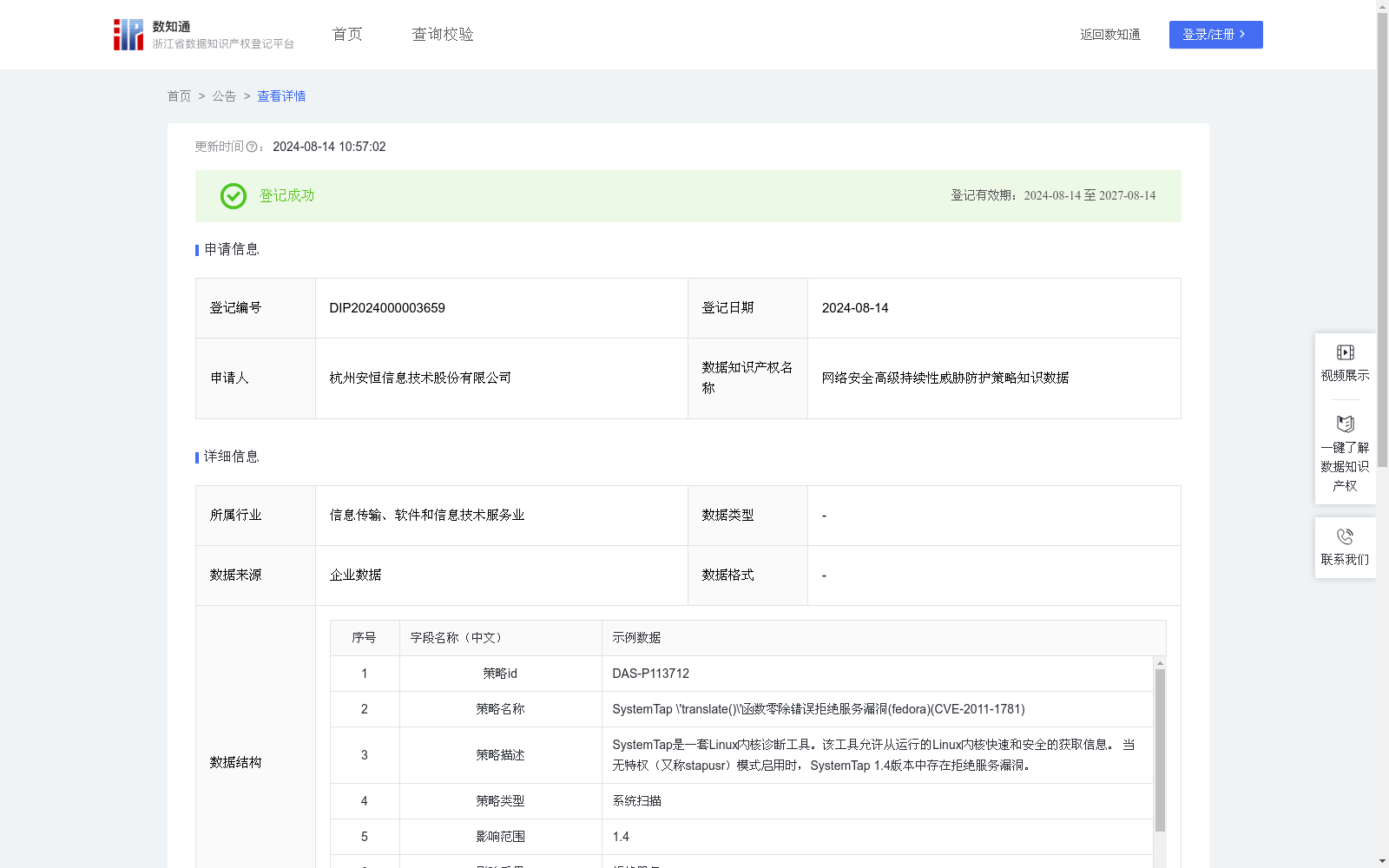
网络安全高级持续性威胁防护策略知识数据
收藏资源简介:
安全管理-漏洞扫描与漏洞管理 应用场景:在漏洞扫描过程中,安全管理策略知识数据被用于验证发现的漏洞是否已被现有安全策略所覆盖或是否需要调整策略以应对新发现的威胁。通过比对漏洞数据库与策略库,安全团队可以快速识别哪些漏洞是策略盲点,从而优先制定补救措施和更新安全策略。 端点安全-终端防病毒 应用场景:终端防病毒软件利用安全管理策略知识数据来优化病毒检测规则和行为分析模型。这些数据包括已知病毒的特征码、恶意软件的行为模式以及最新的安全威胁情报,帮助防病毒软件更准确地识别并阻止潜在的恶意软件入侵,同时减少误报和漏报。 端点安全-终端安全管理 应用场景:在终端安全管理中,策略知识数据用于配置和执行终端访问控制、应用程序白名单、系统补丁管理等策略。通过定期更新策略知识库,管理员可以确保终端符合最新的安全标准,防止未授权访问、恶意软件执行和漏洞利用。 端点安全-终端检测与响应(EDR) 应用场景:EDR系统利用安全管理策略知识数据来增强对终端异常行为的检测和响应能力。策略知识数据包括预设的威胁指示器、行为基线模型和响应预案,帮助EDR系统快速识别并响应潜在的安全事件,如勒索软件攻击、数据泄露等步骤1:数据采集,通过公司扫描类、流量类、终端类和防护类产品的策略规则提取的信息。 步骤2:数据清洗,对采集到的数据进行结构化转换和标准化处理,并进行多维信息的聚合。以更好地满足后续对恶意家族进行数据分析和关联的需求。 步骤3:数据加工,通过策略平台进行数据汇总,汇集扫描类、流量类、终端类和防护类产品的策略信息,规则类型包括系统扫描、主机扫描、数据库扫描、流量规则、WAF规则、玄武盾规则以及终端攻防规则等,每月根据最新策略规则进行汇总,按照策略名称与更新时间取最新策略信息。
Security Management - Vulnerability Scanning and Vulnerability Management Application Scenario: In the vulnerability scanning process, security management policy knowledge data is used to verify whether the discovered vulnerabilities are covered by existing security policies or whether policies need to be adjusted to address newly discovered threats. By comparing the vulnerability database and the policy repository, the security team can quickly identify the vulnerabilities that are policy blind spots, thereby prioritizing the formulation of remediation measures and updates to security policies. Endpoint Security - Endpoint Antivirus Application Scenario: Endpoint antivirus software leverages security management policy knowledge data to optimize virus detection rules and behavior analysis models. Such data includes signatures of known viruses, behavioral patterns of malware, and the latest security threat intelligence, helping antivirus software more accurately identify and block potential malicious software intrusions while reducing false positives and false negatives. Endpoint Security - Endpoint Security Management Application Scenario: In endpoint security management, policy knowledge data is used to configure and enforce policies such as terminal access control, application whitelisting, and system patch management. By regularly updating the policy knowledge base, administrators can ensure that terminals comply with the latest security standards, preventing unauthorized access, malicious software execution, and vulnerability exploitation. Endpoint Security - Endpoint Detection and Response (EDR) Application Scenario: EDR systems utilize security management policy knowledge data to enhance the detection and response capabilities for abnormal terminal behaviors. Policy knowledge data includes preset threat indicators, behavioral baseline models, and response plans, helping EDR systems quickly identify and respond to potential security incidents such as ransomware attacks and data leaks. Step 1: Data Collection: Extract information from the policy rules of the company's scanning, traffic, terminal, and protection products. Step 2: Data Cleaning: Perform structured conversion and standardization processing on the collected data, and aggregate multi-dimensional information to better meet the subsequent needs of data analysis and correlation for malicious families. Step 3: Data Processing: Summarize data through the policy platform, gathering policy information from scanning, traffic, terminal, and protection products. Rule types include system scanning, host scanning, database scanning, traffic rules, WAF rules, Xuanwudun rules, and terminal attack and defense rules, etc. The latest policy information is summarized monthly based on the latest policy rules, and select the most up-to-date policy information according to the policy name and update time.