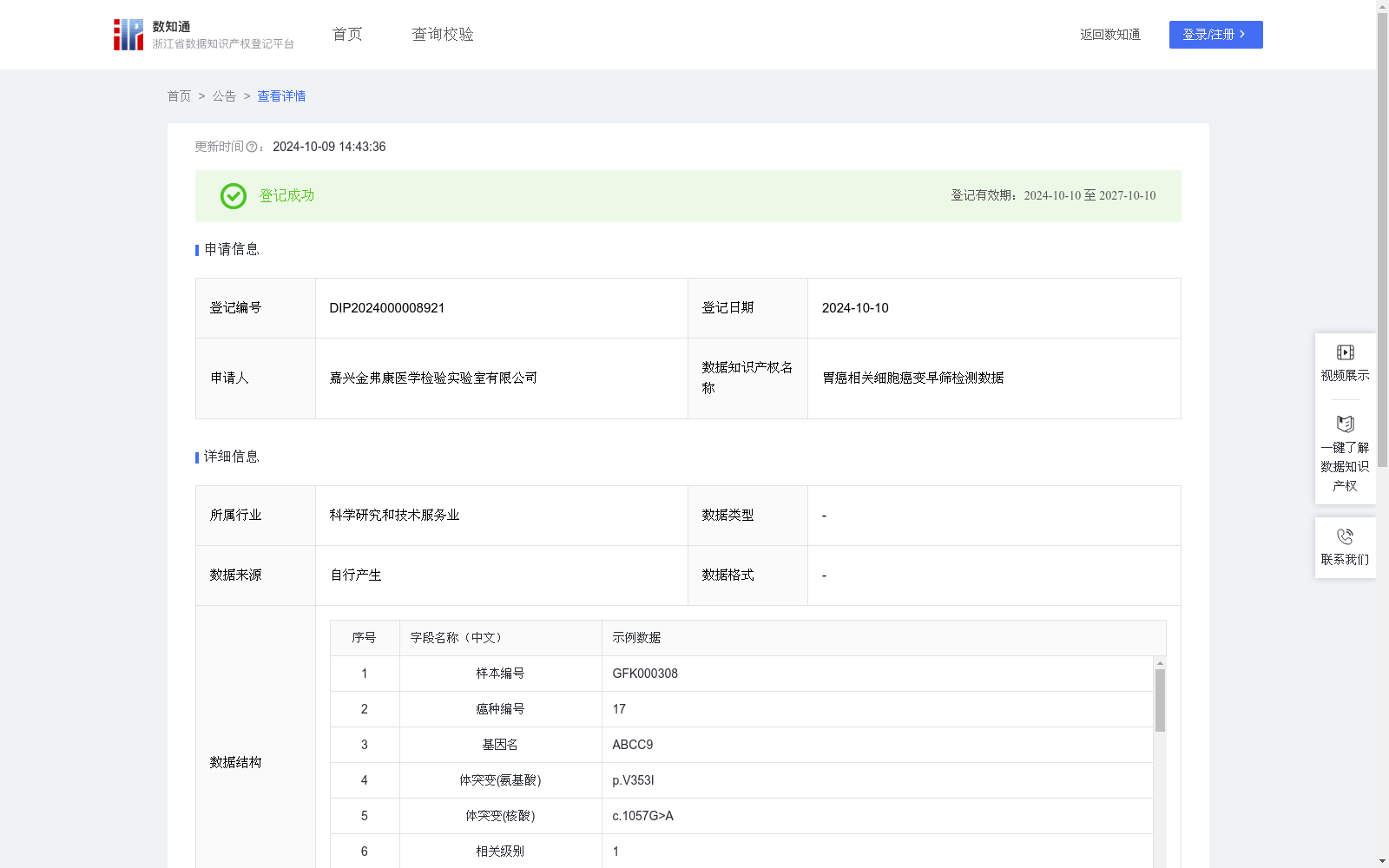
胃癌相关细胞癌变早筛检测数据
收藏资源简介:
癌症早筛检测,通过检测15毫升血液中DNA碎片里面是否含有癌特异性突变,实现对细胞癌化信号的早期排查。采用专利分子捕获技术和高通量测序技术检测血液中来自不同组织癌化细胞的DNA小片段,覆盖关键抑癌基因中超1900种特异突变指标,对体内是否存在癌化克隆细胞(癌细胞的前体)、存在多少以及在哪里进行计算,可对正常细胞的癌化进程进行定量监控,能让预警发生在细胞癌变前,及早发现和治疗胃癌患者,减少因晚期治疗而带来的高昂医疗费用和医疗资源的浪费。 使用专利分子捕获技术和高通量测序技术检测血液中来自不同组织癌化细胞的DNA小片段,覆盖关键抑癌基因中超1900种特异突变指标。1、数据质量控制:对原始的FASTQ文件进行质控,检查序列数据的质量,移除污染序列,确保数据的准确性;2、去接头:去除接头序列和低质量的碱基,确保分析过程中只使用高质量的序列。3、序列比对:使用比对工具将质控后的序列映射比对。4、突变位点检测:选择特定的变异检测工具,检测比对后序列的变异性,得到显著突变位点;5、位点功能注释:结合选择的BED文件对显著突变位点进行功能注释,判断在基因组中的位置(如是否位于功能重要区域或已知的致病性位点),得到“突变区域”字段。6、癌症相关性分析:利用注释信息和临床数据库,分析显著突变位点与不同类型癌症的关联性,得到“癌种编号”,“相关级别”字段若为特异性相关记为“1”,普通相关记为“2”。7、基于蛋白质原始状态和突变后的物理化学性质构建OBCD癌症早筛模型,通过分析突变前后蛋白质性质发生的变化,判断该显著突变位点发生突变对人体的影响,结合蛋白质在细胞信号转导过程中是否发生磷酸化以及对应的净电荷,为癌症的早筛提供参考依据。
Early Cancer Screening Test detects cancer-specific mutations in DNA fragments extracted from 15 mL of blood to conduct early screening for oncogenic transformation signals. It adopts patented molecular capture technology and high-throughput sequencing (HTS) technology to detect small DNA fragments from oncogenic cells of different tissues in blood, covering over 1900 specific mutation markers in key tumor suppressor genes. It calculates whether there are oncogenic clonal cells (precursors of cancer cells) in the body, their quantity and location, enabling quantitative monitoring of the carcinogenic process of normal cells. This allows early warning to be issued at the pre-carcinogenic stage, enabling early detection and treatment of gastric cancer patients, thereby reducing exorbitant medical costs and waste of medical resources caused by late-stage treatment. The test uses patented molecular capture technology and high-throughput sequencing technology to detect small DNA fragments from oncogenic cells of different tissues in blood, covering over 1900 specific mutation markers in key tumor suppressor genes. The analysis pipeline includes the following 7 steps: 1. Data Quality Control (QC): Perform quality control on raw FASTQ files, check the quality of sequence data, remove contaminated sequences, and ensure data accuracy; 2. Adapter Trimming: Remove adapter sequences and low-quality bases to ensure only high-quality sequences are used for the analysis process; 3. Sequence Alignment: Use alignment tools to map and align the QC-filtered sequences; 4. Mutation Site Detection: Select specific variant detection tools to detect the variability of aligned sequences and obtain significant mutation sites; 5. Site Functional Annotation: Perform functional annotation on the significant mutation sites using the selected BED files, determine their genomic positions (e.g., whether they are located in functionally important regions or known pathogenic sites), and generate the "Mutation Region" field; 6. Cancer Association Analysis: Use annotation information and clinical databases to analyze the association between significant mutation sites and different cancer types, and generate the "Cancer Type ID" and "Relevance Level" fields. The "Relevance Level" is marked as "1" for specific association and "2" for general association; 7. Construction of OBCD Early Cancer Screening Model: Construct the OBCD Early Cancer Screening Model based on the native and post-mutation physicochemical properties of proteins. By analyzing changes in protein properties before and after mutation, evaluate the impact of the mutation at this significant site on the human body. Combine whether the protein undergoes phosphorylation during cell signal transduction and its corresponding net charge to provide reference basis for early cancer screening.