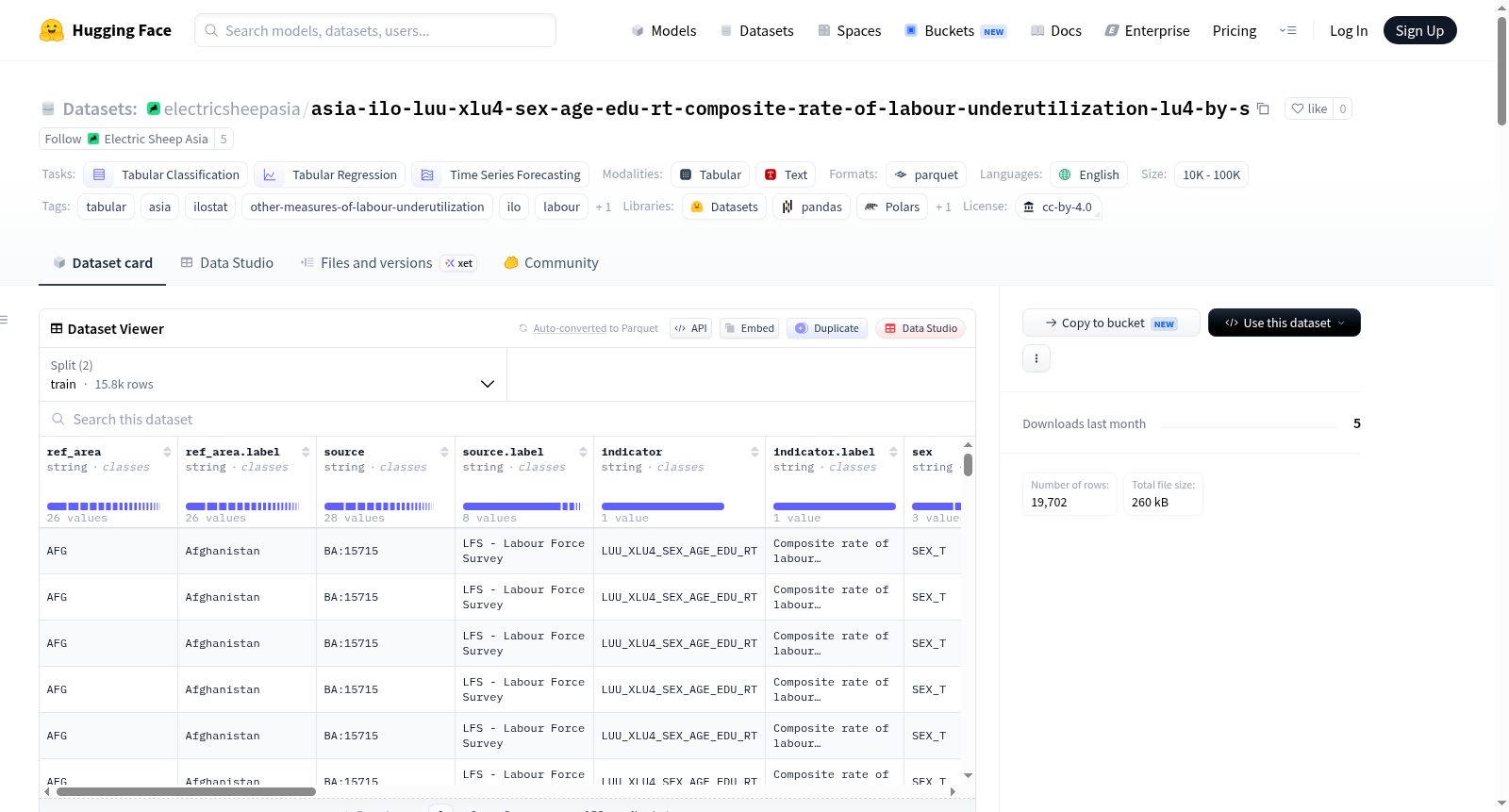
electricsheepasia/asia-ilo-luu-xlu4-sex-age-edu-rt-composite-rate-of-labour-underutilization-lu4-by-s
收藏资源简介:
--- license: cc-by-4.0 language: - en task_categories: - tabular-classification - tabular-regression - time-series-forecasting multilinguality: monolingual size_categories: - 10K<n<100K tags: - tabular - asia - ilostat - other-measures-of-labour-underutilization - ilo - labour - employment pretty_name: "Composite rate of labour underutilization (LU4) by sex, age and education (%) | Asia (ILOSTAT)" --- # Composite rate of labour underutilization (LU4) by sex, age and education (%) | Asia (ILOSTAT) 🌏 **19,702 observations** · **30 Asia countries** · **1999–2025** · *Repackaged by [Electric Sheep Asia](https://huggingface.co/electricsheepasia)*      ## TL;DR This dataset contains **19,702 observations** of `Other measures of labour underutilization` data across **30 Asia countries**, spanning **1999–2025**, covering **1 distinct indicators**. ## About the source **ILOSTAT** is the ILO's central statistics database, the leading global source for labour statistics. It compiles indicators across employment, unemployment, wages, working time, child labour, informal economy, social protection, occupational injuries, and SDG decent work targets — drawing on national labour force surveys, household income surveys, establishment surveys, and administrative records. Coverage spans 200+ economies, with the ILO's Department of Statistics responsible for harmonisation. - **Source:** [ILOSTAT](https://www.ilo.org/shinyapps/bulkexplorer/?id=LUU_XLU4_SEX_AGE_EDU_RT) - **Publisher:** International Labour Organization (ILO) - **License:** [cc-by-4.0](https://creativecommons.org/licenses/by/4.0/) - **Topic:** Other measures of labour underutilization ## Methodology Data pulled directly from the ILOSTAT REST API at `https://rplumber.ilo.org/data/indicator?id=LUU_XLU4_SEX_AGE_EDU_RT` and filtered to Asia ISO3 country codes. ILOSTAT harmonises raw survey microdata using ICLS (International Conference of Labour Statisticians) definitions; sources are flagged in the `source.label` column for traceability. ## Geographic coverage 30 Asia countries · top rows shown below, sorted by row count: | Country | Rows | First year | Last year | |---------|-----:|-----------:|----------:| | `CYP` | 2,692 | 1999 | 2024 | | `VNM` | 1,864 | 2010 | 2024 | | `THA` | 1,668 | 2010 | 2024 | | `LKA` | 1,522 | 2010 | 2024 | | `TUR` | 1,181 | 2004 | 2013 | | `PSE` | 1,107 | 2015 | 2025 | | `BRN` | 939 | 2014 | 2024 | | `JOR` | 860 | 2017 | 2024 | | `IDN` | 838 | 2016 | 2023 | | `BGD` | 640 | 2013 | 2024 | | `GEO` | 623 | 2019 | 2024 | | `MNG` | 613 | 2019 | 2024 | | `KHM` | 576 | 2003 | 2019 | | `AFG` | 505 | 2014 | 2021 | | `PHL` | 480 | 2017 | 2023 | | ... | _15 more countries_ | | | ## Indicators (sample) - `LUU_XLU4_SEX_AGE_EDU_RT` — Composite rate of labour underutilization (LU4) by sex, age and education (%) ## Schema | Column | Type | Description | Example | |--------|------|-------------|---------| | `ref_area` | `string` | ISO 3166-1 alpha-3 country code | `AFG` | | `ref_area.label` | `string` | Country name in English | `Afghanistan` | | `source` | `string` | ILOSTAT source code (e.g. labour force survey) | `BA:15715` | | `source.label` | `string` | Source name in English | `LFS - Labour Force Survey` | | `indicator` | `string` | ILOSTAT indicator code | `LUU_XLU4_SEX_AGE_EDU_RT` | | `indicator.label` | `string` | Indicator name in English | `Composite rate of labour underutiliza…` | | `sex` | `string` | Disaggregation by sex (SEX_T = total, SEX_M = male, SEX_F = female) | `SEX_T` | | `sex.label` | `string` | — | `Total` | | `classif1` | `string` | First classification variable (age, education, status, etc.) | `AGE_YTHADULT_YGE15` | | `classif1.label` | `string` | — | `Age (Youth, adults): 15+` | | `classif2` | `string` | Second classification variable where applicable | `EDU_AGGREGATE_TOTAL` | | `classif2.label` | `string` | — | `Education (Aggregate levels): Total` | | `time` | `int64` | Observation year | `2021` | | `obs_value` | `float64` | Observed indicator value (unit varies — see indicator definition) | `19.229` | | `obs_status` | `string` | Observation status flag (e.g. provisional, unreliable) | `U` | | `obs_status.label` | `string` | — | `Unreliable` | | `note_classif` | `string` | — | `C3:2620` | | `note_classif.label` | `string` | — | `Nonstandard education level: Includin…` | | `note_indicator` | `string` | — | `I11:264` | | `note_indicator.label` | `string` | — | `Break in series: Methodology revised` | | `note_source` | `string` | — | `R1:3513_S3:8` | | `note_source.label` | `string` | — | `Repository: ILO-STATISTICS - Micro da…` | ## Disaggregation dimensions The following columns provide disaggregation dimensions: - **`sex`** (3 unique values): `SEX_T`, `SEX_M`, `SEX_F` ## Data quality & caveats - Data is annual frequency. Some indicators also publish monthly or quarterly series — those are not included here. - When an indicator has multiple sources for the same country×year, the ILO-selected 'best source' is used. - Disaggregation columns (`sex`, `classif1`, `classif2`) are non-null only when the indicator publishes that breakdown. ## Usage ```python from datasets import load_dataset ds = load_dataset("electricsheepasia/asia-ilo-luu-xlu4-sex-age-edu-rt-composite-rate-of-labour-underutilization-lu4-by-s") df = ds["train"].to_pandas() print(df.head()) ``` ### Filter to one country ```python indonesia = df[df["ref_area"] == "IDN"] ``` ### Time-series for a single indicator ```python sample = (df[df["indicator"] == "LUU_XLU4_SEX_AGE_EDU_RT"] .sort_values("time")) sample.plot(x="time", y="obs_value", title="LUU_XLU4_SEX_AGE_EDU_RT") ``` ### Pivot to country × year matrix ```python matrix = (df[df["indicator"] == "LUU_XLU4_SEX_AGE_EDU_RT"] .pivot_table(index="time", columns="ref_area", values="obs_value")) print(matrix.tail()) ``` ## Citation ```bibtex @misc{asia_ilo_luu_xlu4_sex_age_edu_rt_composite_rate_of_labour_underutilization_lu4_by_s_2025, title = {Composite rate of labour underutilization (LU4) by sex, age and education (%) | Asia (ILOSTAT)}, author = {International Labour Organization (ILO)}, year = {2025}, url = {https://www.ilo.org/shinyapps/bulkexplorer/?id=LUU_XLU4_SEX_AGE_EDU_RT}, publisher = {HuggingFace Datasets, repackaged by Electric Sheep Asia}, howpublished = {\url{https://huggingface.co/datasets/electricsheepasia/asia-ilo-luu-xlu4-sex-age-edu-rt-composite-rate-of-labour-underutilization-lu4-by-s}} } ``` ## License Released under [cc-by-4.0](https://creativecommons.org/licenses/by/4.0/). Original data © International Labour Organization (ILO). When using this dataset, please cite both the original source above and the Electric Sheep Asia repackaging. ## About Electric Sheep Electric Sheep Asia is part of the Electric Sheep mission: a unified, ML-ready data layer for Asia on HuggingFace. We pull data from authoritative open sources, normalize the schemas, package as Parquet, and publish with consistent dataset cards so researchers and developers can use `load_dataset()` to start working in seconds. Browse the full collection: [huggingface.co/electricsheepasia](https://huggingface.co/electricsheepasia) --- _Provenance: ingested 2026-05-27 via the Electric Sheep pipeline. Source URL: https://www.ilo.org/shinyapps/bulkexplorer/?id=LUU_XLU4_SEX_AGE_EDU_RT_
This dataset contains Other measures of labour underutilization data from the International Labour Organization (ILO) ILOSTAT database, specifically the Composite rate of labour underutilization (LU4) by sex, age and education (%). It covers 30 Asian countries from 1999 to 2025, with 19,702 observations. The data is sourced from the ILOSTAT REST API and filtered to Asian country codes, focusing on the composite labour underutilization rate disaggregated by sex, age, and education. The dataset includes columns such as country code, source information, indicator code, sex classification, age and education classifications, observation year, observed value, and status flags, making it suitable for tabular classification, regression, and time-series forecasting tasks. The data is published at an annual frequency and is harmonized using ILOs International Conference of Labour Statisticians (ICLS) definitions.