
OcularAge
收藏资源简介:
OcularAge数据集是克拉克森大学在长达八年的纵向研究中收集的,包括超过21,000张近红外(NIR)眼部图像,涉及288名4至16岁的儿童。该数据集旨在通过比较虹膜和周围眼部图像来评估儿童年龄估计。数据集使用两种不同的成像传感器收集,并利用多任务深度学习框架进行年龄预测和年龄组分类。该研究结果表明,周围眼部模型始终优于基于虹膜的模型,实现了1.33年的平均绝对误差和83.82%的年龄组分类准确率。
The OcularAge dataset was collected by Clarkson University during an eight-year longitudinal study, comprising over 21,000 near-infrared (NIR) ocular images from 288 children aged 4 to 16 years old. This dataset aims to evaluate pediatric age estimation by comparing iris and periocular images. It was gathered using two distinct imaging sensors, and a multi-task deep learning framework is employed to conduct age prediction and age group classification. The study results demonstrate that the periocular model consistently outperforms the iris-based model, achieving a mean absolute error of 1.33 years and an age group classification accuracy of 83.82%.
数据集概述:OcularAge: A Comparative Study of Iris and Periocular Images for Pediatric Age Estimation
基本信息
- 标题: OcularAge: A Comparative Study of Iris and Periocular Images for Pediatric Age Estimation
- 作者: Naveenkumar G Venkataswamy, Poorna Ravi, Stephanie Schuckers, Masudul H. Imtiaz
- 提交日期: 2025年5月8日
- arXiv标识符: arXiv:2505.05374v1
- DOI: 10.48550/arXiv.2505.05374
- 领域: 电气工程与系统科学 > 图像与视频处理 (eess.IV); 计算机视觉与模式识别 (cs.CV)
研究内容
- 研究目标: 比较虹膜和眼周图像在儿童年龄估计中的应用。
- 研究对象: 4至16岁的儿童。
- 数据集: 包含超过21,000张近红外(NIR)图像,来自288名儿童,采集时间跨度为8年,使用两种不同的成像传感器。
- 方法: 采用多任务深度学习框架,联合进行年龄预测和年龄组分类。
主要发现
- 性能对比: 眼周模型表现优于虹膜模型,平均绝对误差(MAE)为1.33年,年龄组分类准确率为83.82%。
- 应用潜力: 首次证明从儿童眼部图像进行可靠年龄估计的可行性,适用于隐私保护的儿童中心应用。
- 技术优势: 模型在不同成像传感器上表现稳健,推理速度低于10毫秒/图像,适合实时应用。
数据集与技术细节
- 数据类型: 近红外(NIR)图像。
- 数据规模: 超过21,000张图像。
- 数据特点: 纵向数据集,采集时间跨度为8年。
- 模型特点: 采用卷积神经网络(CNN)架构,适应非方形眼部输入。
研究意义
- 基准建立: 首次为儿童眼部年龄估计建立纵向基准。
- 系统设计: 为设计专注于儿童的鲁棒生物识别系统提供基础。
- 实际应用: 适用于虚拟现实(VR)头显等资源受限设备,具有实时应用潜力。
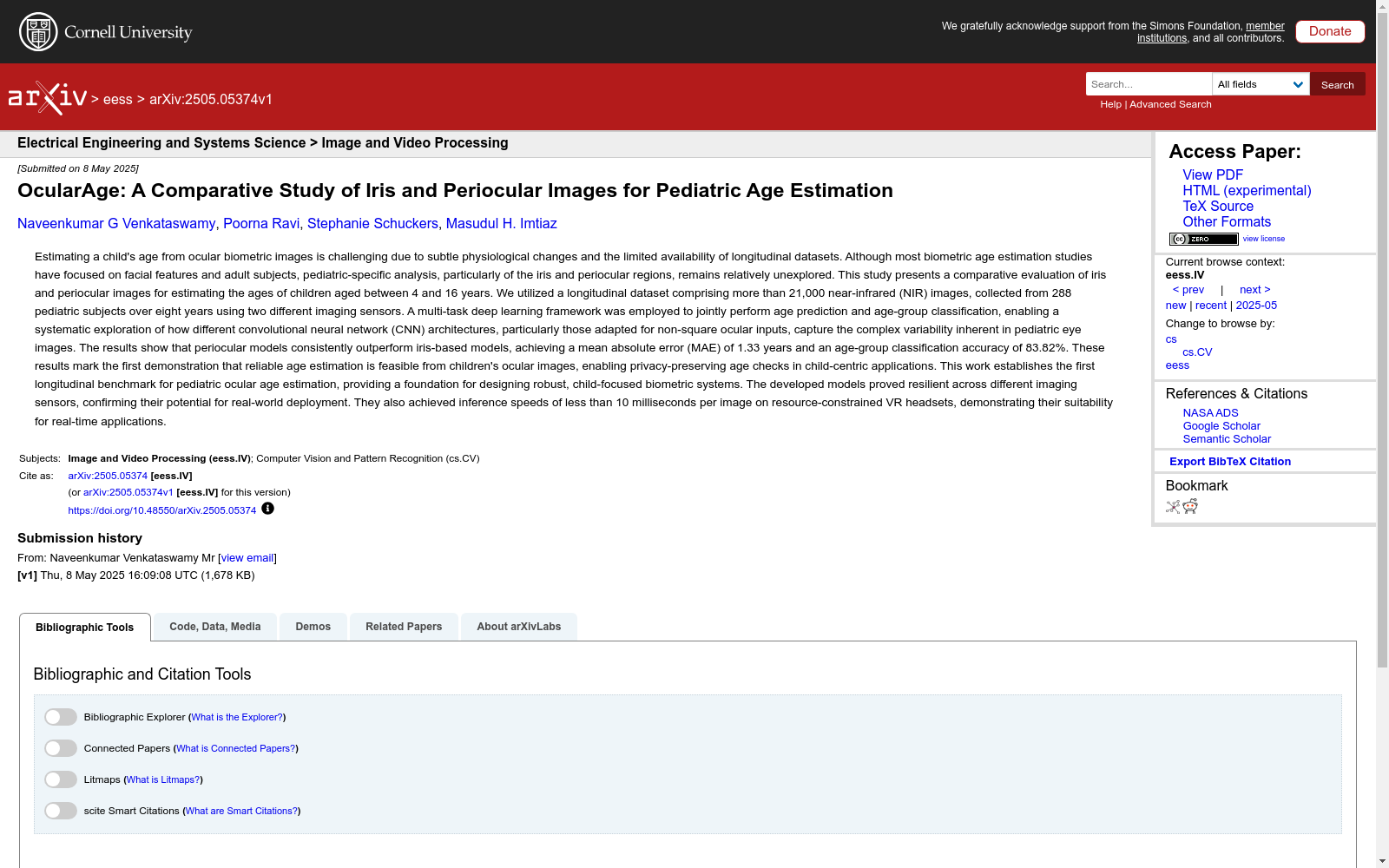
- 1OcularAge: A Comparative Study of Iris and Periocular Images for Pediatric Age Estimation克拉克森大学 · 2025年


