
15-Scene
收藏阿里云天池2026-05-15 更新2024-05-21 收录
下载链接:
https://tianchi.aliyun.com/dataset/176860
下载链接
链接失效反馈官方服务:
资源简介:
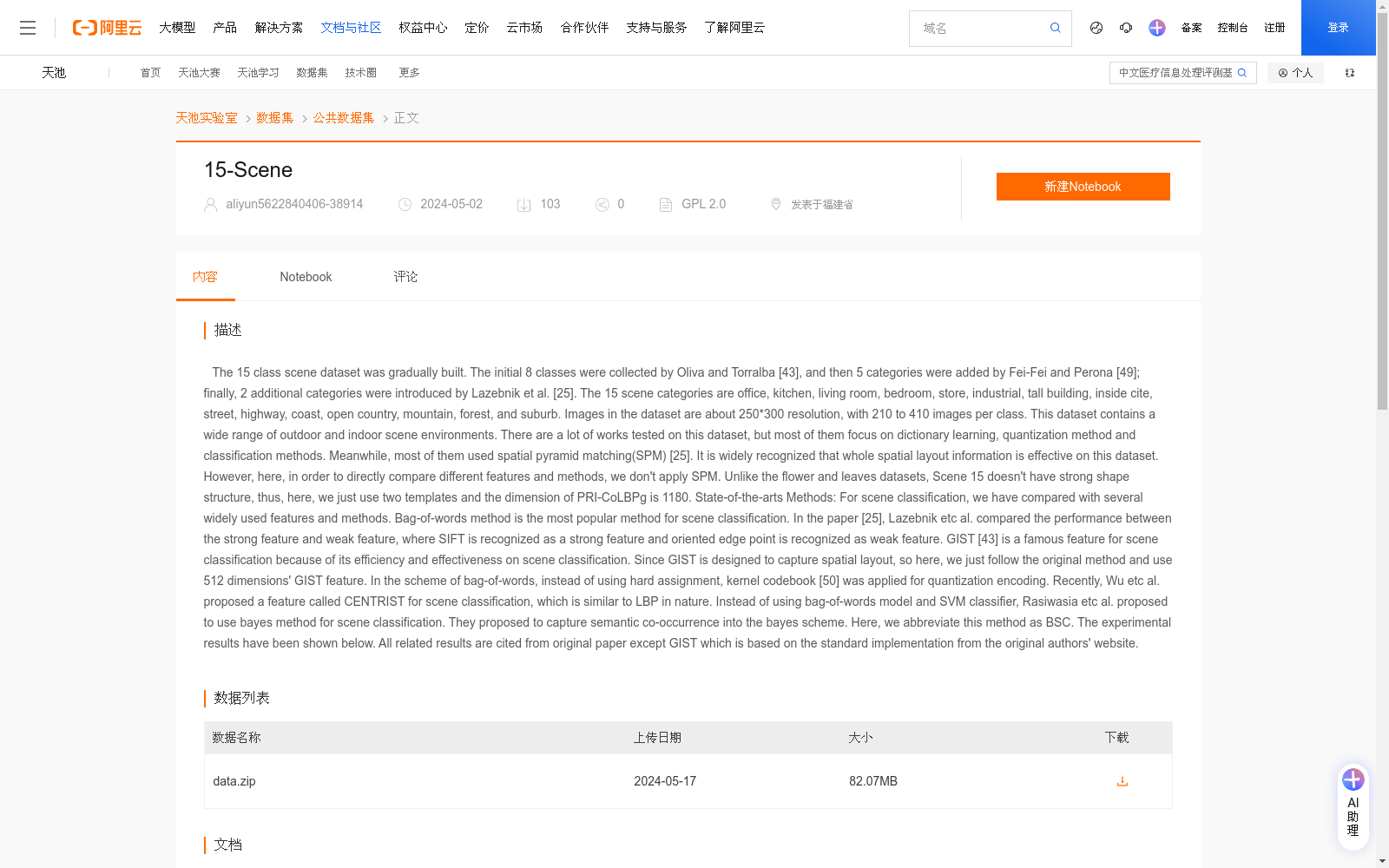
The 15 class scene dataset was gradually built. The initial 8 classes were collected by Oliva and Torralba [43], and then 5 categories were added by Fei-Fei and Perona [49]; finally, 2 additional categories were introduced by Lazebnik et al. [25]. The 15 scene categories are office, kitchen, living room, bedroom, store, industrial, tall building, inside cite, street, highway, coast, open country, mountain, forest, and suburb. Images in the dataset are about 250*300 resolution, with 210 to 410 images per class. This dataset contains a wide range of outdoor and indoor scene environments.
There are a lot of works tested on this dataset, but most of them focus on dictionary learning, quantization method and classification methods. Meanwhile, most of them used spatial pyramid matching(SPM) [25]. It is widely recognized that whole spatial layout information is effective on this dataset. However, here, in order to directly compare different features and methods, we don't apply SPM. Unlike the flower and leaves datasets, Scene 15 doesn't have strong shape structure, thus, here, we just use two templates and the dimension of PRI-CoLBPg is 1180.
State-of-the-arts Methods: For scene classification, we have compared with several widely used features and methods. Bag-of-words method is the most popular method for scene classification. In the paper [25], Lazebnik etc al. compared the performance between the strong feature and weak feature, where SIFT is recognized as a strong feature and oriented edge point is recognized as weak feature. GIST [43] is a famous feature for scene classification because of its efficiency and effectiveness on scene classification. Since GIST is designed to capture spatial layout, so here, we just follow the original method and use 512 dimensions' GIST feature. In the scheme of bag-of-words, instead of using hard assignment, kernel codebook [50] was applied for quantization encoding. Recently, Wu etc al. proposed a feature called CENTRIST for scene classification, which is similar to LBP in nature. Instead of using bag-of-words model and SVM classifier, Rasiwasia etc al. proposed to use bayes method for scene classification. They proposed to capture semantic co-occurrence into the bayes scheme. Here, we abbreviate this method as BSC. The experimental results have been shown below. All related results are cited from original paper except GIST which is based on the standard implementation from the original authors' website.
本15类场景数据集为逐步构建所得。最初的8个类别由Oliva与Torralba[43]采集,随后Fei-Fei与Perona[49]补充了5个类别,最终Lazebnik等人[25]又新增了2个类别。该15个场景类别分别为办公室、厨房、客厅、卧室、商店、工业场景、高层建筑、城市内部、街道、高速公路、海岸、开阔乡村、山地、森林以及郊区。数据集内图像分辨率约为250×300,每类别包含210至410张图像。本数据集涵盖了丰富多样的室内外场景环境。
已有大量研究在该数据集上开展测试,其中多数工作聚焦于字典学习、量化方法与分类算法,且大多采用了空间金字塔匹配(Spatial Pyramid Matching, SPM)[25]方法。学界普遍认为完整空间布局信息在该数据集上具有良好效果,但为了直接对比不同特征与算法,本文未采用SPM方法。与花卉、叶片数据集不同,Scene 15数据集并不具备显著的形状结构,因此本文仅采用2个模板,且PRI-CoLBPg特征的维度为1180。
主流方法:针对场景分类任务,本文对比了多种常用特征与算法。词袋(Bag-of-words)模型是场景分类中最常用的方法。在文献[25]中,Lazebnik等人对比了强特征与弱特征的性能表现,其中尺度不变特征变换(SIFT)被视为强特征,方向边缘点则被视为弱特征。GIST[43]是场景分类领域知名的特征,因其在场景分类任务中兼具高效性与有效性而被广泛应用。由于GIST特征旨在捕捉空间布局信息,因此本文沿用原始实现方式,采用512维的GIST特征。在词袋模型框架下,本文未采用硬分配方式,而是使用核字典(kernel codebook)[50]进行量化编码。近期,Wu等人提出了一种用于场景分类的CENTRIST特征,其本质与局部二值模式(LBP)相似。与词袋模型结合支持向量机(SVM)分类器的方案不同,Rasiwasia等人提出了基于贝叶斯方法的场景分类方案,该方案旨在将语义共现信息融入贝叶斯框架中,本文将此方法简称为BSC。实验结果如下所示。除GIST特征采用原作者官方网站提供的标准实现外,其余所有相关结果均引自原始文献。
提供机构:
阿里云天池
创建时间:
2024-05-02
搜集汇总
数据集介绍
背景与挑战
背景概述
15-Scene是一个经典的计算机视觉图像数据集,包含15个室内外场景类别(如办公室、厨房、街道、森林等),每类有210至410张分辨率约为250*300的图像。该数据集广泛用于场景分类研究,常作为测试基准用于评估字典学习、量化方法和分类算法,并常结合空间金字塔匹配(SPM)等技术以提升性能。
以上内容由遇见数据集搜集并总结生成



