
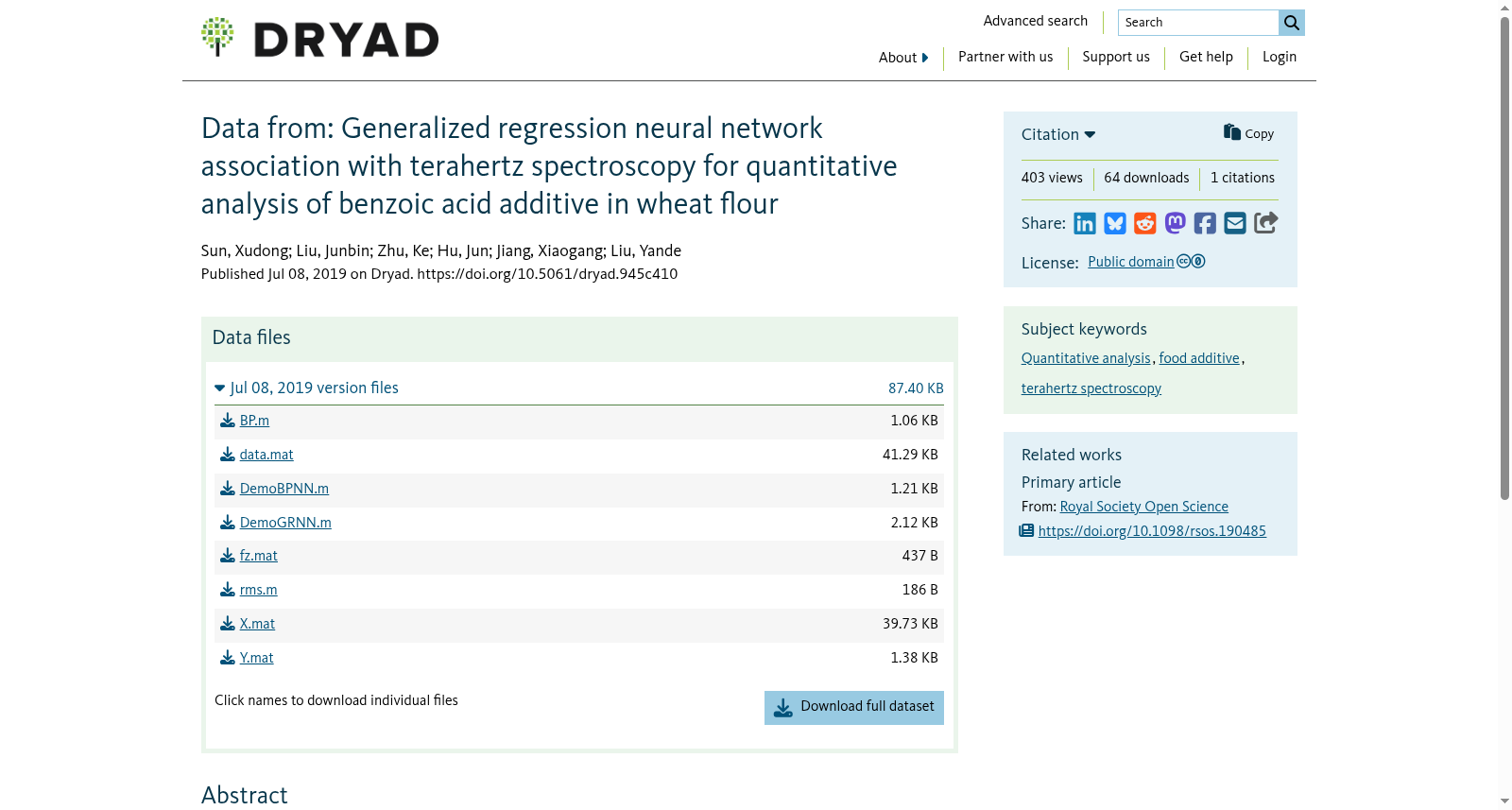
Data from: Generalized regression neural network association with terahertz spectroscopy for quantitative analysis of benzoic acid additive in wheat flour
收藏DataCite Commons2025-05-01 更新2025-04-09 收录
下载链接:
https://datadryad.org/dataset/doi:10.5061/dryad.945c410
下载链接
链接失效反馈官方服务:
资源简介:
Investigations were initiated to develop terahertz (THz) techniques
associated with machine learning methods of generalized neural network
(GRNN) and back propagation neural network (BPNN) to rapid measure benzoic
acid (BA) content in wheat flour. The absorption coefficient exhibited a
maximum absorption peak at 1.94THz, which generally increased with the
content of BA additive. THz spectra were transformed into orthogonal
principal component analysis (PCA) scores as the input vectors of GRNN and
BPNN models. The best GRNN model was achieved with 3 PCA scores and spread
value of 0.2. Compared with BPNN model, GRNN model to powder samples could
be considered very successful for quality control of wheat flour with a
correlation coefficient of prediction (rp) of 0.85 and root mean square
error of prediction (RMSEP) of 0.10%. The results suggest that THz
technique association with GRNN has significant potential to
quantitatively analyze BA additive in wheat flour.
本研究开展相关探索,旨在开发结合广义神经网络(GRNN)与反向传播神经网络(BPNN)两类机器学习方法的太赫兹(THz)检测技术,以实现小麦粉中苯甲酸(BA)含量的快速测定。样品的吸收系数在1.94THz处存在最大吸收峰,且该值随苯甲酸添加剂添加量的提升总体呈上升趋势。将采集得到的THz光谱转换为正交主成分分析(PCA)得分,作为GRNN与BPNN模型的输入向量。最终得到的最优GRNN模型采用3个PCA得分作为输入,其扩展参数设为0.2。相较于BPNN模型,用于粉末样品检测的GRNN模型在小麦粉质量控制中表现极佳,其预测相关系数(rp)达0.85,预测均方根误差(RMSEP)为0.10%。上述结果表明,结合GRNN的THz检测技术在定量分析小麦粉中的苯甲酸添加剂方面具备显著应用潜力。
提供机构:
Dryad
创建时间:
2019-07-08
搜集汇总
数据集介绍
背景与挑战
背景概述
该数据集包含用于定量分析小麦粉中苯甲酸添加剂的太赫兹光谱数据和相关机器学习代码。数据包括太赫兹吸收系数、苯甲酸含量、频率信息以及广义回归神经网络和反向传播神经网络的实现程序。研究展示了太赫兹技术结合GRNN模型在小麦粉质量控制中的潜力,预测性能优异。
以上内容由遇见数据集搜集并总结生成


