
Data for Small RNA SmsR1 modulates acidogenicity and cariogenic virulence by affecting protein acetylation in <i>Streptococcus mutans.</i>
收藏DataCite Commons2025-04-01 更新2024-08-19 收录
下载链接:
https://figshare.com/articles/dataset/_Data_for_Small_RNA_SmsR1_modulates_acidogenicity_and_cariogenic_virulence_by_affecting_protein_acetylation_in_i_Streptococcus_mutans_i_/25486303/1
下载链接
链接失效反馈官方服务:
资源简介:
Post-transcriptional regulation by small RNAs and post-translational modifications (PTM) such as lysine acetylation play fundamental roles in physiological circuits, offering rapid responses to environmental signals with low energy consumption. Yet, the interplay between these regulatory systems remains underexplored. Here, we unveil the cross-talk between sRNAs and lysine acetylation in <i>Streptococcus mutans</i>, a primary cariogenic pathogen known for its potent acidogenic virulence. Through systematic overexpression of sRNAs in <i>S. mutans,</i> we identified sRNA SmsR1 as a critical player in modulating acidogenicity, a key cariogenic virulence feature in <i>S. mutans</i>.<i> </i>Furthermore, combined with the analysis of predicted target mRNA and transcriptome results, potential target genes were identified and experimentally verified. A direct interaction between SmsR1 and 5’-UTR region of <i>pdhC</i> gene was determined by <i>in vitro</i> binding assays. Importantly, we found that overexpression of<i> </i>SmsR1 reduced the expression of <i>pdhC</i> mRNA and increased the intracellular concentration of acetyl-CoA, resulting in global changes in protein acetylation levels. This was verified by acetyl-proteomics<b> </b>in<i> S. mutans</i>, along with an increase in acetylation level and decreased activity of LDH. Our study unravels a novel regulatory paradigm where sRNA bridges post-transcriptional regulation with post-translational modification, underscoring bacterial adeptness in fine-tuning responses to environmental stress.
小RNA(small RNAs)介导的转录后调控与赖氨酸乙酰化等翻译后修饰(PTM)在生理通路中发挥核心作用,能够以低能耗快速响应环境信号。然而,这两类调控系统之间的互作仍有待深入探索。本研究聚焦变形链球菌(Streptococcus mutans)——一种以强产酸毒力著称的主要致龋病原菌——揭秘了其小RNA与赖氨酸乙酰化之间的串扰机制。通过对变形链球菌的小RNA进行系统性过表达筛选,我们鉴定出小RNA SmsR1是调控产酸性的关键因子,而产酸性是变形链球菌重要的致龋毒力特征。进一步结合预测靶标mRNA与转录组分析结果,我们筛选得到潜在靶基因并开展实验验证。通过体外(in vitro)结合实验,证实SmsR1可直接结合pdhC基因的5'-UTR区域。值得注意的是,我们发现过表达SmsR1会下调pdhC mRNA的表达,并提升细胞内乙酰辅酶A的浓度,进而导致蛋白质乙酰化水平的全局改变。这一发现通过变形链球菌的乙酰化蛋白质组学(acetyl-proteomics)实验得到验证,同时伴随乳酸脱氢酶(LDH)乙酰化水平升高与酶活性降低。本研究揭示了一种全新的调控范式:小RNA作为桥梁,连接转录后调控与翻译后修饰,凸显了细菌能够精准微调以响应环境胁迫的适应性能力。
提供机构:
figshare创建时间:
2024-03-27
搜集汇总
数据集介绍
背景与挑战
背景概述
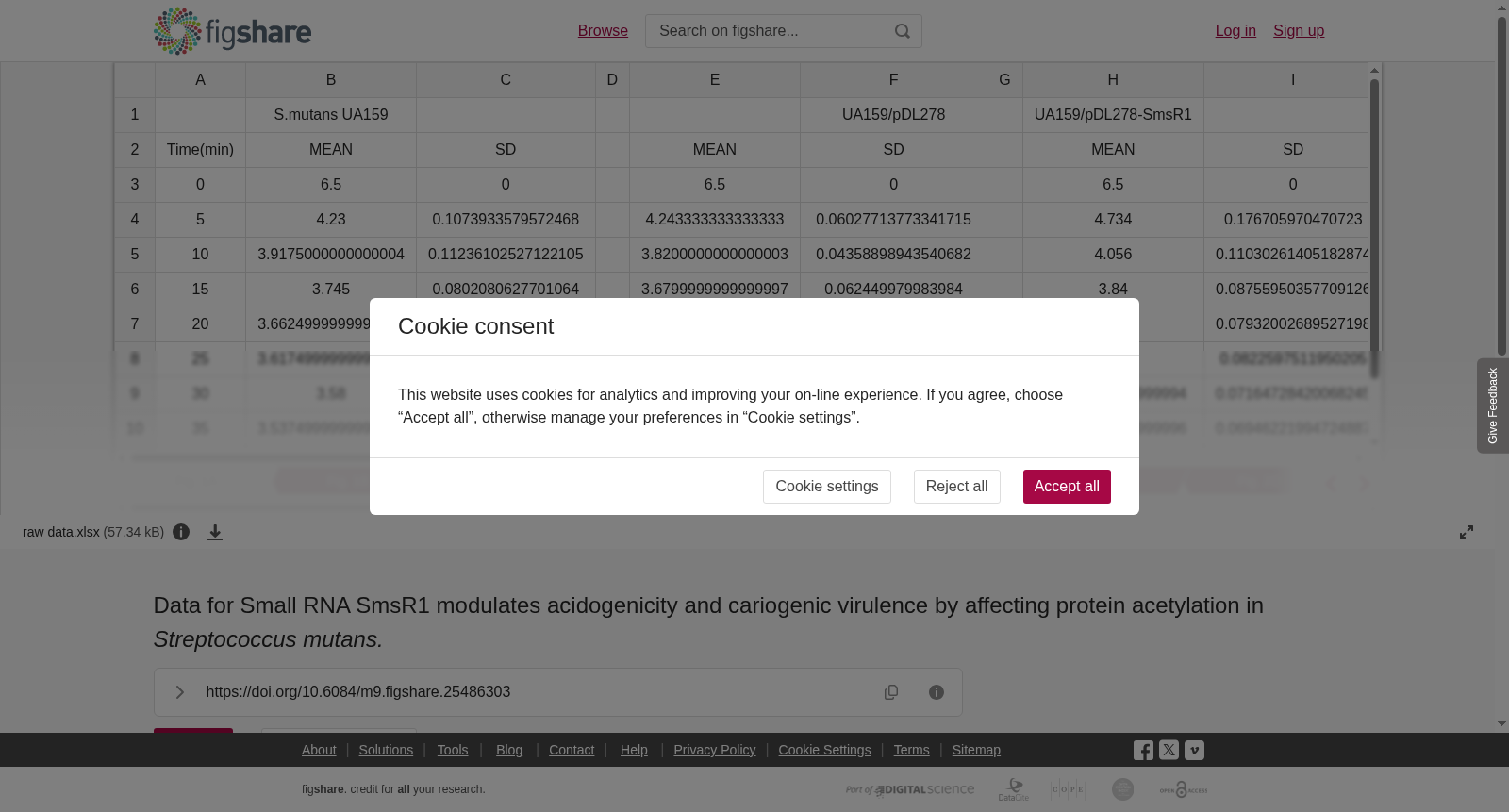
该数据集提供了关于变形链球菌中小RNA SmsR1调控机制研究的原始数据,重点揭示了SmsR1通过影响pdhC基因表达和蛋白质乙酰化水平来调节细菌产酸性与致龋毒力的分子途径。数据支持了sRNA在连接转录后调控与翻译后修饰中的新型作用模式,属于细菌学领域的基础研究。
以上内容由遇见数据集搜集并总结生成


