
1 + 1 > 2? The synergistic effect of carbon emissions reduction policies: empirical evidence from China
收藏DataCite Commons2025-06-28 更新2024-11-06 收录
下载链接:
https://tandf.figshare.com/articles/dataset/1_1_2_The_synergistic_effect_of_carbon_emissions_reduction_policies_empirical_evidence_from_China/27606134/1
下载链接
链接失效反馈官方服务:
资源简介:
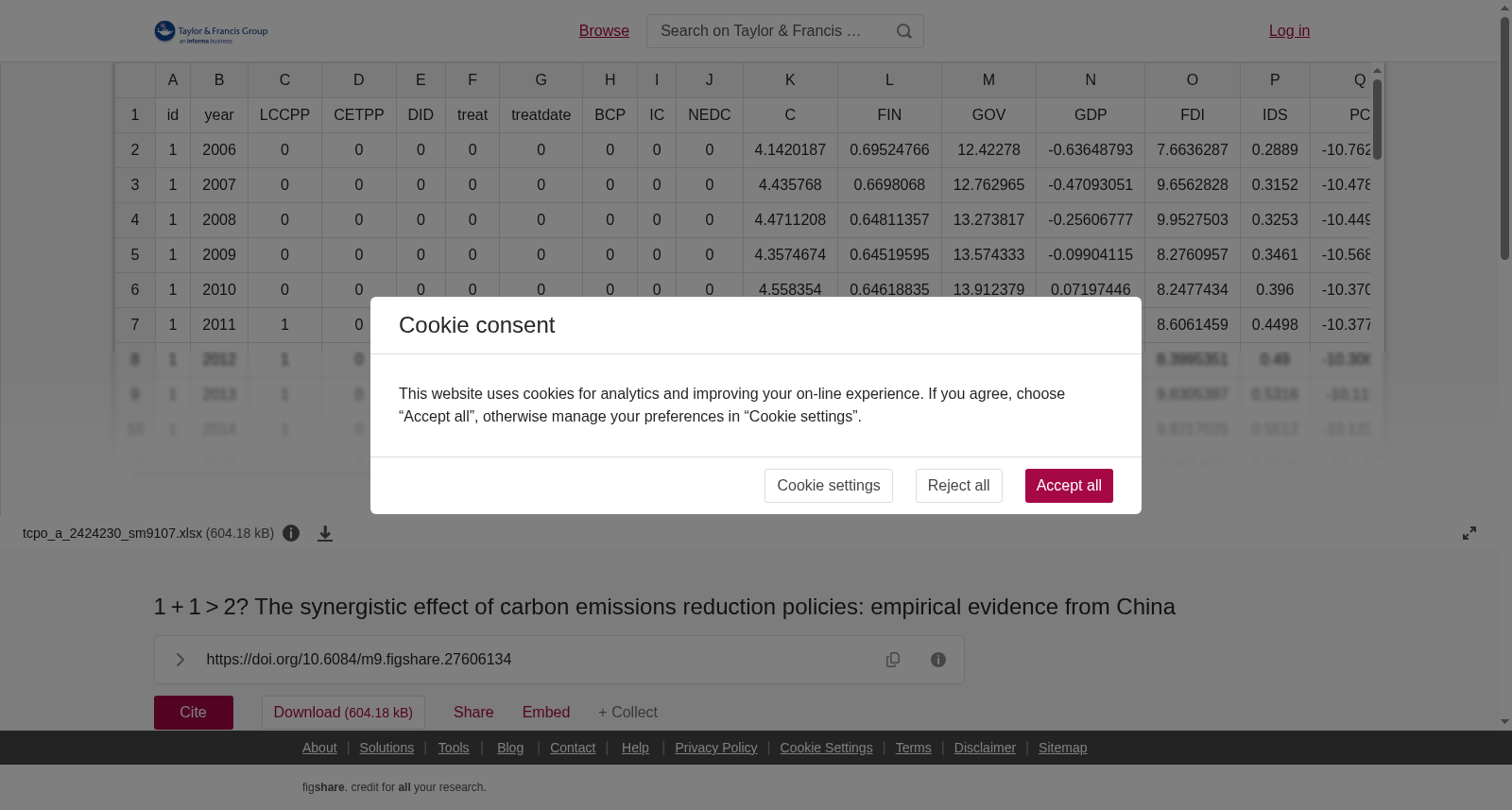
The low-carbon city pilot policy (LCCPP) and the carbon emissions trading pilot policy (CETPP) are important measures for China to reduce its carbon emissions. However, the existing literature typically focuses narrowly on the effect of a single policy tool, leaving it unclear whether the LCCPP and CETPP are in conflict or complementary. Therefore, we investigated the synergistic effect of the LCCPP and CETPP in China using the difference-in-differences (DID) method. Compared with the 5.4% reduction of the LCCPP and the 5.1% reduction of the CETPP, the dual pilot policy (DPP) can improve the carbon emissions reduction effect to 11.9%. However, the effect of the DPP takes time to become apparent owing to a policy lag. The DPP primarily achieves its effect by promoting technological progress and optimizing energy allocation. In addition, the carbon emissions reduction effect of the DPP is more evident in large, high-ranking, and resource-based cities. Our work can help policymakers fully consider the coordination between future climate policies and design reasonable mixed policy tools. Reducing carbon emissions requires collaborative efforts between the LCCPP and CETPP. Thus, the Chinese government should strengthen the synergy between these two policies to avoid policy crossover, repetition, and conflict.The Chinese government should clarify the policy objectives of the LCCPP and CETPP, enhance the link between the market and the government, and effectively reduce carbon emissions through government support and market screening.The coverage of the LCCPP and CETPP should be expanded and effective policy operation mechanisms and regulatory systems should be established.Large cities should establish more low-carbon funds to promote the implementation of the LCCPP and CETPP. High-ranking cities should leverage commercial resources to design more low-carbon application scenarios. Resource-based cities should view the LCCPP and CETPP as crucial for industrial transformation and seek new economic growth pathways based on low-carbon development principles. Reducing carbon emissions requires collaborative efforts between the LCCPP and CETPP. Thus, the Chinese government should strengthen the synergy between these two policies to avoid policy crossover, repetition, and conflict. The Chinese government should clarify the policy objectives of the LCCPP and CETPP, enhance the link between the market and the government, and effectively reduce carbon emissions through government support and market screening. The coverage of the LCCPP and CETPP should be expanded and effective policy operation mechanisms and regulatory systems should be established. Large cities should establish more low-carbon funds to promote the implementation of the LCCPP and CETPP. High-ranking cities should leverage commercial resources to design more low-carbon application scenarios. Resource-based cities should view the LCCPP and CETPP as crucial for industrial transformation and seek new economic growth pathways based on low-carbon development principles.
低碳城市试点政策(LCCPP)与碳排放权交易试点政策(CETPP)是中国推进碳减排的重要举措。然而,现有研究大多仅聚焦于单一政策工具的减排效应,尚未明确LCCPP与CETPP之间是存在冲突还是互补关系。有鉴于此,本文采用双重差分法(Difference-in-Differences, DID)对中国LCCPP与CETPP的协同减排效应展开研究。相较于LCCPP单独实施时5.4%的减排幅度与CETPP单独实施时5.1%的减排幅度,双重试点政策(Dual Pilot Policy, DPP)可将碳减排效应提升至11.9%。但由于政策时滞效应,DPP的减排效果需要一定时间方能显现。DPP主要通过推动技术进步与优化能源配置来实现减排目标。此外,DPP的碳减排效应在大型城市、高行政级别城市以及资源型城市中更为显著。
本研究可为政策制定者充分考量未来气候政策间的协同配合、设计合理的组合型政策工具提供参考。碳减排工作需要LCCPP与CETPP的协同发力。因此,中国政府应强化两项政策间的协同性,避免政策交叉、重复与冲突。中国政府应明确LCCPP与CETPP的政策目标,强化市场与政府间的联动机制,通过政府扶持与市场筛选有效推进碳减排工作。应扩大LCCPP与CETPP的政策覆盖范围,建立健全有效的政策运行机制与监管体系。大型城市应设立更多低碳基金,以推动LCCPP与CETPP的落地实施。高行政级别城市应依托商业资源打造更多低碳应用场景。资源型城市应将LCCPP与CETPP视为产业转型的关键抓手,依托低碳发展理念探寻新的经济增长路径。
碳减排工作需要LCCPP与CETPP的协同发力。因此,中国政府应强化两项政策间的协同性,避免政策交叉、重复与冲突。中国政府应明确LCCPP与CETPP的政策目标,强化市场与政府间的联动机制,通过政府扶持与市场筛选有效推进碳减排工作。应扩大LCCPP与CETPP的政策覆盖范围,建立健全有效的政策运行机制与监管体系。大型城市应设立更多低碳基金,以推动LCCPP与CETPP的落地实施。高行政级别城市应依托商业资源打造更多低碳应用场景。资源型城市应将LCCPP与CETPP视为产业转型的关键抓手,依托低碳发展理念探寻新的经济增长路径。
提供机构:
Taylor & Francis
创建时间:
2024-11-04
搜集汇总
数据集介绍
以上内容由遇见数据集搜集并总结生成


