
Leeds Global Skin Archive (LeGSA): a multicultural human skin phenotype and colour spectra collection
收藏DataCite Commons2025-04-01 更新2025-05-07 收录
下载链接:
https://figshare.com/articles/dataset/The_Leeds_Skin_Database_-_LSDB/28228571/2
下载链接
链接失效反馈官方服务:
资源简介:
<b>Introduction</b>The Leeds Global Skin Archive (LeGSA) offers a detailed collection of spectral and colorimetric data for human skin, encompassing 15,256 records from 2,113 subjects. This data spans from 2012 to 2024 and originates from eleven datasets curated by international laboratories in eight countries: the UK, Spain, China, Japan, Pakistan, Thailand, Iraq, and Saudi Arabia. Each dataset follows a standardised measurement protocol to maintain data consistency.In the LeGSA, individual records provide extensive details including record number, data origin, subject identification, and skin type—categorised by ethnicity, gender, age, and body location. The dataset also includes detailed information on the measurement instruments used, such as type, specular component inclusion, wavelength range and interval.Alongside spectral data, each sample also contains CIE colorimetric data, including tristimulus values, xy chromaticity coordinates, CIELAB parameters, etc., based on the CIE 1931 standard colorimetric observer and the CIE standard illuminant D65.<b>Data Records</b>The dataset is organised into two primary spreadsheets: a coding scheme and a datasheet. The datasheet arranges data across columns labelled A to BQ:A: Unique record identifierB: Data origin (linked to an origin table in the coding scheme)C: Subject numberD to G: Ethnicity, gender, age group, and body location (each linked to respective reference tables in the coding scheme)H to L: Instrument details including type and spectral measurement specificsN to BD: Spectral data from 360 nm to 780 nmBF to BQ: CIE colorimetric dataThis structured format ensures that users can easily access and interpret data for diverse research applications.<b>Measurement Protocol</b>The nationality or ethnicity, gender, age, and body location of the subject are important and depend on the requirements of the specific study that needs the measurement of human skin colour. Thus, this information for each participant was first determined through self-evaluation via a questionnaire. In regions with homogeneous populations (e.g., China, Thailand, Japan), all participants belonged to the same ethnic group. In regions with mixed populations (e.g., the UK), participants were provided with a questionnaire that included options for existing ethnicities, mixed ethnicity, and “other” (self-defined). This information was recorded using consistent coding schemes in the dataset (see Data Records).To ensure the integrity and consistency of all skin spectral reflectance measurements in this study, several standardised conditions were rigorously maintained. First, it was essential for the skin of all subjects to be clean, unabraded, and free from any cosmetics, lotions, or medical products that could affect the measurement outcomes. Each subject was prepared accordingly prior to data collection to meet this standard. Additionally, the measurement instruments (portable spectrophotometer - SP) were calibrated according to manufacturer guidelines before each session. Lighting conditions for measurements were carefully controlled; all measurements were conducted under diffuse lighting conditions to avoid discrepancies associated with collimated light sources. This was facilitated by lighting systems integrated within the measurement instruments (SP). Such controlled environments guaranteed that the spectral data collected was accurate and consistent across all subjects and datasets.During the measurement, the portable spectrophotometer was brought to the subject, ensuring the sample area had no blemishes (e.g. hair, freckles, etc.) and had not been subjected to recent pressure (e.g. to promote blood flow). Areas with visible hair (e.g., the chin of male participants with beards) were avoided during measurements to ensure that only clear skin areas were included in the dataset. When using a spectrophotometer, care was taken to ensure the instrument was gently in contact with the area of skin to be measured, to prevent extraneous light from reaching the detector (see Figure 1b). It was also necessary to be careful that no excessive pressure was applied to the skin when contacting the device, which might lead to a change in its colour due to the promotion of blood flow beneath the surface. Measurement parameters mentioned in the last section, such as the geometry of illumination and the inclusion of the specular component, must be checked before measurement. Measurements were taken at 4-10 different body locations depending on the site, with the forehead, cheek, and back of the hand covered by all sites. For consistency, measurements were taken from one randomly selected side (left or right) of each subject. Laterality was generally not recorded, except for Datasets 7 and 8, which included bilateral cheek measurements. After completing the measurements, we reviewed the data and excluded any measurements with zero reflectance (e.g., due to instrument error) or any participant data with colour difference greater than 15 ∆E_ab^* between positions. All measurement data were then carefully recorded and reported in accordance with the predefined coding schemes. This protocol not only supports the reliability of our measurements but also enhances the comparability of our data across various locations and time periods.<b>Citing the Database</b>Any use of the LSDB should cite the following reference: Lu, Yan; Xiao, Kaida; Pointer, Michael; He, Ruili; Zhou, Sicong; Nasseraldin, Ahmed; et al. (2025). Leeds Global Skin Archive (LeGSA): a multicultural human skin phenotype and colour spectra collection. figshare. Dataset. https://doi.org/10.6084/m9.figshare.28228571.v2<b>Contact the Author</b>Support and Contact Information: For technical support or queries related to the database, please contact Prof. Kaida Xiao (k.xiao1@leeds.ac.uk) and Dr Yan Lu (y.lu3@leeds.ac.uk).<br>
引言
利兹全球皮肤档案库(Leeds Global Skin Archive,LeGSA)收录了详尽的人类皮肤光谱与比色数据,涵盖来自2113名受试者的15256条记录。该数据集的时间跨度为2012年至2024年,数据源自8个国家(英国、西班牙、中国、日本、巴基斯坦、泰国、伊拉克、沙特阿拉伯)的国际实验室所整理的11个数据集。所有数据集均遵循标准化测量规程,以保障数据一致性。
在LeGSA中,单条记录包含丰富详细信息,包括记录编号、数据来源、受试者标识以及按种族、性别、年龄和身体部位分类的皮肤类型。数据集还收录了所用测量仪器的详细信息,包括仪器类型、是否包含镜面反射分量、波长范围与间隔。
除光谱数据外,每条样本还包含基于国际照明委员会(CIE,International Commission on Illumination)1931标准色度观察者与CIE标准照明体D65的比色数据,包括三刺激值、xy色度坐标、CIELAB参数等。
数据记录
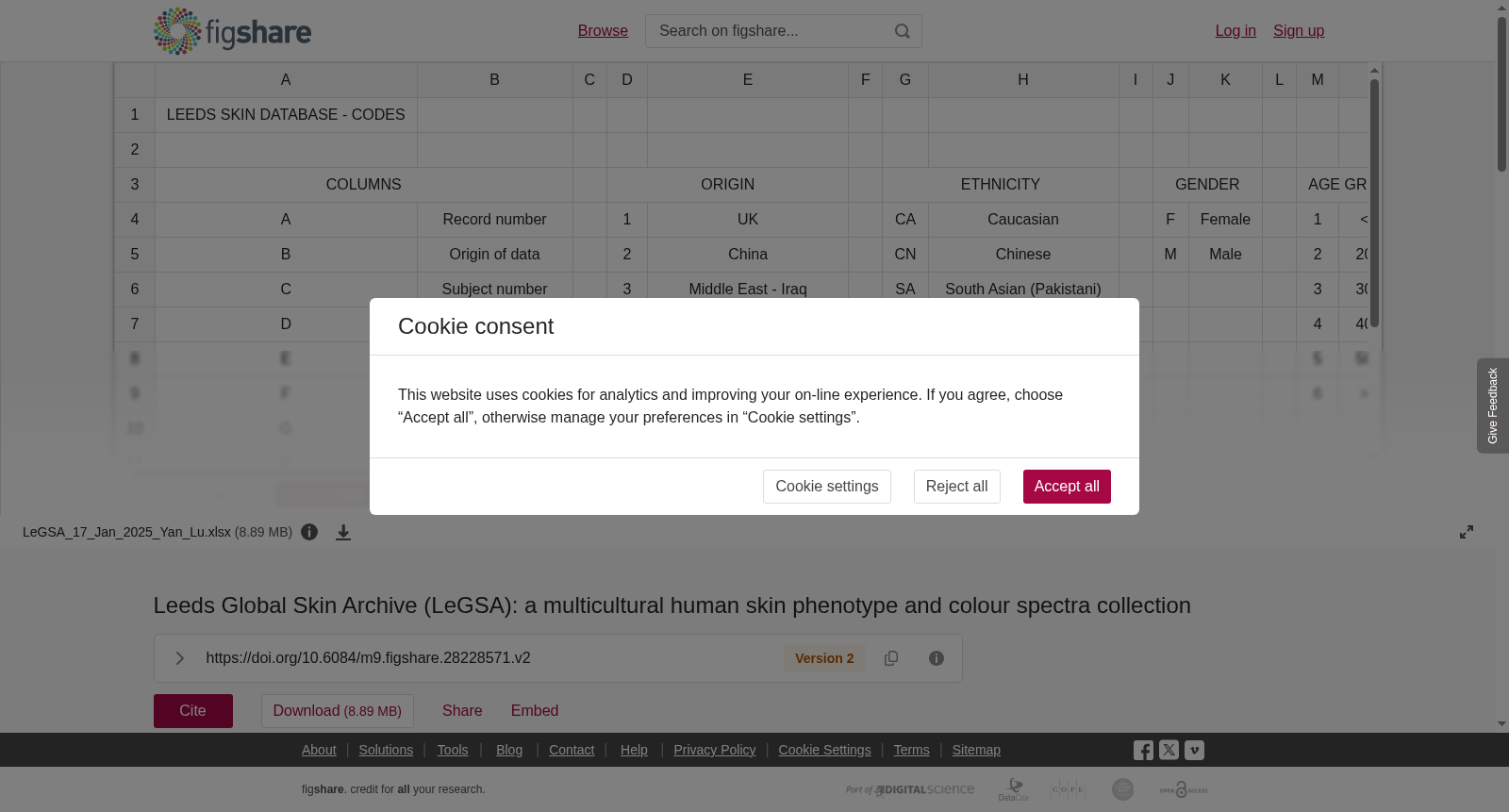
本数据集分为两个主要电子表格:编码方案表与数据表。数据表的列从A至BQ依次排布:
A列:唯一记录标识符
B列:数据来源(与编码方案表中的来源表关联)
C列:受试者编号
D至G列:种族、性别、年龄组与身体部位(每一项均与编码方案表中的对应参考表关联)
H至L列:仪器详情,包括仪器类型与光谱测量细节
N至BD列:360 nm至780 nm区间的光谱数据
BF至BQ列:CIE比色数据
该结构化格式可帮助用户轻松获取并解读数据,适用于各类研究场景。
测量规程
受试者的国籍/种族、性别、年龄与身体部位均为关键信息,其选取需依据人体皮肤颜色测量相关特定研究的需求。因此,所有受试者的上述信息首先通过问卷自评的方式确定。在人口同质性较高的地区(如中国、泰国、日本),所有受试者均属于同一族群;在人口构成多元的地区(如英国),受试者填写的问卷包含现有种族、混血种族以及“其他(自行定义)”的选项。该类信息将通过数据集内统一的编码方案进行记录(详见“数据记录”章节)。
为保障本研究中所有皮肤光谱反射率测量的完整性与一致性,研究团队严格遵循多项标准化条件。首先,所有受试者的皮肤需保持清洁、无擦伤,且未涂抹任何可能影响测量结果的化妆品、护肤品或医用产品;在数据采集前,所有受试者均需按照该标准完成皮肤准备。此外,测量仪器(便携式分光光度计SP)需在每次测量前按照厂商指南完成校准。测量的光照条件需严格管控:所有测量均在漫射光照条件下进行,以避免平行光源带来的测量偏差,测量仪器(SP)内置的光照系统可保障该条件的实现。此类受控环境可确保采集到的光谱数据在所有受试者与数据集之间均具备准确性与一致性。
测量过程中,需将便携式分光光度计移至受试者皮肤部位,确保待测区域无瑕疵(如毛发、雀斑等)且未受近期按压(如为促进血液循环的按压);需避开带有明显毛发的区域(如留胡须男性的下巴部位),以确保数据集仅包含清晰的皮肤区域。使用分光光度计时,需确保仪器与待测皮肤区域轻柔接触,以避免外界光线进入检测器(详见图1b);同时需注意,接触仪器时不可对皮肤施加过大压力,否则可能因皮肤表层下血液循环加快而导致肤色改变。测量前需核查前文提及的测量参数,如照明几何构型与是否包含镜面反射分量。
根据测量部位的不同,需在4至10个不同身体部位进行测量,其中前额、脸颊与手背为所有测量均覆盖的部位。为保障一致性,所有测量均选取受试者身体的单侧(左侧或右侧,随机选择)进行;通常无需记录左右侧信息,但数据集7与8除外,这两个数据集包含双侧脸颊的测量数据。测量完成后,研究团队将对数据进行审核,剔除所有反射率为零的测量结果(如因仪器故障导致),以及不同部位间色差值超过15 ΔE_ab^*的受试者数据。随后,所有测量数据将按照预先定义的编码方案进行细致记录与上报。该规程不仅保障了测量结果的可靠性,还提升了不同地域与时间跨度下数据的可比性。
数据库引用
使用本数据库需引用以下参考文献:Lu, Yan; Xiao, Kaida; Pointer, Michael; He, Ruili; Zhou, Sicong; Nasseraldin, Ahmed; 等. (2025). 利兹全球皮肤档案库(LeGSA):多族群人类皮肤表型与颜色光谱数据集. figshare. 数据集. https://doi.org/10.6084/m9.figshare.28228571.v2
作者联系方式
技术支持与联系方式:若需获取数据库相关技术支持或咨询,请联系Kaida Xiao教授(k.xiao1@leeds.ac.uk)与Yan Lu博士(y.lu3@leeds.ac.uk)。
提供机构:
figshare
创建时间:
2025-03-03
搜集汇总
数据集介绍
背景与挑战
背景概述
Leeds Global Skin Archive (LeGSA) 是一个多文化人类皮肤表型和颜色光谱的数据集,包含来自8个国家2,113名受试者的15,256条记录,提供详细的光谱和色度数据,并遵循严格的标准化测量协议。数据集结构清晰,分为编码方案和数据表两部分,便于研究应用。
以上内容由遇见数据集搜集并总结生成


