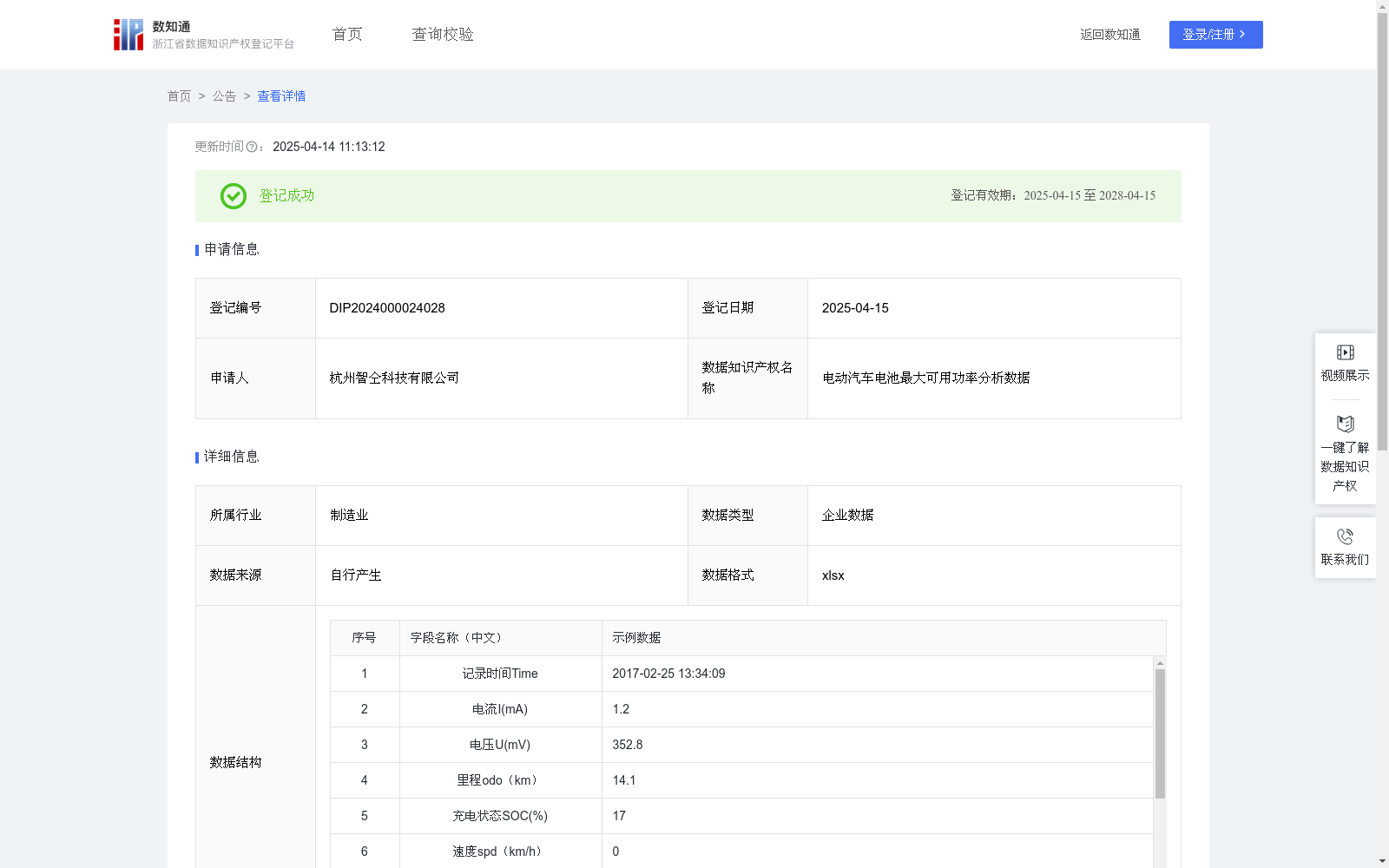
电动汽车电池最大可用功率分析数据
收藏资源简介:
通过对电动汽车动力电池的电流、电压、温度等运行数据的实时采集和分析,计算出动力电池的归一化最大可用功率,该数据可用于以下场景:(1)电池制造商及供应商:用于改进电池管理系统,提高电动汽车的整体性能和安全性,以及生产工艺的提升。(2)车队运营和管理公司:用于车队管理和优化,预测车辆维修需求,优化维护计划,提高车队运营效率和安全性,降低运营成本。(3)二手车评估和交易平台:用于电动汽车电池的残值评估,为买卖双方提供更透明和可靠的电池健康状态信息,进而影响车辆定价。(4)保险公司:用于评估电动汽车保险风险,定制更合理的保险产品,还可以通过监测电池状态减少事故发生率。(5)能源服务公司:用于帮助能源公司优化电动汽车与电网之间的能量互动,实施智能充电策略,以及探索V2G(车辆到电网)技术,提高能源利用效率。(6)研究机构和咨询公司:用于电动汽车相关的技术研究和趋势分析,咨询公司则可以为其客户提供有数据支持的市场分析与预测。(7)政府和监管机构:用于进行政策制定和效果评估,推动新能源汽车产业相关法规和标准的制定。数据采集与清洗:实时采集电动汽车电池电流、电压、温度等运行数据,初步筛选和清洗,剔除异常数据,并将清洗后的数据分为充电阶段和放电阶段。 电导计算:在放电阶段,根据电流和电压数据,利用统计方法,以20分钟为周期,计算电池的等效内阻Ri。通过求Ri的倒数,获得相应的电导值Gi。 温度归一化:通过分析Gi和温度tem的关系,建立温度-电导的函数关系G0=f(tem,Gi)。根据该函数,将电导值折算到标准温度25℃下的电导值G0。 最大功率计算:假设电池电动势为V,内阻为R0,负载电阻为R,负载功率为P=V²R/(R+R0)²。当R=R0时,功率达到最大值,Pmax=V²/4R0。由此,电池最大可用功率与R0成反比,与G0成正比。通过对G0进行归一化处理,得到电池的归一化最大可用功率。 根据以上数据处理,可进行如下应用: (1)电池状态监测:通过分析电池最大可用功率的历史趋势,识别电池性能的变化,监控电池的健康状态,并在电池出现性能下降时发出预警。 (2)风险预警:实时监控电池功率数据,结合历史趋势,及时识别可能的异常情况,为用户提供预警信息,降低安全风险。 (3)残值评估:通过长时间的数据积累与分析,评估电池的剩余价值,为二手市场中的电池交易和回收提供决策依据。 (4)优化能量管理系统:通过对最大可用功率的实时计算和趋势分析,帮助优化电动汽车的能量管理策略,提高能源利用效率。
By real-time collecting and analyzing operating data such as current, voltage, and temperature of the power batteries for electric vehicles (EVs), the normalized maximum available power of the power battery can be calculated. This dataset can be applied to the following scenarios: (1) Battery manufacturers and suppliers: To improve battery management systems (BMS), enhance the overall performance and safety of EVs, and optimize production processes. (2) Fleet operation and management companies: For fleet management and optimization, predicting vehicle maintenance needs, optimizing maintenance plans, improving fleet operation efficiency and safety, and reducing operating costs. (3) Used car evaluation and trading platforms: To assess the residual value of EV batteries, provide more transparent and reliable battery health status information for both buyers and sellers, thereby affecting vehicle pricing. (4) Insurance companies: To evaluate EV insurance risks, customize more reasonable insurance products, and reduce accident rates by monitoring battery status. (5) Energy service companies: To help energy companies optimize energy interaction between EVs and the power grid, implement smart charging strategies, and explore Vehicle-to-Grid (V2G) technology to improve energy utilization efficiency. (6) Research institutions and consulting firms: For technical research and trend analysis related to EVs; consulting firms can provide data-supported market analysis and forecasts for their clients. (7) Governments and regulatory authorities: For policy formulation and effect evaluation, and promoting the formulation of regulations and standards related to the new energy vehicle industry. Data collection and cleaning: Collect real-time operating data of EV batteries such as current, voltage, and temperature, conduct preliminary screening and cleaning, eliminate abnormal data, and divide the cleaned data into charging and discharging phases. Conductance calculation: During the discharging phase, based on current and voltage data, use statistical methods to calculate the equivalent internal resistance Ri of the battery with a 20-minute cycle. Obtain the corresponding conductance value Gi by taking the reciprocal of Ri. Temperature normalization: Analyze the relationship between Gi and temperature tem, establish the temperature-conductance functional relationship G0 = f(tem, Gi). Convert the conductance value to the conductance value G0 at the standard temperature of 25°C based on this function. Maximum power calculation: Assume that the battery electromotive force is V, the internal resistance is R0, the load resistance is R, and the load power is P = V²R/(R+R0)². When R=R0, the power reaches the maximum value Pmax = V²/(4R0). Thus, the maximum available power of the battery is inversely proportional to R0 and directly proportional to G0. Normalize G0 to obtain the normalized maximum available power of the battery. Based on the above data processing, the following applications can be carried out: (1) Battery status monitoring: Analyze the historical trend of the battery's maximum available power, identify changes in battery performance, monitor battery health status, and issue early warnings when battery performance declines. (2) Risk early warning: Monitor real-time battery power data, combine with historical trends, timely identify potential abnormal situations, provide early warning information for users, and reduce safety risks. (3) Residual value assessment: Accumulate and analyze data over a long period to assess the residual value of the battery, providing decision-making basis for battery trading and recycling in the second-hand market. (4) Energy management system optimization: Through real-time calculation and trend analysis of the maximum available power, help optimize the EV energy management strategy and improve energy utilization efficiency.