
Mobility-assisted psuedo-MS3 sequencing of protein ions
收藏DataONE2024-06-26 更新2024-07-06 收录
下载链接:
https://search.dataone.org/view/https://doi.org/10.5061/dryad.mpg4f4r83
下载链接
链接失效反馈官方服务:
资源简介:
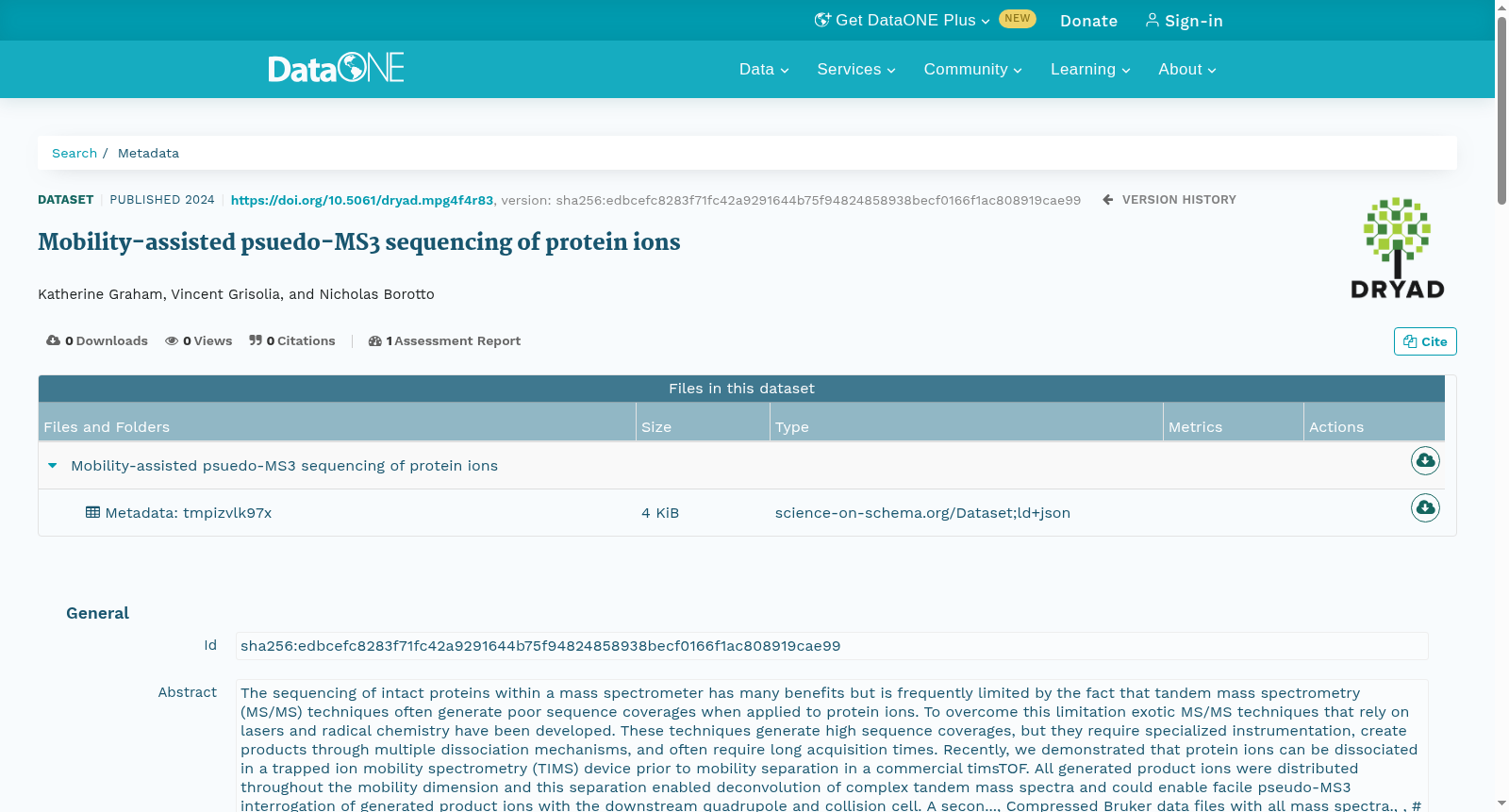
The sequencing of intact proteins within a mass spectrometer has many benefits but is frequently limited by the fact that tandem mass spectrometry (MS/MS) techniques often generate poor sequence coverages when applied to protein ions. To overcome this limitation exotic MS/MS techniques that rely on lasers and radical chemistry have been developed. These techniques generate high sequence coverages, but they require specialized instrumentation, create products through multiple dissociation mechanisms, and often require long acquisition times. Recently, we demonstrated that protein ions can be dissociated in a trapped ion mobility spectrometry (TIMS) device prior to mobility separation in a commercial timsTOF. All generated product ions were distributed throughout the mobility dimension and this separation enabled deconvolution of complex tandem mass spectra and could enable facile pseudo-MS3 interrogation of generated product ions with the downstream quadrupole and collision cell. A secon..., Compressed Bruker data files with all mass spectra., , # Mobility-Assisted Psuedo-MS3 Sequencing of Protein Ions
[https://doi.org/10.5061/dryad.mpg4f4r83](https://doi.org/10.5061/dryad.mpg4f4r83)
In this deposit are the raw Bruker datafiles that were used to generate all figures found within the manuscript with the same title. The protein analyzed and the instrument utilized is explicitly indicated in the title of each data file. We recommend utilizing the software Bruker DataAnalysis to view both mass and mobility spectra, however, any software package capable of analyzing timsTOF data can be employed. The methods section in the accompanying manuscript describe in detail how the instrumental parameters are altered over the time course of the measurement.Â
质谱仪内完整蛋白质的测序具备诸多优势,但常受限于串联质谱(tandem mass spectrometry, MS/MS)技术应用于蛋白质离子时往往难以获得良好的序列覆盖度这一问题。为克服这一局限,研究人员开发了依赖激光与自由基化学的非常规MS/MS技术。这类技术可实现高序列覆盖度,但需要专用仪器,通过多种解离机制生成产物,且通常需要较长的采集时长。近期,我们团队证实,在商用timsTOF设备中,可先在俘获式离子迁移谱(trapped ion mobility spectrometry, TIMS)装置内对蛋白质离子进行解离,再开展迁移分离。所有生成的产物离子均分布于迁移维度中,该分离过程可实现复杂串联质谱的解卷积,还能借助下游四极杆与碰撞池,轻松实现产物离子的伪MS3分析。A secon..., 包含所有质谱数据的压缩布鲁克(Bruker)数据文件。
# 迁移辅助伪MS3蛋白质离子测序
https://doi.org/10.5061/dryad.mpg4f4r83
本存档中包含了用于生成同标题论文中所有图表的原始布鲁克数据文件。每份数据文件的标题均明确标注了所分析的蛋白质与所用仪器。我们推荐使用布鲁克DataAnalysis软件查看质谱与迁移谱,但任何可分析timsTOF数据的软件均可使用。随附论文的方法部分详细描述了在整个测量过程中仪器参数的调整方式。
搜集汇总
数据集介绍
以上内容由遇见数据集搜集并总结生成

暂无相关数据集


