
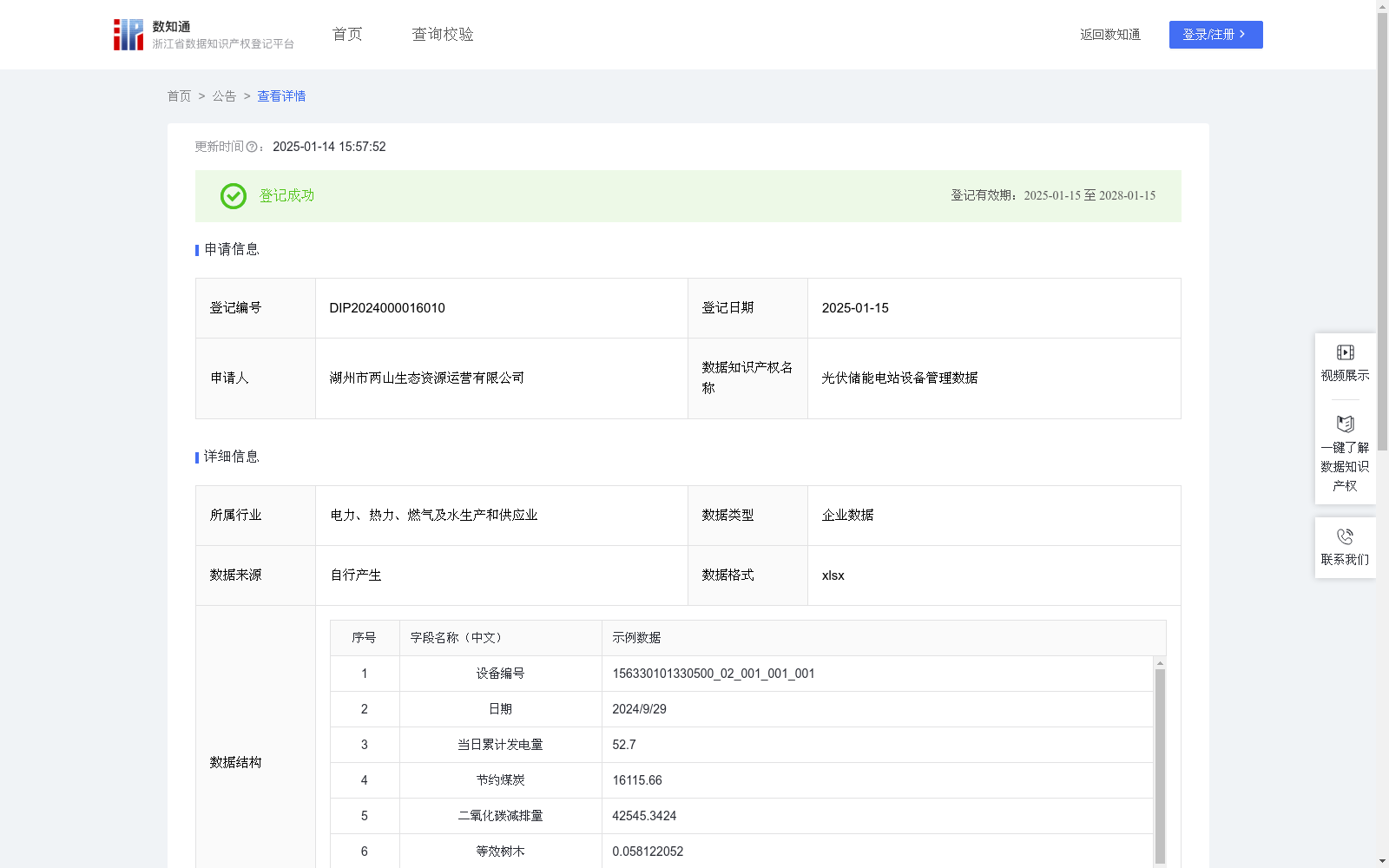
光伏储能电站设备管理数据
收藏浙江省数据知识产权登记平台2025-01-14 更新2025-01-15 收录
下载链接:
https://www.zjip.org.cn/home/announce/trends/111243
下载链接
链接失效反馈官方服务:
资源简介:
基于物联网技术,将光伏储能设备的实时数据通过无线网络传输至综合能源管理平台进行分析挖掘。通过实时计算设备回传数据,分析电站每日发电、减碳减排、预警情况,从而帮助日常规管理单位了解光伏储能电站的各项关键指标,优化管理效率,提高电站收益。1.数据采集:将光伏储能设备采集到的各项感知数据通过设备物联网模块传输至综合能源管理平台;
2.数据清洗:对于一些显著异常的生产数据,采用平均值修正、盖帽法等方式进行修复,确保整体数据可信;
3.数据算法处理与加工:1)由逆变器感知采集数据回传,获得当日累计发电量;2)节约煤炭=当日累计发电量*供电煤耗率,其中供电煤耗率按照国家能源局发布数据305.8g/kwh计算;3)二氧化碳减排量=当日累计发电量*供电煤耗率*每克煤排放二氧化碳量,其中每克煤排放二氧化碳量按照国家发改委发布文件中标准系数2.64计算;4)等效树木=二氧化碳减排量/平均单树每年吸收二氧化碳量*树木平均年龄,其中平均单树每年吸收二氧化碳量及树木平均年龄按行业标准18.3kg/年、40年计算。5)告警等级通过告警算法与告警阈值策略分为1-4等,若某设备当日累计发电量低于该设备前十日当日累计发电量的算数平均值则告警4等;若光伏设备逆电器的功率数据为0或低于当日所有光伏设备逆电器功率的算数平均值50%以上等异常问题则告警3等;若当日光伏储能设备异常离线等问题则告警2等;若光伏储能设备离线超过3日等问题则告警1等。告警次数则由对应告警等级次数加总而成。
4.数据应用:通过各类算法计算出光伏储能电站的发电、减碳减排、预警等数据,帮助管理人员更好掌控电站情况,从而优化管理效率,减少安全隐患,提高电站收益。
Based on Internet of Things (IoT) technology, real-time data from photovoltaic (PV) and energy storage equipment is transmitted to the integrated energy management platform via wireless networks for analysis and data mining. By performing real-time calculations on the data returned by the equipment, the daily power generation, carbon emission reduction, and early warning status of the power station are analyzed, helping daily management units understand various key indicators of the PV and energy storage power station, optimize management efficiency, and increase power station revenue.
1. Data Collection: Various sensing data collected by PV and energy storage equipment are transmitted to the integrated energy management platform via the IoT modules of the devices;
2. Data Cleaning: For some significantly abnormal production data, methods such as average value correction and capping are adopted for repair to ensure the credibility of the overall data;
3. Data Algorithm Processing and Refinement: 1) Obtain the daily cumulative power generation by collecting and returning data sensed by the inverters; 2) Coal Saved = Daily Cumulative Power Generation × Power Supply Coal Consumption Rate, where the power supply coal consumption rate is calculated as 305.8 g/kWh based on data released by the National Energy Administration; 3) Carbon Dioxide Emission Reduction = Daily Cumulative Power Generation × Power Supply Coal Consumption Rate × Carbon Dioxide Emission per Gram of Coal, where the carbon dioxide emission per gram of coal is calculated as the standard coefficient 2.64 specified in documents released by the National Development and Reform Commission (NDRC); 4) Equivalent Trees = (Carbon Dioxide Emission Reduction / Annual Carbon Dioxide Absorption per Single Tree) × Average Tree Age, where the annual carbon dioxide absorption per single tree and the average tree age are calculated in accordance with industry standards of 18.3 kg/year and 40 years respectively; 5) Alarm levels are divided into 4 levels (Level 1 to 4) via alarm algorithms and alarm threshold strategies: Level 4 alarm is triggered if the daily cumulative power generation of a certain device is lower than the arithmetic average of its daily cumulative power generation in the previous ten days; Level 3 alarm is triggered for abnormal issues such as the power data of PV device inverters being 0 or more than 50% lower than the arithmetic average of the power of all PV device inverters on the same day; Level 2 alarm is triggered for abnormal offline issues of PV and energy storage equipment on the same day; Level 1 alarm is triggered for issues such as PV and energy storage equipment being offline for more than 3 consecutive days. The total number of alarms is the sum of the counts of corresponding alarm levels;
4. Data Application: Various algorithms are used to calculate data such as power generation, carbon emission reduction, and early warnings of PV and energy storage power stations, helping managers better grasp the status of the power station, thereby optimizing management efficiency, reducing potential safety hazards, and increasing power station revenue.
提供机构:
湖州市两山生态资源运营有限公司
创建时间:
2024-11-18
搜集汇总
数据集介绍
特点
光伏储能电站设备管理数据集包含设备编号、日期、发电量、节约煤炭、二氧化碳减排量等关键指标,每日更新,通过物联网技术采集并经过算法处理,用于优化电站管理和提升收益。
以上内容由遇见数据集搜集并总结生成


