Dataset for: ADAPTATION OF SPATIO-TEMPORAL CONVERGENT PROPERTIES IN CENTRAL VESTIBULAR NEURONS IN MONKEYS
收藏资源简介:
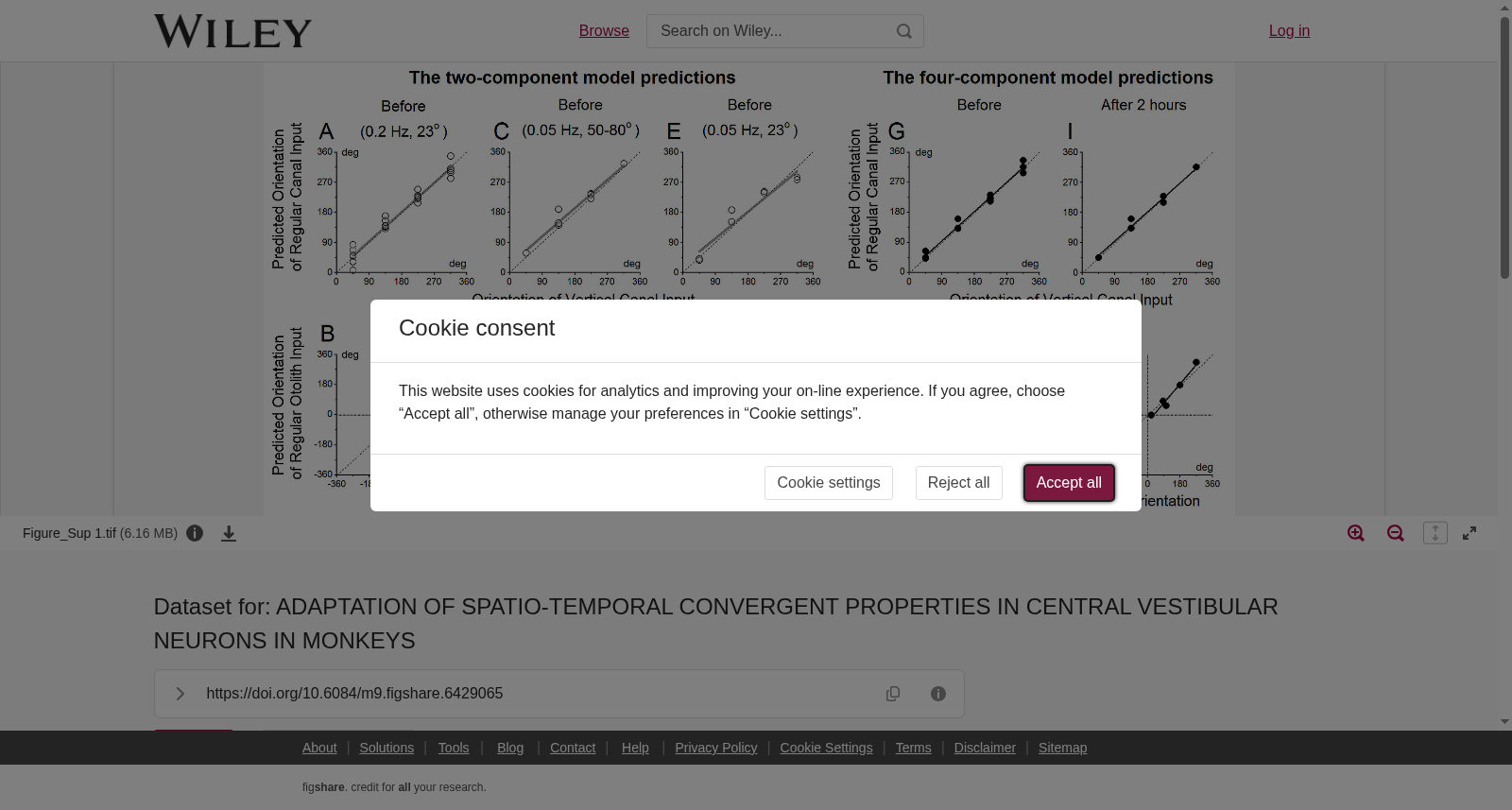
The spatio-temporal convergent (STC) response occurs in central vestibular cells when dynamic and static inputs are activated. The functional significance of STC behavior is not fully understood. Whether STC is a property of some specific central vestibular neurons, or whether it is a response that can be induced in any neuron at some frequencies is unknown. It is also unknown how the change in orientation of otolith polarization vector (orientation adaptation) effects on STC behavior. A new complex model, that includes inputs with regular and irregular discharges from both canal and otolith afferents, was applied to experimental data to determine how many convergent inputs are sufficient to explain the STC behavior as a function of frequency and orientation adaptation. The canal-otolith and otolith-only neurons were recorded in the vestibular nuclei of three monkeys. About 42% (11/26 canal-otolith and 3/7 otolith-only) neurons showed typical STC responses at least at one frequency before orientation adaptation. After orientation adaptation in side-down head position for 2 hours some canal-otolith and otolith-only neurons altered their STC responses. Thus, STC is a property of weights of the regular and irregular vestibular afferent inputs to central vestibular neurons which appear and/or disappear based on stimulus frequency and orientation adaptation. This indicates that STC properties are more common for central vestibular neurons than previously assumed. While gravity-dependent adaptation is also critically dependent on stimulus frequency and orientation adaptation, we propose that STC behavior is also linked to the neural network responsible for localized contextual learning during gravity-dependent adaptation.
时空收敛(spatio-temporal convergent, STC)反应指动态与静态输入被激活时,中枢前庭细胞所出现的反应。目前对于STC反应的功能意义尚未完全阐明。尚不清楚STC究竟是部分特定中枢前庭神经元的固有特性,还是一种可在特定频率下于任意神经元中诱导产生的反应。此外,耳石极化矢量(otolith polarization vector)方向的变化(即方位适应(orientation adaptation))如何影响STC反应,同样尚不明确。本研究构建了一种新型复杂模型,该模型纳入了来自半规管和耳石传入纤维的规则与不规则放电输入,并将其应用于实验数据,以明确需要多少收敛输入,才能基于刺激频率与方位适应情况解释STC反应的特征。研究人员在三只恒河猴的前庭神经核中记录了半规管-耳石神经元与仅耳石神经元的活动。在方位适应前,约42%的神经元(11/26个半规管-耳石神经元与3/7个仅耳石神经元)在至少一种刺激频率下表现出典型的STC反应。在侧卧位进行2小时方位适应后,部分半规管-耳石神经元与仅耳石神经元的STC反应发生了改变。由此可见,STC是中枢前庭神经元所接收的规则与不规则前庭传入输入的权重特性,其可随刺激频率与方位适应的变化出现或消失。这表明中枢前庭神经元的STC特性的普遍性高于此前的认知。尽管重力依赖型适应同样高度依赖刺激频率与方位适应,但本研究提出,STC反应还与重力依赖型适应过程中负责局部情境学习的神经网络存在关联。