rahulvyasm/medical_insurance_data
收藏资源简介:
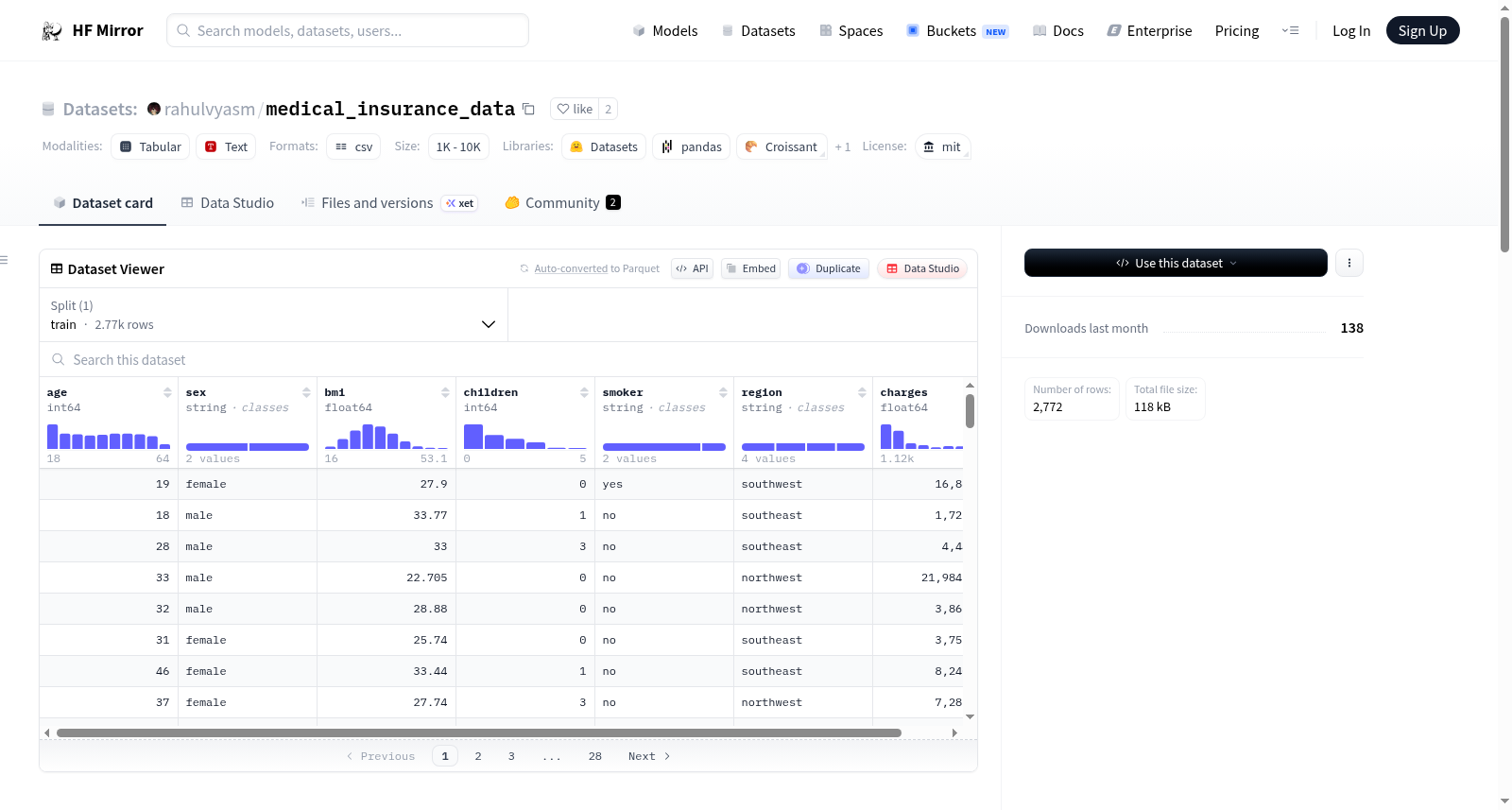
--- license: mit --- # Dataset Card for Medical Insurance Cost Prediction The medical insurance dataset encompasses various factors influencing medical expenses, such as age, sex, BMI, smoking status, number of children, and region. This dataset serves as a foundation for training machine learning models capable of forecasting medical expenses for new policyholders. Its purpose is to shed light on the pivotal elements contributing to increased insurance costs, aiding the company in making more informed decisions concerning pricing and risk assessment. ## Dataset Description The dataset contains **2.7K rows** and **7 columns** **Columns include** 1. Age 2. Sex 3. BMI (Body Mass Index) 4. Children 5. Smoker 6. Region 7. Charges #### Table of Contents - [Introduction](#introduction) - [Problem Statement](#problem-statement) - [Features](#features) - [Technologies Used](#technologies-used) - [Usage](#usage) - [Installation](#installation) - [Data Preparation](#data-preparation) - [Model Training](#model-training) - [Model Evaluation](#model-evaluation) - [Model Serialization](#model-serialization) - [Contributors](#contributors) - [License](#license) #### Introduction Healthcare costs are a significant concern for individuals and families worldwide. Predicting medical insurance costs accurately can help insurance companies determine premiums and assist individuals in planning their healthcare expenses. This project focuses on building machine learning models to predict insurance costs based on demographic and health-related attributes. #### Problem Statement 1. What are the most important factors that affect medical expenses? 2. How well can machine learning models predict medical expenses? 3. How can machine learning models be used to improve the efficiency and profitability of health insurance companies? #### Features - **Data Exploration**: Explore the dataset to understand its structure, identify missing values, and analyze the distribution of features. - **Data Preprocessing**: Prepare the data by handling categorical variables, renaming columns, and scaling numerical features. - **Model Training**: Utilize linear regression and ridge regression models to train predictive models on the prepared dataset. - **Pipeline Construction**: Construct a data preprocessing pipeline to streamline the process of transforming input data for model training. - **Model Evaluation**: Evaluate model performance using metrics such as R-squared score and mean squared error to assess predictive accuracy. - **Model Serialization**: Save trained models and pipelines to disk using the pickle library for future use. #### Technologies Used - **Python**: Programming language used for data manipulation, analysis, and model implementation. - **Libraries**: NumPy, Pandas, Seaborn, Matplotlib, and Scikit-learn for data handling, visualization, and machine learning tasks. - **Machine Learning Models**: Linear Regression, Ridge Regression - **Pickle**: Python library used for serializing trained models and pipelines to disk. ### Dataset Sources From multiple online and offline datasets ## Problem Statement 1. What are the primary factors influencing medical expenses? 2. How accurate are machine learning models in predicting medical expenses? 3. In what ways can machine learning models enhance the efficiency and profitability of health insurance companies?
--- 许可证:MIT(MIT) --- # 医疗保险成本预测数据集卡片 本医疗保险数据集涵盖了影响医疗支出的多项核心因素,包括年龄(Age)、性别(Sex)、体重指数(Body Mass Index,BMI)、吸烟状态、子女数量与所在地区。该数据集可作为训练机器学习模型的基础数据源,用于预测新保单持有人的医疗支出。 本数据集旨在揭示推高保险成本的关键影响因素,助力保险公司在定价与风险评估领域做出更科学的决策。 ## 数据集概况 本数据集包含**2700条数据行**与**7个特征列**,特征列详情如下: 1. 年龄(Age) 2. 性别(Sex) 3. 体重指数(Body Mass Index,BMI) 4. 子女数量(Children) 5. 吸烟状态(Smoker) 6. 所在地区(Region) 7. 医疗支出费用(Charges) #### 目录 - [引言](#introduction) - [问题陈述](#problem-statement) - [数据处理与建模流程](#features) - [所用技术](#technologies-used) - [使用方法](#usage) - [安装步骤](#installation) - [数据准备](#data-preparation) - [模型训练](#model-training) - [模型评估](#model-evaluation) - [模型序列化](#model-serialization) - [贡献者](#contributors) - [许可证](#license) #### 引言 医疗支出是全球范围内个人与家庭普遍关注的重要议题。精准预测医疗保险成本,既能帮助保险公司确定保费标准,也能协助个人规划自身医疗开支。本项目旨在基于人口统计与健康相关属性,构建可预测保险成本的机器学习模型。 #### 问题陈述 1. 哪些因素对医疗支出的影响最为显著? 2. 机器学习模型在预测医疗支出方面的表现如何? 3. 如何利用机器学习模型提升健康保险公司的运营效率与盈利能力? #### 数据处理与建模流程 - **数据探索**:对数据集进行探查,以明确其结构、识别缺失值并分析各特征的分布情况。 - **数据预处理**:通过处理分类变量、重命名特征列以及对数值特征进行标准化,完成数据集的准备工作。 - **模型训练**:基于预处理后的数据集,使用线性回归(Linear Regression)与岭回归(Ridge Regression)模型训练预测模型。 - **流水线构建**:搭建数据预处理流水线,以简化模型训练阶段的输入数据转换流程。 - **模型评估**:采用决定系数(R-squared score)与均方误差(Mean Squared Error)等指标评估模型性能,以衡量其预测准确性。 - **模型序列化**:借助pickle库,将训练完成的模型与流水线保存至磁盘,以便后续复用。 #### 所用技术栈 - **Python**:用于数据操作、分析与模型实现的编程语言。 - **工具库**:NumPy、Pandas、Seaborn、Matplotlib与Scikit-learn,用于数据处理、可视化与机器学习任务。 - **机器学习模型**:线性回归(Linear Regression)、岭回归(Ridge Regression) - **Pickle**:用于将训练完成的模型与流水线序列化并保存至磁盘的Python库。 ### 数据集来源 来源于多份线上与线下数据集 ## 问题陈述 1. 哪些因素对医疗支出的影响最为显著? 2. 机器学习模型在预测医疗支出方面的表现如何? 3. 如何利用机器学习模型提升健康保险公司的运营效率与盈利能力?
数据集概述
数据集名称
Medical Insurance Cost Prediction
数据集描述
该数据集包含2.7K行和7列,主要用于训练机器学习模型以预测新保单持有人的医疗费用。数据集涵盖了影响医疗费用的各种因素,如年龄、性别、BMI、吸烟状态、子女数量和地区。
数据集目的
旨在揭示导致保险成本增加的关键因素,帮助公司在定价和风险评估方面做出更明智的决策。
数据集结构
- 行数:2.7K
- 列数:7
- 列信息:
- Age
- Sex
- BMI (Body Mass Index)
- Children
- Smoker
- Region
- Charges
数据集用途
用于构建和训练机器学习模型,以预测基于人口统计和健康相关属性的医疗费用。
技术使用
- 编程语言:Python
- 库:NumPy, Pandas, Seaborn, Matplotlib, Scikit-learn
- 机器学习模型:线性回归、岭回归
- 模型序列化:使用Pickle库
许可证
MIT