CtRes
收藏资源简介:
为了全面描述风力涡轮机的运行状态,使用加速度计从其主要部件收集了振动加速度数据。数据集涵盖了风力涡轮机的关键部件,并提供了其运行状态的全面描述: - **桨轴承**:振动加速度信号从三个桨轴承的径向和轴向方向收集。每个桨轴承由两个通道监控,产生六个同步观测通道,采样频率为`1280 Hz`。该数据集包含三个条件标签:正常运行、一个桨轴承损坏和所有三个桨轴承损坏。 - **齿轮箱**:振动加速度信号从六个齿轮箱测量位置收集,包括低速轴的径向方向、第一级行星级的径向方向、高速轴的径向方向、高速轴的轴向方向、输入轴的径向方向和中间轴的径向方向。所有通道的采样频率为`2560 Hz`。该数据集包含三个条件标签:正常运行、高速端齿轮故障以及低速轴和高速端齿轮的组合故障。 - **发电机**:振动加速度信号从发电机的非驱动端和驱动端的径向方向收集,形成两个同步观测通道,采样频率为`25,600 Hz`。
To comprehensively characterize the operating status of wind turbines, vibration acceleration data was collected from their key components using accelerometers. The dataset covers the critical components of wind turbines and provides a comprehensive description of their operating states: - **Pitch Bearings**: Vibration acceleration signals were collected from the radial and axial directions of three pitch bearings. Each pitch bearing is monitored by two channels, generating six synchronized observation channels with a sampling frequency of `1280 Hz`. This dataset includes three condition labels: normal operation, damage to one pitch bearing, and damage to all three pitch bearings. - **Gearbox**: Vibration acceleration signals were collected from six measurement positions on the gearbox, including the radial direction of the low-speed shaft, the radial direction of the first-stage planetary stage, the radial direction of the high-speed shaft, the axial direction of the high-speed shaft, the radial direction of the input shaft, and the radial direction of the intermediate shaft. The sampling frequency for all channels is `2560 Hz`. This dataset includes three condition labels: normal operation, gear fault at the high-speed end, and combined fault of the low-speed shaft and high-speed end gear. - **Generator**: Vibration acceleration signals were collected from the radial directions of the non-drive end and drive end of the generator, forming two synchronized observation channels with a sampling frequency of `25,600 Hz`.
好的,根据您提供的数据集详情页面README文件内容,以下是关于该数据集的详细总结。
数据集概述:CtRes(LeMo框架下的风力涡轮机故障诊断数据集)
简介
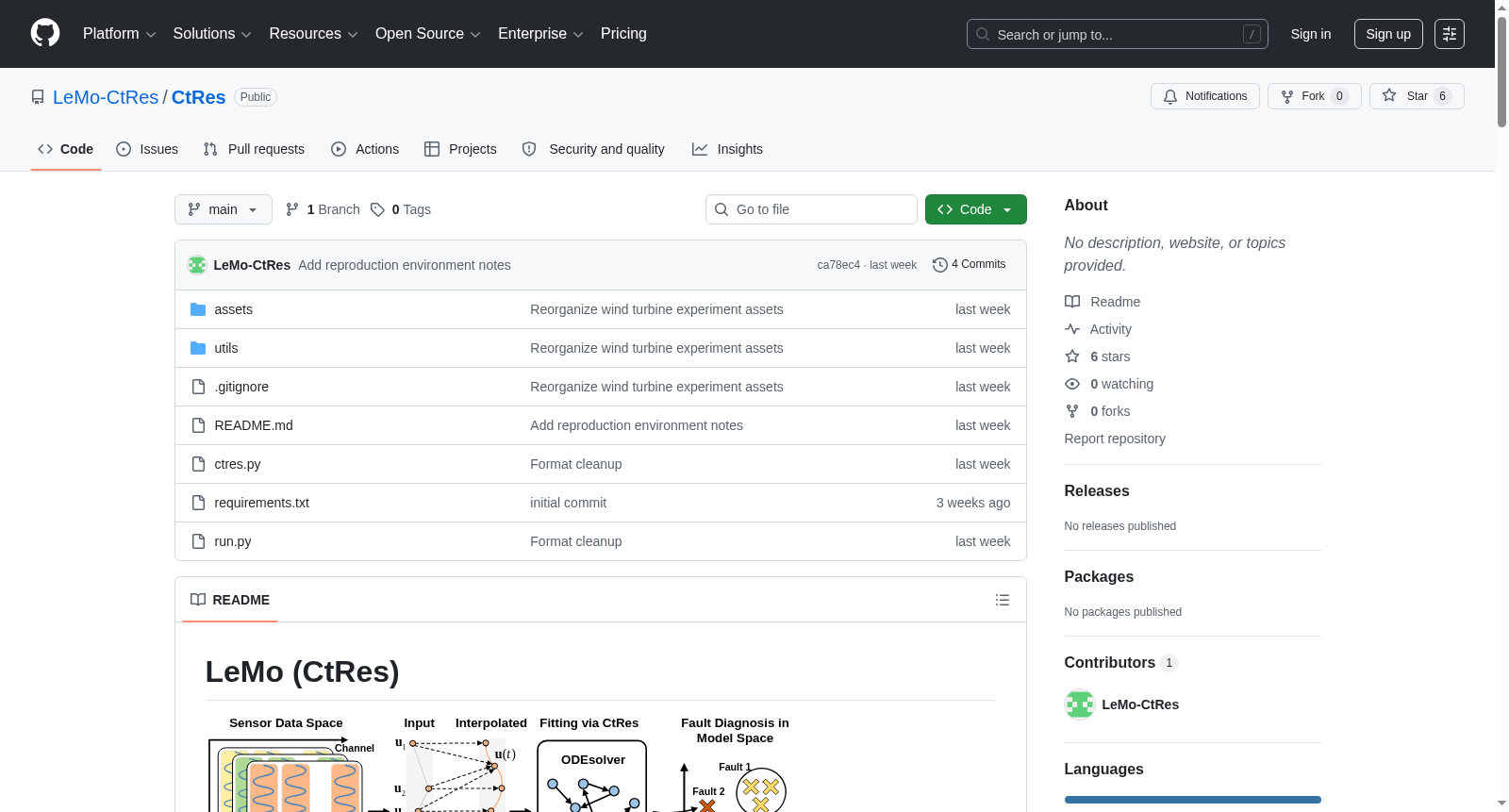
CtRes(Continuous-time Reservoir Network,连续时间储层网络)是应用于 LeMo(Learning in the Model Space) 框架下的一个项目,专注于从不规则采样的传感器时间序列中进行风力涡轮机故障诊断。该方法通过在 模型空间 中表示每个传感器序列,而非直接在原始数据空间中进行诊断,从而更紧凑、稳定地捕捉序列的时序动态。
数据集构成
该数据集通过加速度计从风力涡轮机的关键部件收集振动加速度数据,覆盖了以下五个主要部件,每个部件都有特定的监测通道、采样率和工况标签:
| 部件 | 监测通道 | 采样率 | 工况标签 |
|---|---|---|---|
| 变桨轴承 | 3个变桨轴承,每个轴承2个通道(径向和轴向),共6个同步通道 | 1280 Hz | 正常运行、单个变桨轴承损坏、三个变桨轴承均损坏 |
| 齿轮箱 | 6个测量位置(低速轴径向、一级行星级径向、高速轴径向、高速轴轴向、输入轴径向、中间轴径向) | 2560 Hz | 正常运行、高速端齿轮故障、低速轴和高速端齿轮联合故障 |
| 发电机 | 2个同步通道(非驱动端径向、驱动端径向) | 25,600 Hz | 正常运行、发电机轴承损坏 |
| 叶片 | 3个叶片,每个叶片2个通道(挥舞和摆振方向),共6个同步通道 | 1280 Hz | 正常运行、单个叶片异常 |
| 主轴承 | 1个通道(水平方向) | 2560 Hz | 正常运行、主轴承损坏 |
方法论(LeMo框架三阶段)
该诊断方法分为三个关键阶段:
- 模型空间中的序列拟合:每个传感器序列通过 CtRes 进行拟合。CtRes 通过连续时间储层状态演化来捕捉序列的时序动态,其生成的读出模型作为该序列在模型空间中的表示。
- 序列表示之间的距离建模:定义了读出模型表示之间的距离度量,使得模型空间中的距离可以反映原始传感器序列内在时序动态的差异。
- 模型空间中的故障诊断:直接在学得的表示上进行故障诊断,支持离线故障分类和在线流式故障检测两种设置。
环境与依赖
- 推荐环境:已在 Windows 系统上复现。
- Python版本:已验证 Python 3.11 和 Python 3.12。
- 主要依赖:
- python == 3.11
- numpy == 2.1.2
- torch == 2.6.0
- torchcde == 0.2.5
- torchdiffeq == 0.2.5
- scikit-learn == 1.6.1
- scipy == 1.17.1
- h5py == 3.16.0
- matplotlib == 3.10.8
- pandas == 3.0.2
- tqdm == 4.67.3
使用方式
- 运行脚本:使用
python run.py即可默认加载五个风力涡轮机部件数据集并执行完整的离线诊断流程。也支持通过参数python run.py path/to/split_data.npz加载用户自定义的拆分数据集。 - 自定义数据格式:加载的自定义
.npz文件需要包含特定的训练/测试数据、时间戳和标签数组,并遵循指定的形状要求(数据:[batch, length, channels];时间戳:[batch, observed_length];标签:[batch])。