
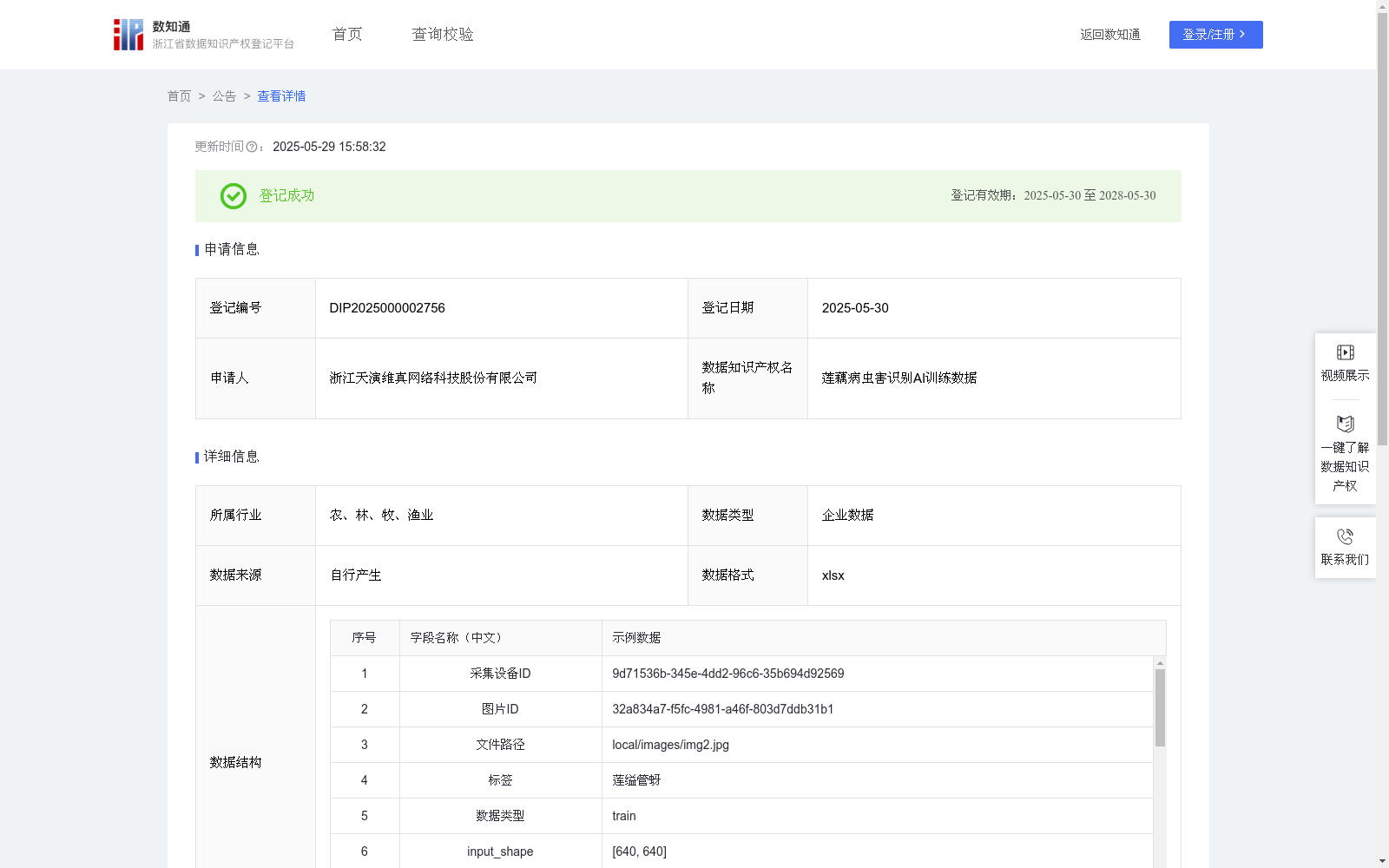
莲藕病虫害识别AI训练数据
收藏浙江省数据知识产权登记平台2025-05-29 更新2025-05-30 收录
下载链接:
https://www.zjip.org.cn/home/announce/trends/133414
下载链接
链接失效反馈官方服务:
资源简介:
本训练数据主要应用于提升AI模型在莲藕病虫害识别场景中对病虫害的识别能力和识别准确度。通过这些数据的训练,采集莲藕叶片高清图像数据,结合深度学习模型对叶片表面的病斑、虫害特征进行多维度分析,能够快速识别病虫害类型及严重程度,生成科学的诊断结果。这种技术不仅显著提升了病虫害识别的准确率,还通过精准定位病害区域,减少了农药的过度使用,降低了环境污染风险,同时提升了防治效率。1、数据采集:由企业采购相机等硬件设备拍摄的莲藕叶片高清图像,详细记录每张图像的图像ID、文件路径、标签拍摄时间等关键信息。同时,对图像进行初步分类,标注其是否含有病虫害以及病虫害的类型。
2、图像预处理:对采集到的图像进行去噪处理,去除图像中的噪声干扰,使图像更加清晰。同时,增强图像的对比度,突出图像中的病虫害特征,提升图像质量,为后续的特征提取和模型训练提供更好的基础。
3、数据准备:从指定路径读取预处理后的图像数据,提取图像的标签、目标框(病虫害的位置)信息,同时加载图像对应的特征数据。
4、模型训练:采深度学习框架进行模型训练。利用标记好的病虫害图像数据,通过调整模型的超参数(如学习率、批次大小等),优化模型结构,减少训练过程中的损失值。在每个训练周期(Epoch)结束时,记录训练损失和精度,监控模型的训练进度。
5、模型评估:通过验证集对训练好的模型进行性能评估,计算验证损失和精度,检验模型对未见过数据的识别能力。同时,计算F1分数、精确率和召回率等指标,生成混淆矩阵和AUC值,全面评估模型的性能。
6、结果分析与优化:根据收集到的各种指标,分析模型在病虫害识别任务中的优缺点。针对模型存在的问题,如对某些病虫害类型的识别精度较低,进一步优化算法参数,如调整模型的网络结构、改进损失函数等,提高模型的识别精度和泛化能力。最终输出病虫害识别结果。
This training dataset is primarily used to enhance the pest and disease recognition capability and accuracy of AI models in the scenario of lotus root pest and disease identification. Through training with this dataset, high-definition image data of lotus root leaves are collected, combined with deep learning models to conduct multi-dimensional analysis of lesion and pest characteristics on the leaf surface, enabling rapid identification of pest and disease types and severity, and generating scientific diagnostic results. This technology not only significantly improves the accuracy of pest and disease recognition, but also reduces excessive pesticide use and the risk of environmental pollution through accurate localization of disease areas, while improving prevention and control efficiency. 1. Data Collection: High-definition images of lotus root leaves captured by hardware equipment such as cameras purchased by enterprises, with key information such as image ID, file path, and shooting time of each image recorded in detail. Meanwhile, preliminary classification of the images is conducted, and annotations are made on whether they contain pests and diseases and the type of pests and diseases. 2. Image Preprocessing: Denoising processing is performed on the collected images to remove noise interference and make the images clearer. At the same time, the contrast of the images is enhanced to highlight the pest and disease characteristics in the images and improve image quality, providing a better foundation for subsequent feature extraction and model training. 3. Data Preparation: Read the preprocessed image data from the specified path, extract the labels and bounding box (position of pests and diseases) information of the images, and load the corresponding feature data of the images. 4. Model Training: Deep learning frameworks are used for model training. Using the annotated pest and disease image data, the hyperparameters of the model (such as learning rate, batch size, etc.) are adjusted, the model structure is optimized, and the loss value during training is reduced. At the end of each training epoch, the training loss and accuracy are recorded to monitor the model's training progress. 5. Model Evaluation: The trained model is evaluated for performance using the validation set, and the validation loss and accuracy are calculated to test the model's recognition ability for unseen data. Meanwhile, indicators such as F1-score, precision, and recall are calculated, and a confusion matrix and Area Under the Curve (AUC) value are generated to comprehensively evaluate the model's performance. 6. Result Analysis and Optimization: Analyze the advantages and disadvantages of the model in the pest and disease recognition task based on various collected indicators. For problems existing in the model, such as low recognition accuracy for certain pest and disease types, further optimize algorithm parameters, such as adjusting the network structure of the model, improving the loss function, etc., to improve the model's recognition accuracy and generalization ability. Finally, the pest and disease recognition results are output.
提供机构:
浙江天演维真网络科技股份有限公司
创建时间:
2025-04-15
搜集汇总
数据集介绍
以上内容由遇见数据集搜集并总结生成



