simrepairbench
收藏资源简介:
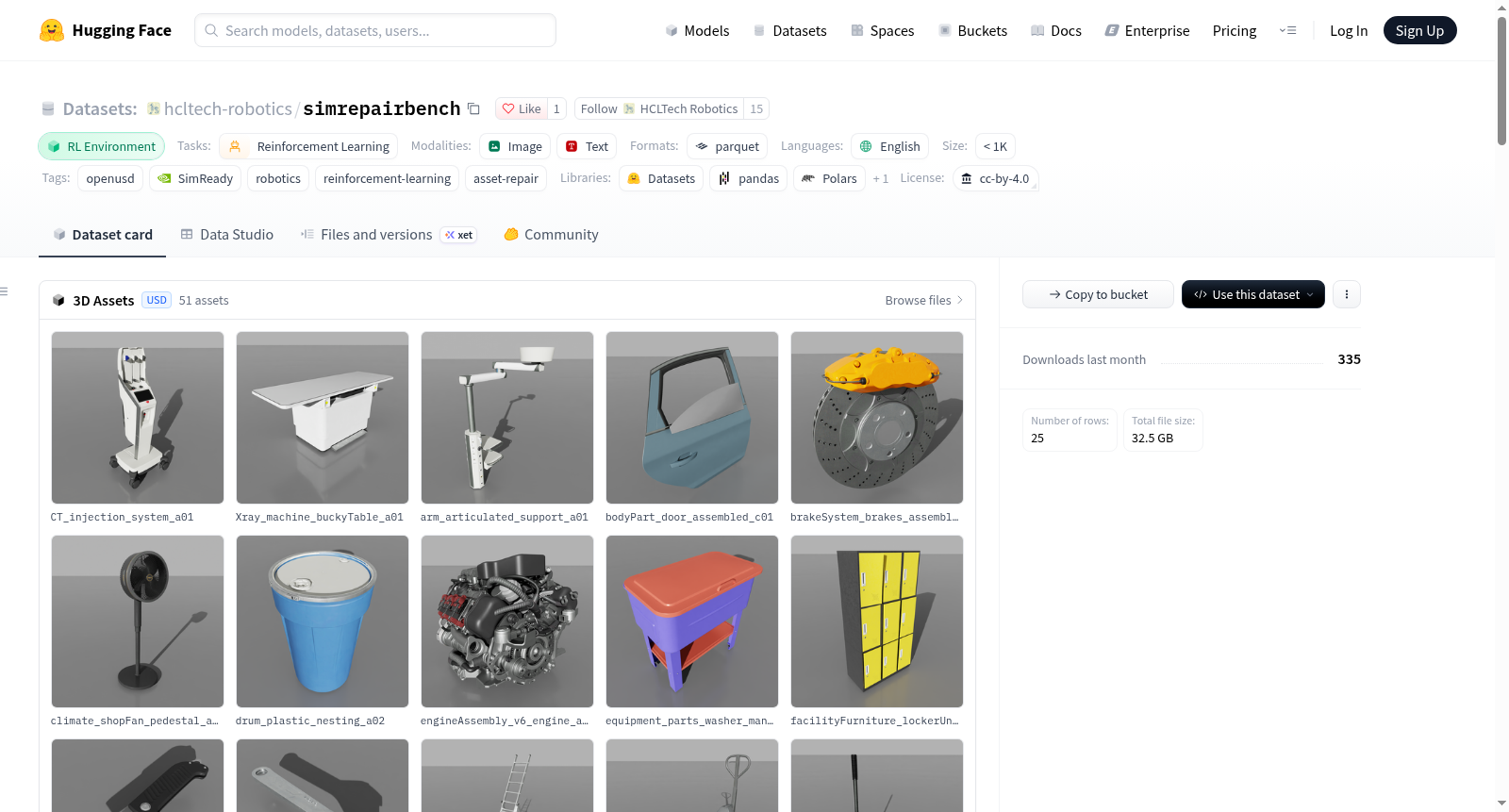
SimRepairBench 是一个面向机器人仿真的 OpenUSD 资产修复数据集与基准,旨在支持修复 simulation-ready OpenUSD 对象。其公共样本 CASTAIGNE25 包含 25 个被故意损坏的对象,涵盖铰接式车间设备、工具柜、医疗推车、X 光台、洗碗机、风扇、虎钳、钻机、钳子、扳手、刀具、床、患者椅、储物柜、制动组件、零件清洗机、车门、货架、鼓和发动机等。这些对象表面可能看似可信,但关节、碰撞几何或依赖关系等内部行为可能错误。数据集定义的核心任务是:从提供的损坏包出发,在不破坏仍然正常部件的前提下,恢复任务 brief 所指定的行为。它支持 Wilde 及其他修复智能体,并将每个问题与其解决过程联系起来。每个任务都定义满意修复必须保留或恢复的内容;案例查看器将原始对象与损坏输入配对,并在内部故障难以直接观察时提供带标签的诊断叠加。CASTAIGNE25 包含跨 25 个对象的 128 个 authored faults。对象以 R01–R25 标识,用于连接故障描述和修复要求;单个故障以 R01-D01 等标识区分。故障覆盖多种修复挑战:千斤顶、支撑臂、传送带和梯子涉及关节图、局部坐标系、行程限制和运动间隙;工具柜、医疗推车、X 光台和洗碗机涉及组件对应关系、伸缩机构和受阻运动;风扇、虎钳、钻机、钳子、扳手和刀具涉及轴、枢轴、薄几何和质量属性;床、患者椅和储物柜涉及重复部件、层级、缺失组件和独立运动;制动组件、零件清洗机、车门、货架、鼓和发动机涉及碰撞空腔、附件、材质绑定和资产依赖。故障类型包括部分单位转换、命名空间迁移、变换被烘焙到错误层级位置等。多个故障可能在一个对象中相互作用,因此仅修正孤立属性不一定足以恢复机构。数据以 Hugging Face Datasets 配置 cases 提供,默认划分 castaigne25,数据文件为 data/cases.parquet。字段包括 original_image、broken_image、case_id、title、asset_id、source_revision、source_url、license、fault_count、faults(含 defect_id、description)、failure_story、required_outcome、scope、agent_evidence、whole_package_path、whole_entrypoint、broken_package_path、broken_entrypoint、package_path、package_sha256、episode_paths、verification_scope。每行汇总预览、故障描述、修复要求和包位置;package_path 标识归档,package_sha256 记录摘要。完整归档应下载以保留对象附带资源的相对路径。每个归档包含 asset.usdc、其资源、instruction.md、evidence.json、NVIDIA notices 和逐文件 SHA-256 清单。使用时应先阅读 instruction 和 evidence,再依据 required_outcome 与 scope 确定修复目标;verification_scope 数组描述输入包所记录的检查。README 提供使用 datasets.load_dataset 加载案例表以及 huggingface_hub.hf_hub_download 下载完整归档的示例。数据集标签包括 openusd、simready、robotics、reinforcement-learning、asset-repair、rl-environment,任务类别为 reinforcement-learning。在修复环境和 episode 方面,Harbor 数据集版本 0.2.0 固定了全部 25 个任务及其独立验证器。可通过 harbor 下载不可变集合,也可从源码组装相同环境。每个 actor 接收损坏对象、工具和 brief;参考数据与评分代码保留在独立验证器环境中。任务版本将每个案例连接到已发布任务和验证器哈希。目标奖励结合按故障正确性与向所需状态的渐进进展,在其他故障仍存在时保留部分得分;无效提交或损坏健康部件得零分。修复评分描述测量方式、保留规则以及独立的物理与视觉评分。修复 episode 保留起始包与最终候选之间的关联,稳定的 case 和 episode 标识符链接轨迹、提交资产、客观测量、视觉评估和结果分析。输入应保持不变,并评估最终字节;不成功的尝试也应记录在案。轨迹 schema 描述可观察 episode 数据,视觉评估文档解释独立评判结果。CASTAIGNE25 作为 Wilde 及其他修复智能体的公开训练和演示材料;用于未见评估时,应使用独立资产生成谱系,并从训练材料中排除近重复几何。将输入、动作和独立评估结果保持在一起,可让读者跟踪同一对象从原始修复问题到提交解决方案,并查看 brief 中的行为是否恢复。来源与许可:对象来自 NVIDIA SimReady 资产集合,固定修订 4763fbfaa4f8e97658e68b57d01b4c86659e08b5。源资产保留 Creative Commons Attribution 4.0 许可证和包通知。分发 SimRepairBench 衍生品时,应注明 NVIDIA 为来源,保留通知,并标记源修正、注入故障和修复为修改;包含于本数据集不表示 NVIDIA 认可。文档和数据集记录使用 CC BY 4.0,SimRepairBench 软件使用 MIT,复用的 SimReadyBench evaluator 代码保留原 MIT 通知。README 还提供 BibTeX 引用信息:标题 SimRepairBench: CASTAIGNE25 OpenUSD Asset Repair Tasks,作者 Chris von Csefalvay、Pranav Doma、Achyuthan Unni Krishnan、Tamas Foldi,组织 HCLTech,年份 2026,URL 为数据集主页。数据集语言为英语,许可为 cc-by-4.0。
SimRepairBench is an OpenUSD asset repair dataset and benchmark for robotics simulation, designed to support repairing simulation-ready OpenUSD objects. Its public sample CASTAIGNE25 contains 25 intentionally broken objects, covering articulated workshop equipment, tool cabinets, medical carts, X-ray tables, dishwashers, fans, vises, drill rigs, pliers, wrenches, cutters, beds, patient chairs, lockers, brake assemblies, parts washers, car doors, shelving, drums, engines, and more. These objects may appear credible on the surface, but internal behavior such as joints, collision geometry, or dependencies may be incorrect. The core task defined by the dataset is to start from the provided broken package and restore the behavior specified by the task brief without damaging parts that are still healthy. It supports Wilde and other repair agents and links each problem to its resolution process. Each task defines what a satisfactory repair must preserve or restore; the case viewer pairs the original object with the broken input and provides labeled diagnostic overlays when internal faults are difficult to observe directly. CASTAIGNE25 contains 128 authored faults across 25 objects. Objects are identified as R01–R25 to connect fault descriptions and repair requirements; individual faults are distinguished as R01-D01, etc. Faults cover various repair challenges: jacks, support arms, conveyors, and ladders involve joint graphs, local coordinate frames, travel limits, and motion clearances; tool cabinets, medical carts, X-ray tables, and dishwashers involve component correspondence, telescoping mechanisms, and obstructed motion; fans, vises, drill rigs, pliers, wrenches, and cutters involve axes, pivots, thin geometry, and mass properties; beds, patient chairs, and lockers involve repeated parts, hierarchy, missing components, and independent motion; brake assemblies, parts washers, car doors, shelving, drums, and engines involve collision cavities, attachments, material bindings, and asset dependencies. Fault types include partial unit conversion, namespace migration, and transforms baked into the wrong hierarchy location. Multiple faults may interact within one object, so fixing isolated properties alone may not be sufficient to restore the mechanism. Data is provided as a Hugging Face Datasets configuration cases, with default split castaigne25 and data file data/cases.parquet. Fields include original_image, broken_image, case_id, title, asset_id, source_revision, source_url, license, fault_count, faults (with defect_id, description), failure_story, required_outcome, scope, agent_evidence, whole_package_path, whole_entrypoint, broken_package_path, broken_entrypoint, package_path, package_sha256, episode_paths, and verification_scope. Each row summarizes previews, fault descriptions, repair requirements, and package locations; package_path identifies the archive, and package_sha256 records the digest. Full archives should be downloaded to preserve relative paths of accompanying object resources. Each archive contains asset.usdc, its resources, instruction.md, evidence.json, NVIDIA notices, and a per-file SHA-256 manifest. Users should first read instruction and evidence, then determine repair goals based on required_outcome and scope; the verification_scope array describes checks recorded for the input package. The README provides examples of loading the case table with datasets.load_dataset and downloading full archives with huggingface_hub.hf_hub_download. Dataset tags include openusd, simready, robotics, reinforcement-learning, asset-repair, and rl-environment, with task category reinforcement-learning. Regarding the repair environment and episodes, Harbor dataset version 0.2.0 pins all 25 tasks and their independent verifiers. The immutable collection can be downloaded via harbor, or the same environment can be assembled from source. Each actor receives the broken object, tools, and brief; reference data and scoring code remain in a separate verifier environment. Task versions connect each case to published task and verifier hashes. The target reward combines per-fault correctness and progressive progress toward the required state, preserving partial credit while other faults remain; invalid submissions or damage to healthy parts receive zero. Repair scoring describes measurement methods, preservation rules, and independent physical and visual scoring. Repair episodes preserve the association between the starting package and the final candidate, and stable case and episode identifiers link trajectories, submitted assets, objective measurements, visual evaluations, and result analysis. Inputs should remain unchanged, and final bytes are evaluated; unsuccessful attempts should also be recorded. The trajectory schema describes observable episode data, and the visual evaluation document explains independent judging results. CASTAIGNE25 serves as public training and demonstration material for Wilde and other repair agents; for unseen evaluation, independent asset generation lineages should be used, and near-duplicate geometry should be excluded from training material. Keeping inputs, actions, and independent evaluation results together allows readers to track the same object from the original repair problem to the submitted solution and see whether the behavior in the brief has been restored. Source and license: objects come from the NVIDIA SimReady asset collection at fixed revision 4763fbfaa4f8e97658e68b57d01b4c86659e08b5. Source assets retain the Creative Commons Attribution 4.0 license and package notices. When distributing SimRepairBench derivatives, NVIDIA should be credited as the source, notices should be retained, and source corrections, injected faults, and repairs should be marked as modifications; inclusion in this dataset does not imply NVIDIA endorsement. Documentation and dataset records use CC BY 4.0, SimRepairBench software uses MIT, and reused SimReadyBench evaluator code retains the original MIT notice. The README also provides BibTeX citation information: title SimRepairBench: CASTAIGNE25 OpenUSD Asset Repair Tasks, authors Chris von Csefalvay, Pranav Doma, Achyuthan Unni Krishnan, Tamas Foldi, organization HCLTech, year 2026, URL as the dataset homepage. The dataset language is English and the license is cc-by-4.0.
SimRepairBench 数据集总结
基本信息
| 项目 | 内容 |
|---|---|
| 数据集名称 | SimRepairBench |
| 数据集页面 | https://huggingface.co/datasets/hcltech-robotics/simrepairbench |
| 公开样例 | CASTAIGNE25 |
| 语言 | en |
| 许可证 | cc-by-4.0 |
| 任务类别 | reinforcement-learning |
| 标签 | openusd、simready、robotics、reinforcement-learning、asset-repair、rl-environment |
| 作者 | Chris von Csefalvay、Pranav Doma、Achyuthan Unni Krishnan、Tamas Foldi |
| 机构 | HCLTech |
数据集说明
- SimRepairBench 评估模型如何修复用于机器人仿真的 OpenUSD 资产。
- 公开样例 CASTAIGNE25 包含 25 个修复任务,覆盖从 articulated workshop equipment 到日常工具的对象。
- 对象可能外观可信,但关节、碰撞几何或依赖关系存在错误;任务目标是恢复其任务简报中指定的行为,同时不丢失仍正常工作的部件。
- 基准将任务输入、修复协议、评估器和模型结果分离。
- 每个模型从相同的损坏包和任务简报开始。
- 完整参考为验证器提供比较证据,不是模型生成的修复。
- 修复结果记录模型实际提交的候选,以及该尝试中的动作和测量。
- 案例查看器将完整参考与损坏输入配对,使用带标签的诊断覆盖层显示内部故障。
- 诊断每个故障所需组件保持 composed、active、visible、inspectable。
- 修复代理可使用幸存几何、安装地标和候选探针定位问题并检查所需行为。
配置与字段
| 配置项 | 内容 |
|---|---|
| 配置名称 | cases |
| 默认配置 | true |
| 数据文件 split | castaigne25 |
| 数据文件路径 | https://huggingface.co/datasets/hcltech-robotics/simrepairbench/blob/main/data/cases.parquet |
| 字段 | 类型 |
|---|---|
| original_image | image |
| broken_image | image |
| case_id | string |
| dataset_version | string |
| title | string |
| asset_id | string |
| source_revision | string |
| source_url | string |
| license | string |
| fault_count | int64 |
| faults | list,包含 defect_id(string)、description(string) |
| failure_story | string |
| required_outcome | string |
| scope | string |
| agent_evidence | string |
| whole_package_path | string |
| whole_entrypoint | string |
| broken_package_path | string |
| broken_entrypoint | string |
| package_path | string |
| package_sha256 | string |
| episode_paths | list[string] |
| verification_scope | list[string] |
案例与故障
- CASTAIGNE25 包含 25 个对象上的 128 个编写故障。
- 标识符
R01–R25将每个对象连接到其故障描述和修复要求。 - 标识符如
R01-D01区分案例内的单个故障。
| 对象 | 修复挑战 |
|---|---|
| Jacks、support arm、conveyor、ladder | 关节图、局部坐标系、行程限制和移动间隙 |
| Tool cabinet、medical cart、X-ray table、dishwasher | 组件对应、伸缩机构和受阻行程 |
| Fan、vise、drill、pliers、wrench、knife | 轴、枢轴、薄几何和质量属性 |
| Bed、patient chair、locker unit | 重复部件、层级、组件配合和独立运动 |
| Brake assembly、parts washer、car door、rack、drum、engine | 碰撞腔体、附件、材质绑定和资产依赖 |
- 故障表示的错误包括部分单位转换、命名空间迁移、或将变换烘焙到层级中的错误部分。
- 多个故障可能在一个对象内相互作用,因此仅纠正孤立属性不一定足以恢复机制。
- R17 对角线比较视频:https://huggingface.co/datasets/hcltech-robotics/simrepairbench/blob/main/media/videos/R17-diagonal-broken-left-intact-right.mp4
- R17 捕获设置:https://huggingface.co/datasets/hcltech-robotics/simrepairbench/blob/main/media/videos/R17-diagonal.json
- R17 比较显示左侧损坏轮胎和右侧完整参考,在同步检查轨道中两个视图共享相机、比例、光照和中心。
- 原生 3D 画廊打开损坏输入;完整参考可通过案例表浏览。
使用数据
- 使用 Hugging Face Datasets 加载案例表并选择对象:
python from datasets import load_dataset
cases = load_dataset( "hcltech-robotics/simrepairbench", "cases", split="castaigne25" ) case = cases[0] print(case["case_id"], case["title"], case["faults"])
- 每行汇总预览、故障描述、修复要求和包位置。
package_path标识归档,package_sha256记录其摘要。- 下载完整归档以保留对象附带资源的相对路径:
python from huggingface_hub import hf_hub_download
archive = hf_hub_download( "hcltech-robotics/simrepairbench", case["package_path"], repo_type="dataset" )
- 每个归档包含
asset.usdc、其资源、instruction.md、evidence.json、NVIDIA 通知和逐文件 SHA-256 清单。 - 先从说明和证据开始,然后使用案例的
required_outcome和scope确定修复必须达到的目标。 verification_scope数组描述为输入包记录的检查。- 数据集格式文档:https://huggingface.co/datasets/hcltech-robotics/simrepairbench/blob/main/docs/dataset-format.md
修复环境与 Episodes
- Harbor 数据集将修复任务及其独立验证器分组:https://hub.harborframework.com/datasets/hcltech-robotics/simrepairbench
- 固定任务版本记录不可变数据集和任务摘要:https://huggingface.co/datasets/hcltech-robotics/simrepairbench/blob/main/harbor/releases/castaigne25-0.3.0.json
- 每个 actor 接收损坏对象、工具和任务简报;参考数据和评分代码保留在单独验证器环境。
- 组装环境脚本:https://huggingface.co/datasets/hcltech-robotics/simrepairbench/blob/main/scripts/export_harbor_tasks.py,参数为
--materialize --fetch --case all。 - 目标奖励结合每个故障的正确性和朝向所需状态的评分进展。
- 当其他故障仍存在时保留部分分数,无效提交和损坏健康部件得零。
- 修复评分文档:https://huggingface.co/datasets/hcltech-robotics/simrepairbench/blob/main/docs/scoring.md
- 修复 episode 保留起始包与最终候选之间的连接。
- 稳定 case 和 episode 标识符链接轨迹、提交资产、客观测量、视觉评估和结果分析。
- 保持输入不变并评估精确最终字节;不成功尝试也属于记录。
- Episode schema:https://huggingface.co/datasets/hcltech-robotics/simrepairbench/blob/main/schema/episode-linkage.schema.json
- 模型和尝试通过固定
task_revision、版本化model_config_id、attempt_id和episode_id比较。 - 每条记录链接实际轨迹和提交候选到客观、视觉和物理评估。
- 完整参考和受控 fixtures 与模型 rollouts 分开。
- 模型和尝试记录文档:https://huggingface.co/datasets/hcltech-robotics/simrepairbench/blob/main/docs/episodes.md
- CASTAIGNE25 是公开样例;评估报告应标明对其对象或修复轨迹的暴露。
- 未见评估需要单独资产谱系,并排除训练材料中的近重复几何。
归因与许可
- 对象来自 NVIDIA SimReady 资产集合:https://huggingface.co/datasets/nvidia/simready-assets
- 固定 revision:
4763fbfaa4f8e97658e68b57d01b4c86659e08b5 - 源资产保留 Creative Commons Attribution 4.0 许可证和包通知。
- 分发 SimRepairBench 衍生物时,需将 NVIDIA 标识为来源,保留这些通知,并将源修正、注入故障和修复标记为修改。
- 包含在本数据集中不意味着 NVIDIA 认可。
- 文档和数据集记录使用 CC BY 4.0:https://creativecommons.org/licenses/by/4.0/
- SimRepairBench 软件使用 MIT:https://huggingface.co/datasets/hcltech-robotics/simrepairbench/blob/main/LICENSE
- 复用 SimReadyBench 评估器代码保留原始 MIT 通知:https://huggingface.co/datasets/hcltech-robotics/simrepairbench/blob/main/licenses/simreadybench-MIT-LICENSE.txt
相关链接
- 案例浏览:https://huggingface.co/datasets/hcltech-robotics/simrepairbench/viewer/cases/castaigne25
- 案例定义:https://huggingface.co/datasets/hcltech-robotics/simrepairbench/blob/main/cases/castaigne25.json
- Python 代码:https://huggingface.co/datasets/hcltech-robotics/simrepairbench/tree/main/src/simrepairbench
- SimReadyBench:https://huggingface.co/datasets/hcltech-robotics/simreadybench
引用
bibtex @misc{simrepairbench2026, title = {SimRepairBench: CASTAIGNE25 OpenUSD Asset Repair Tasks}, author = {von Csefalvay, Chris and Doma, Pranav and Unni Krishnan, Achyuthan and Foldi, Tamas}, organization = {HCLTech}, year = {2026}, url = {https://huggingface.co/datasets/hcltech-robotics/simrepairbench} }