
MAG for Heterogeneous Graph Learning
收藏Mendeley Data2024-03-27 更新2024-06-29 收录
下载链接:
https://zenodo.org/record/5055136
下载链接
链接失效反馈官方服务:
资源简介:
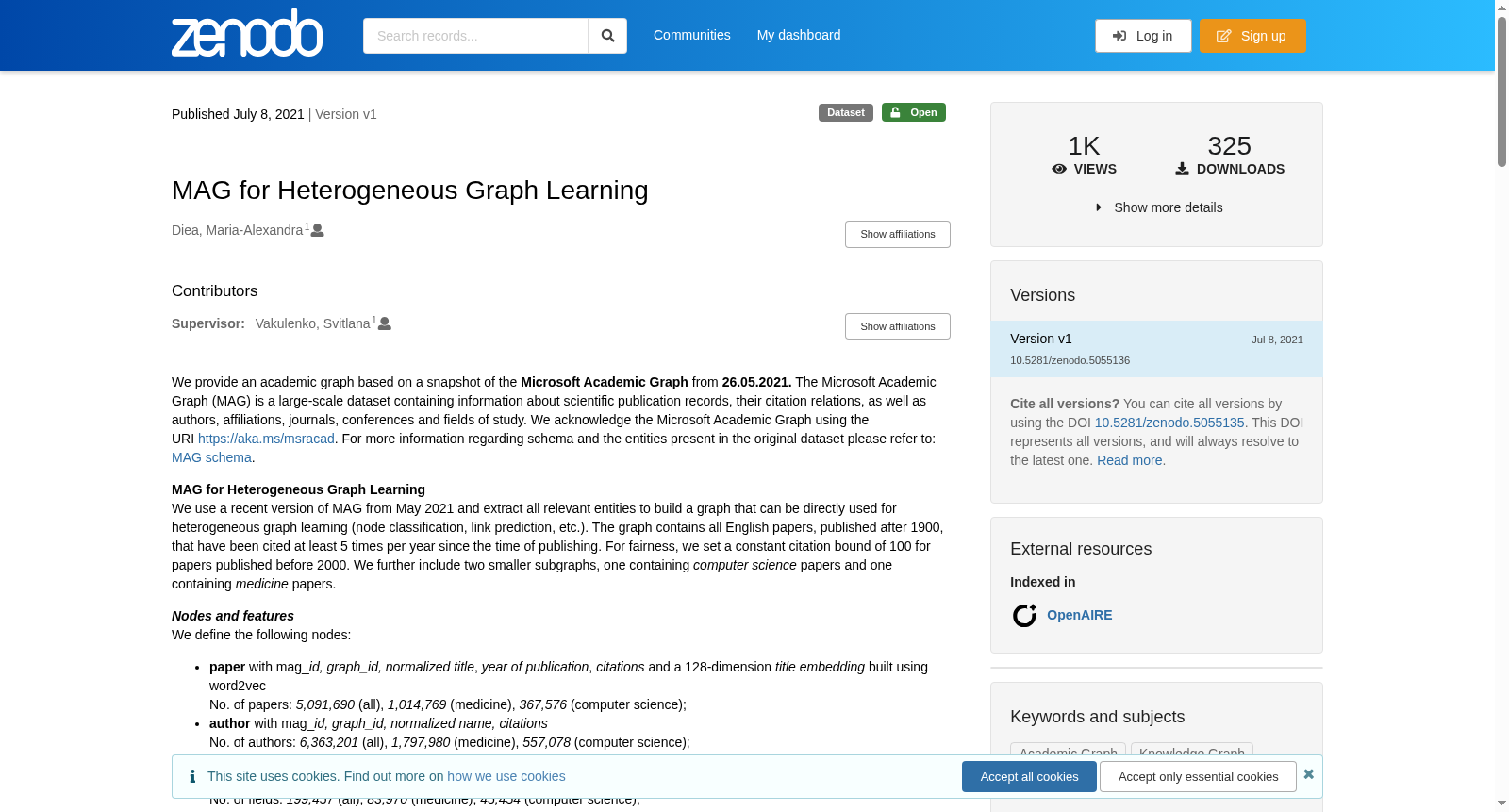
We provide an academic graph based on a snapshot of the Microsoft Academic Graph from 26.05.2021. The Microsoft Academic Graph (MAG) is a large-scale dataset containing information about scientific publication records, their citation relations, as well as authors, affiliations, journals, conferences and fields of study. We acknowledge the Microsoft Academic Graph using the URI https://aka.ms/msracad. For more information regarding schema and the entities present in the original dataset please refer to: MAG schema. MAG for Heterogeneous Graph Learning We use a recent version of MAG from May 2021 and extract all relevant entities to build a graph that can be directly used for heterogeneous graph learning (node classification, link prediction, etc.). The graph contains all English papers, published after 1900, that have been cited at least 5 times per year since the time of publishing. For fairness, we set a constant citation bound of 100 for papers published before 2000. We further include two smaller subgraphs, one containing computer science papers and one containing medicine papers. Nodes and features We define the following nodes: paper with mag_id, graph_id, normalized title, year of publication, citations and a 128-dimension title embedding built using word2vec No. of papers: 5,091,690 (all), 1,014,769 (medicine), 367,576 (computer science); author with mag_id, graph_id, normalized name, citations No. of authors: 6,363,201 (all), 1,797,980 (medicine), 557,078 (computer science); field with mag_id, graph_id, level, citations denoting the hierarchical level of the field where 0 is the highest-level (e.g. computer science) No. of fields: 199,457 (all), 83,970 (medicine), 45,454 (computer science); affiliation with mag_id, graph_id, citations No. of affiliations: 19,421 (all), 12,103 (medicine), 10,139 (computer science); venue with mag_id, graph_id, citations, type denoting whether conference or journal No. of venues: 24,608 (all), 8,514 (medicine), 9,893 (computer science). Edges We define the following edges: author is_affiliated_with affiliation No. of author-affiliation edges: 8,292,253 (all), 2,265,728 (medicine), 665,931 (computer science); author is_first/last/other paper No. of author-paper edges: 24,907,473 (all), 5,081,752 (medicine), 1,269,485 (computer science); paper has_citation_to paper No. of author-affiliation edges: 142,684,074 (all), 16,808,837 (medicine), 4,152,804 (computer science); paper conference/journal_published_at venue No. of author-affiliation edges: 5,091,690 (all), 1,014,769 (medicine), 367,576 (computer science); paper has_field_L0/L1/L2/L3/L4 field No. of author-affiliation edges: 47,531,366 (all), 9,403,708 (medicine), 3,341,395 (computer science); field is_in field No. of author-affiliation edges: 339,036 (all), 138,304 (medicine), 83,245 (computer science); We further include a reverse edge for each edge type defined above that is denoted with the prefix rev_ and can be removed based on the downstream task. Data structure The nodes and their respective features are provided as separate .tsv files where each feature represents a column. The edges are provided as a pickled python dictionary with schema: {target_type:
{source_type:
{edge_type:
{target_id:
{source_id:
{time
}
}
}
}
}
} We provide three compressed ZIP archives, one for each subgraph (all, medicine, computer science), however we split the file for the complete graph into 500mb chunks. Each archive contains the separate node features and edge dictionary.
本数据集基于2021年5月26日快照版的微软学术图谱(Microsoft Academic Graph,简称MAG)构建。微软学术图谱是一款大规模数据集,涵盖科学出版物记录、引文关系,以及作者、机构、期刊、会议与研究领域等信息。本成果使用微软学术图谱的引用URI为https://aka.ms/msracad。如需了解原始数据集的数据模式(schema)与实体详情,请参考:MAG schema。
面向异构图学习的微软学术图谱
我们采用2021年5月的最新版MAG,提取所有相关实体以构建可直接用于异构图学习的图谱(支持节点分类、链路预测等下游任务)。该图谱包含1900年后发表、且自发表以来年均被引至少5次的全部英文论文;为保证实验公平性,我们为2000年前发表的论文设置了100次的固定被引量上限。此外还包含两个小型子图谱:分别为计算机科学领域论文子图谱与医学领域论文子图谱。
节点与特征
我们定义了以下五类节点:
1. 论文节点:包含mag_id、graph_id、标准化标题、发表年份、被引量,以及基于word2vec构建的128维标题嵌入。论文总量:全量图谱5,091,690篇,医学子图谱1,014,769篇,计算机科学子图谱367,576篇;
2. 作者节点:包含mag_id、graph_id、标准化姓名、被引量。作者总量:全量图谱6,363,201位,医学子图谱1,797,980位,计算机科学子图谱557,078位;
3. 研究领域节点:包含mag_id、graph_id、层级与被引量,其中层级数值0代表最高层级领域(如计算机科学)。研究领域总量:全量图谱199,457个,医学子图谱83,970个,计算机科学子图谱45,454个;
4. 机构节点:包含mag_id、graph_id、被引量。机构总量:全量图谱19,421个,医学子图谱12,103个,计算机科学子图谱10,139个;
5. 发表场所节点:包含mag_id、graph_id、被引量与类型,用于标识该场所为会议还是期刊。发表场所总量:全量图谱24,608个,医学子图谱8,514个,计算机科学子图谱9,893个。
边关系
我们定义了以下六类边关系:
1. 作者-隶属机构边:即作者隶属于机构(author is_affiliated_with affiliation)。该类边总量:全量图谱8,292,253条,医学子图谱2,265,728条,计算机科学子图谱665,931条;
2. 作者-论文边:即作者以第一作者、通讯作者或其他作者身份参与论文创作(author is_first/last/other paper)。该类边总量:全量图谱24,907,473条,医学子图谱5,081,752条,计算机科学子图谱1,269,485条;
3. 论文间引文边:即论文引用其他论文(paper has_citation_to paper)。该类边总量:全量图谱142,684,074条,医学子图谱16,808,837条,计算机科学子图谱4,152,804条;
4. 论文-发表场所边:即论文发表于会议或期刊(paper conference/journal_published_at venue)。该类边总量:全量图谱5,091,690条,医学子图谱1,014,769条,计算机科学子图谱367,576条;
5. 论文-研究领域边:即论文隶属于L0至L4层级的研究领域(paper has_field_L0/L1/L2/L3/L4 field)。该类边总量:全量图谱47,531,366条,医学子图谱9,403,708条,计算机科学子图谱3,341,395条;
6. 领域层级边:即研究领域隶属于更高层级领域(field is_in field)。该类边总量:全量图谱339,036条,医学子图谱138,304条,计算机科学子图谱83,245条;
此外,我们为上述每一类边添加了前缀为rev_的反向边,可根据下游任务需求移除。
数据结构
节点及其对应特征以独立的制表符分隔值(TSV)文件提供,每个特征对应一列。边以采用pickle格式序列化的Python字典形式存储,其结构为:{目标实体类型: {源实体类型: {边类型: {目标实体ID: {源实体ID: {时间戳}}}}}}
我们提供了三个压缩ZIP归档文件,分别对应全量图谱、医学子图谱与计算机科学子图谱;其中全量图谱的文件被拆分为500MB的分块。每个归档文件均包含独立的节点特征文件与边字典文件。
创建时间:
2023-06-28
搜集汇总
数据集介绍
背景与挑战
背景概述
MAG for Heterogeneous Graph Learning数据集是基于微软学术图谱构建的异质图,包含超过500万篇论文、600万作者及多种学术实体,适用于图学习任务。数据集特别筛选了高引用英文论文,并提供全量、医学和计算机科学三个子图,便于不同领域的研究使用。
以上内容由遇见数据集搜集并总结生成


