MultiCloudSRE-Ops
收藏资源简介:
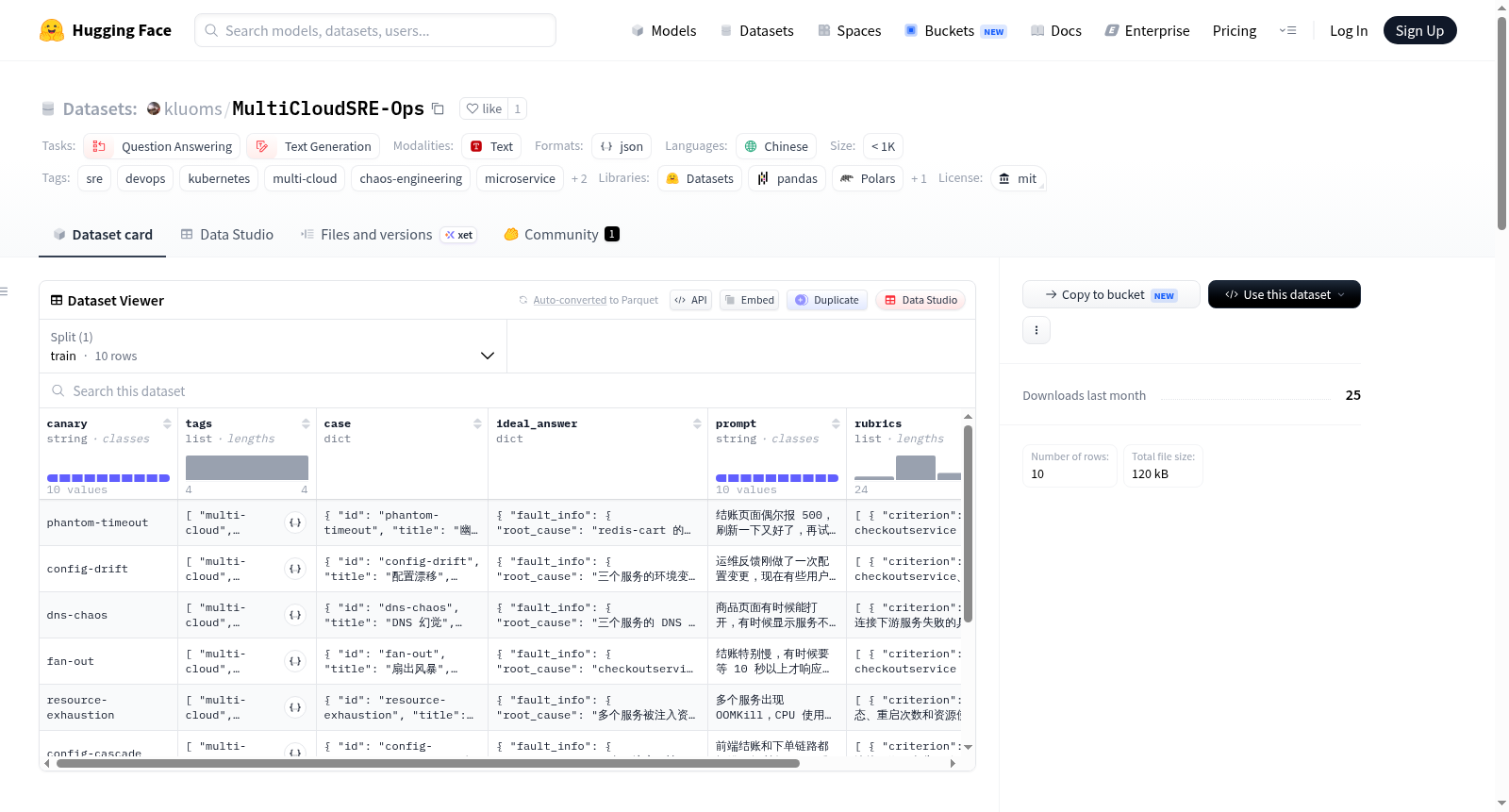
多云运维 SRE 故障排查挑战数据集是一个专注于站点可靠性工程(SRE)领域,特别是多云环境下微服务系统故障诊断与恢复的数据集。该数据集基于一个部署在阿里云、腾讯云和 AWS 三朵云上的真实电商微服务系统构建,旨在模拟和评估在复杂、分布式云原生环境中进行故障排查的能力。数据集的核心内容围绕一系列预设的故障场景(Case),每条数据记录代表一个独立的故障排查挑战,包含结构化字段:id(题目的唯一标识符)、case(包含完整的故障案例数据,如故障标题、详细现象描述、故障注入脚本和恢复脚本)、ideal_answer(提供针对故障的理想答案,包括分析、逻辑推理、验证方法和解决方案)、rubrics(定义评估答案的评分标准数组,包含评价准则、分值和标签)和prompt(作为输入提示的字符串,描述需解决的故障现象)。数据集覆盖了10类典型的云原生和混合云故障类型,例如组合故障(如幽灵超时)、配置问题(如配置漂移、跨云配置错误)、网络问题(如DNS幻觉、网络抖动)、资源问题(如资源耗尽、资源限制误配)、复杂故障(如扇出风暴、综合故障)以及具有时间特性的故障(如短时故障)。数据集规模较小(少于1000条样本),主要适用于评估和训练人工智能系统(特别是大型语言模型或智能运维AIOps工具)在问答(Question-Answering)和文本生成(Text-Generation)任务上的表现,具体场景是自动化或辅助的SRE故障诊断、根因分析和解决方案生成,也可用于SRE技能培训、混沌工程实验验证以及多云运维场景下的基准测试。
The Multi-Cloud Operations SRE Fault Troubleshooting Challenge Dataset is a dataset focused on the field of Site Reliability Engineering (SRE), specifically targeting fault diagnosis and recovery in microservice systems within multi-cloud environments. It is built upon a real e-commerce microservice system deployed across Alibaba Cloud, Tencent Cloud, and AWS, aiming to simulate and evaluate fault troubleshooting capabilities in complex, distributed cloud-native environments. The core content of the dataset revolves around a series of predefined fault scenarios (Case), with each data record representing an independent fault troubleshooting challenge. It includes structured fields: id (unique identifier for the challenge), case (containing complete fault case data, such as fault title, detailed symptom descriptions, fault injection scripts, and system recovery scripts), ideal_answer (providing an ideal answer for the fault, including analysis, step-by-step logical reasoning, methods for verifying root causes, and final solutions), rubrics (an array defining scoring criteria for evaluating answers, containing specific evaluation criteria, points, and tags), and prompt (a string serving as an input prompt for models or evaluators, typically describing the fault phenomenon to be resolved). The dataset covers 10 typical cloud-native and hybrid cloud fault types, such as combined faults (e.g., ghost timeouts), configuration issues (e.g., configuration drift, cross-cloud configuration errors), network problems (e.g., DNS hallucinations, network jitter), resource issues (e.g., resource exhaustion, resource limit misconfigurations), complex faults (e.g., fan-out storms, comprehensive faults), and time-sensitive faults (e.g., short-term faults). With a small scale (less than 1000 samples), it is primarily suitable for evaluating and training artificial intelligence systems (especially large language models or AIOps tools) in question-answering and text-generation tasks, specifically for automated or assisted SRE fault diagnosis, root cause analysis, and solution generation. It can also be used for SRE skill training, chaos engineering experimental validation, and benchmarking in multi-cloud operations scenarios.
数据集概述:Multi-Cloud SRE Challenge Dataset
这是一个面向多云运维 SRE 故障排查的中文挑战数据集,基于真实的三朵云(阿里云、腾讯云、AWS)电商微服务系统构建。
数据集详情
- 语言: 中文
- 许可证: MIT
- 任务类别: 问答、文本生成
- 标签: SRE、DevOps、Kubernetes、多云、混沌工程、微服务、AIOps、故障排查
- 数据规模: n < 1K(小于1000条)
数据结构
每条数据包含以下字段:
| 字段 | 类型 | 说明 |
|---|---|---|
id |
string | 题目唯一标识 |
case |
object | 完整的案例数据(注入脚本、恢复脚本、故障现象等) |
ideal_answer |
object | 理想答案(故障信息、推理过程、验证方法、解决方案等) |
rubrics |
array | 评分标准(含 criterion、points、tags) |
prompt |
string | 满分答案 prompt |
覆盖的故障类型
- 幽灵超时 - IOChaos + NetworkChaos + PodChaos 组合故障
- 配置漂移 - 环境变量篡改导致服务不稳定
- DNS 幻觉 - DNSChaos 解析故障
- 扇出风暴 - 多重下游故障叠加
- 资源耗尽 - StressChaos + OOMKill + CrashLoopBackOff
- 跨云配置错误 - 跨云环境变量配置错误
- 资源限制误配 - CPU/Memory limit 过低
- 网络抖动+配置误改 - 混合故障
- 短时故障 - 时间窗口故障(已自愈+延迟注入)
- 综合故障 - 真实故障 + 烟雾弹配置
使用方式
python from datasets import load_dataset
ds = load_dataset("your-username/sre-challenge-dataset")
查看第一条数据
print(ds[train][0][prompt]) print(ds[train][0][ideal_answer])
添加新案例
bash python add_case.py --id new-case-id --title "标题" --prompt "故障现象" --case case.json --ideal ideal.json
引用
若使用本数据集,请引用:
bibtex @dataset{sre_challenge_2025, title={Multi-Cloud SRE Challenge Dataset}, year={2025}, publisher={HuggingFace} }