
poloclub/diffusiondb
收藏Hugging Face2024-01-22 更新2024-03-04 收录
下载链接:
https://hf-mirror.com/datasets/poloclub/diffusiondb
下载链接
链接失效反馈官方服务:
资源简介:
---
layout: default
title: Home
nav_order: 1
has_children: false
annotations_creators:
- no-annotation
language:
- en
language_creators:
- found
license:
- cc0-1.0
multilinguality:
- multilingual
pretty_name: DiffusionDB
size_categories:
- n>1T
source_datasets:
- original
tags:
- stable diffusion
- prompt engineering
- prompts
- research paper
task_categories:
- text-to-image
- image-to-text
task_ids:
- image-captioning
---
# DiffusionDB
<img width="100%" src="https://user-images.githubusercontent.com/15007159/201762588-f24db2b8-dbb2-4a94-947b-7de393fc3d33.gif">
## Table of Contents
- [DiffusionDB](#diffusiondb)
- [Table of Contents](#table-of-contents)
- [Dataset Description](#dataset-description)
- [Dataset Summary](#dataset-summary)
- [Supported Tasks and Leaderboards](#supported-tasks-and-leaderboards)
- [Languages](#languages)
- [Two Subsets](#two-subsets)
- [Key Differences](#key-differences)
- [Dataset Structure](#dataset-structure)
- [Data Instances](#data-instances)
- [Data Fields](#data-fields)
- [Dataset Metadata](#dataset-metadata)
- [Metadata Schema](#metadata-schema)
- [Data Splits](#data-splits)
- [Loading Data Subsets](#loading-data-subsets)
- [Method 1: Using Hugging Face Datasets Loader](#method-1-using-hugging-face-datasets-loader)
- [Method 2. Use the PoloClub Downloader](#method-2-use-the-poloclub-downloader)
- [Usage/Examples](#usageexamples)
- [Downloading a single file](#downloading-a-single-file)
- [Downloading a range of files](#downloading-a-range-of-files)
- [Downloading to a specific directory](#downloading-to-a-specific-directory)
- [Setting the files to unzip once they've been downloaded](#setting-the-files-to-unzip-once-theyve-been-downloaded)
- [Method 3. Use `metadata.parquet` (Text Only)](#method-3-use-metadataparquet-text-only)
- [Dataset Creation](#dataset-creation)
- [Curation Rationale](#curation-rationale)
- [Source Data](#source-data)
- [Initial Data Collection and Normalization](#initial-data-collection-and-normalization)
- [Who are the source language producers?](#who-are-the-source-language-producers)
- [Annotations](#annotations)
- [Annotation process](#annotation-process)
- [Who are the annotators?](#who-are-the-annotators)
- [Personal and Sensitive Information](#personal-and-sensitive-information)
- [Considerations for Using the Data](#considerations-for-using-the-data)
- [Social Impact of Dataset](#social-impact-of-dataset)
- [Discussion of Biases](#discussion-of-biases)
- [Other Known Limitations](#other-known-limitations)
- [Additional Information](#additional-information)
- [Dataset Curators](#dataset-curators)
- [Licensing Information](#licensing-information)
- [Citation Information](#citation-information)
- [Contributions](#contributions)
## Dataset Description
- **Homepage:** [DiffusionDB homepage](https://poloclub.github.io/diffusiondb)
- **Repository:** [DiffusionDB repository](https://github.com/poloclub/diffusiondb)
- **Distribution:** [DiffusionDB Hugging Face Dataset](https://huggingface.co/datasets/poloclub/diffusiondb)
- **Paper:** [DiffusionDB: A Large-scale Prompt Gallery Dataset for Text-to-Image Generative Models](https://arxiv.org/abs/2210.14896)
- **Point of Contact:** [Jay Wang](mailto:jayw@gatech.edu)
### Dataset Summary
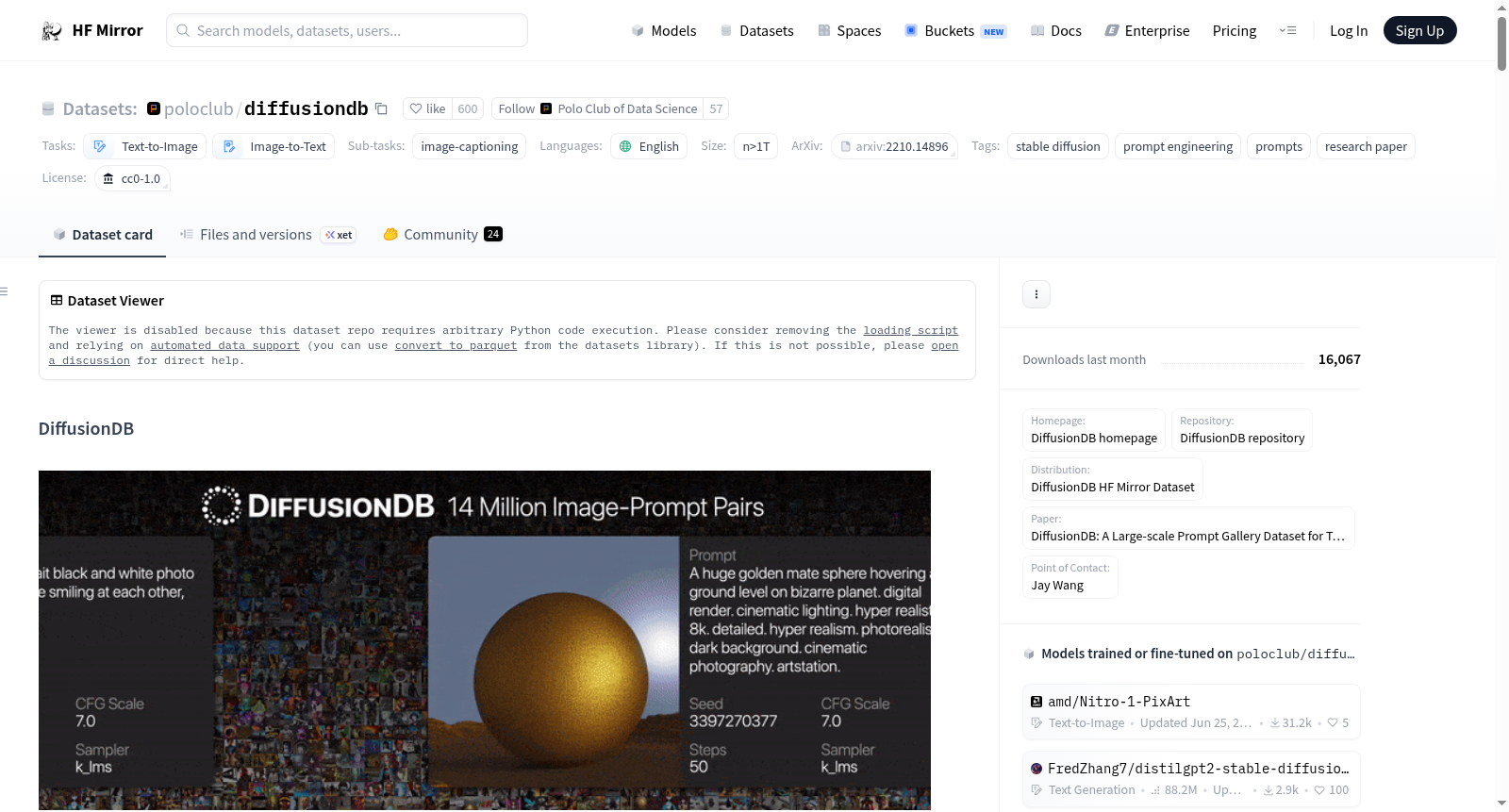
DiffusionDB is the first large-scale text-to-image prompt dataset. It contains **14 million** images generated by Stable Diffusion using prompts and hyperparameters specified by real users.
DiffusionDB is publicly available at [🤗 Hugging Face Dataset](https://huggingface.co/datasets/poloclub/diffusiondb).
### Supported Tasks and Leaderboards
The unprecedented scale and diversity of this human-actuated dataset provide exciting research opportunities in understanding the interplay between prompts and generative models, detecting deepfakes, and designing human-AI interaction tools to help users more easily use these models.
### Languages
The text in the dataset is mostly English. It also contains other languages such as Spanish, Chinese, and Russian.
### Two Subsets
DiffusionDB provides two subsets (DiffusionDB 2M and DiffusionDB Large) to support different needs.
|Subset|Num of Images|Num of Unique Prompts|Size|Image Directory|Metadata Table|
|:--|--:|--:|--:|--:|--:|
|DiffusionDB 2M|2M|1.5M|1.6TB|`images/`|`metadata.parquet`|
|DiffusionDB Large|14M|1.8M|6.5TB|`diffusiondb-large-part-1/` `diffusiondb-large-part-2/`|`metadata-large.parquet`|
##### Key Differences
1. Two subsets have a similar number of unique prompts, but DiffusionDB Large has much more images. DiffusionDB Large is a superset of DiffusionDB 2M.
2. Images in DiffusionDB 2M are stored in `png` format; images in DiffusionDB Large use a lossless `webp` format.
## Dataset Structure
We use a modularized file structure to distribute DiffusionDB. The 2 million images in DiffusionDB 2M are split into 2,000 folders, where each folder contains 1,000 images and a JSON file that links these 1,000 images to their prompts and hyperparameters. Similarly, the 14 million images in DiffusionDB Large are split into 14,000 folders.
```bash
# DiffusionDB 2M
./
├── images
│ ├── part-000001
│ │ ├── 3bfcd9cf-26ea-4303-bbe1-b095853f5360.png
│ │ ├── 5f47c66c-51d4-4f2c-a872-a68518f44adb.png
│ │ ├── 66b428b9-55dc-4907-b116-55aaa887de30.png
│ │ ├── [...]
│ │ └── part-000001.json
│ ├── part-000002
│ ├── part-000003
│ ├── [...]
│ └── part-002000
└── metadata.parquet
```
```bash
# DiffusionDB Large
./
├── diffusiondb-large-part-1
│ ├── part-000001
│ │ ├── 0a8dc864-1616-4961-ac18-3fcdf76d3b08.webp
│ │ ├── 0a25cacb-5d91-4f27-b18a-bd423762f811.webp
│ │ ├── 0a52d584-4211-43a0-99ef-f5640ee2fc8c.webp
│ │ ├── [...]
│ │ └── part-000001.json
│ ├── part-000002
│ ├── part-000003
│ ├── [...]
│ └── part-010000
├── diffusiondb-large-part-2
│ ├── part-010001
│ │ ├── 0a68f671-3776-424c-91b6-c09a0dd6fc2d.webp
│ │ ├── 0a0756e9-1249-4fe2-a21a-12c43656c7a3.webp
│ │ ├── 0aa48f3d-f2d9-40a8-a800-c2c651ebba06.webp
│ │ ├── [...]
│ │ └── part-000001.json
│ ├── part-010002
│ ├── part-010003
│ ├── [...]
│ └── part-014000
└── metadata-large.parquet
```
These sub-folders have names `part-0xxxxx`, and each image has a unique name generated by [UUID Version 4](https://en.wikipedia.org/wiki/Universally_unique_identifier). The JSON file in a sub-folder has the same name as the sub-folder. Each image is a `PNG` file (DiffusionDB 2M) or a lossless `WebP` file (DiffusionDB Large). The JSON file contains key-value pairs mapping image filenames to their prompts and hyperparameters.
### Data Instances
For example, below is the image of `f3501e05-aef7-4225-a9e9-f516527408ac.png` and its key-value pair in `part-000001.json`.
<img width="300" src="https://i.imgur.com/gqWcRs2.png">
```json
{
"f3501e05-aef7-4225-a9e9-f516527408ac.png": {
"p": "geodesic landscape, john chamberlain, christopher balaskas, tadao ando, 4 k, ",
"se": 38753269,
"c": 12.0,
"st": 50,
"sa": "k_lms"
},
}
```
### Data Fields
- key: Unique image name
- `p`: Prompt
- `se`: Random seed
- `c`: CFG Scale (guidance scale)
- `st`: Steps
- `sa`: Sampler
### Dataset Metadata
To help you easily access prompts and other attributes of images without downloading all the Zip files, we include two metadata tables `metadata.parquet` and `metadata-large.parquet` for DiffusionDB 2M and DiffusionDB Large, respectively.
The shape of `metadata.parquet` is (2000000, 13) and the shape of `metatable-large.parquet` is (14000000, 13). Two tables share the same schema, and each row represents an image. We store these tables in the Parquet format because Parquet is column-based: you can efficiently query individual columns (e.g., prompts) without reading the entire table.
Below are three random rows from `metadata.parquet`.
| image_name | prompt | part_id | seed | step | cfg | sampler | width | height | user_name | timestamp | image_nsfw | prompt_nsfw |
|:-----------------------------------------|:-------------------------------------------------------------------------------------------------------------------------------------------------------------------------------------------------------------------------------------------------------------------------------------------------------------------------------------------------------------------------------------------------------------------------------------------------------------------------------|----------:|-----------:|-------:|------:|----------:|--------:|---------:|:-----------------------------------------------------------------|:--------------------------|-------------:|--------------:|
| 0c46f719-1679-4c64-9ba9-f181e0eae811.png | a small liquid sculpture, corvette, viscous, reflective, digital art | 1050 | 2026845913 | 50 | 7 | 8 | 512 | 512 | c2f288a2ba9df65c38386ffaaf7749106fed29311835b63d578405db9dbcafdb | 2022-08-11 09:05:00+00:00 | 0.0845108 | 0.00383462 |
| a00bdeaa-14eb-4f6c-a303-97732177eae9.png | human sculpture of lanky tall alien on a romantic date at italian restaurant with smiling woman, nice restaurant, photography, bokeh | 905 | 1183522603 | 50 | 10 | 8 | 512 | 768 | df778e253e6d32168eb22279a9776b3cde107cc82da05517dd6d114724918651 | 2022-08-19 17:55:00+00:00 | 0.692934 | 0.109437 |
| 6e5024ce-65ed-47f3-b296-edb2813e3c5b.png | portrait of barbaric spanish conquistador, symmetrical, by yoichi hatakenaka, studio ghibli and dan mumford | 286 | 1713292358 | 50 | 7 | 8 | 512 | 640 | 1c2e93cfb1430adbd956be9c690705fe295cbee7d9ac12de1953ce5e76d89906 | 2022-08-12 03:26:00+00:00 | 0.0773138 | 0.0249675 |
#### Metadata Schema
`metadata.parquet` and `metatable-large.parquet` share the same schema.
|Column|Type|Description|
|:---|:---|:---|
|`image_name`|`string`|Image UUID filename.|
|`prompt`|`string`|The text prompt used to generate this image.|
|`part_id`|`uint16`|Folder ID of this image.|
|`seed`|`uint32`| Random seed used to generate this image.|
|`step`|`uint16`| Step count (hyperparameter).|
|`cfg`|`float32`| Guidance scale (hyperparameter).|
|`sampler`|`uint8`| Sampler method (hyperparameter). Mapping: `{1: "ddim", 2: "plms", 3: "k_euler", 4: "k_euler_ancestral", 5: "k_heun", 6: "k_dpm_2", 7: "k_dpm_2_ancestral", 8: "k_lms", 9: "others"}`.
|`width`|`uint16`|Image width.|
|`height`|`uint16`|Image height.|
|`user_name`|`string`|The unique discord ID's SHA256 hash of the user who generated this image. For example, the hash for `xiaohk#3146` is `e285b7ef63be99e9107cecd79b280bde602f17e0ca8363cb7a0889b67f0b5ed0`. "deleted_account" refer to users who have deleted their accounts. None means the image has been deleted before we scrape it for the second time.|
|`timestamp`|`timestamp`|UTC Timestamp when this image was generated. None means the image has been deleted before we scrape it for the second time. Note that timestamp is not accurate for duplicate images that have the same prompt, hypareparameters, width, height.|
|`image_nsfw`|`float32`|Likelihood of an image being NSFW. Scores are predicted by [LAION's state-of-art NSFW detector](https://github.com/LAION-AI/LAION-SAFETY) (range from 0 to 1). A score of 2.0 means the image has already been flagged as NSFW and blurred by Stable Diffusion.|
|`prompt_nsfw`|`float32`|Likelihood of a prompt being NSFW. Scores are predicted by the library [Detoxicy](https://github.com/unitaryai/detoxify). Each score represents the maximum of `toxicity` and `sexual_explicit` (range from 0 to 1).|
> **Warning**
> Although the Stable Diffusion model has an NSFW filter that automatically blurs user-generated NSFW images, this NSFW filter is not perfect—DiffusionDB still contains some NSFW images. Therefore, we compute and provide the NSFW scores for images and prompts using the state-of-the-art models. The distribution of these scores is shown below. Please decide an appropriate NSFW score threshold to filter out NSFW images before using DiffusionDB in your projects.
<img src="https://i.imgur.com/1RiGAXL.png" width="100%">
### Data Splits
For DiffusionDB 2M, we split 2 million images into 2,000 folders where each folder contains 1,000 images and a JSON file. For DiffusionDB Large, we split 14 million images into 14,000 folders where each folder contains 1,000 images and a JSON file.
### Loading Data Subsets
DiffusionDB is large (1.6TB or 6.5 TB)! However, with our modularized file structure, you can easily load a desirable number of images and their prompts and hyperparameters. In the [`example-loading.ipynb`](https://github.com/poloclub/diffusiondb/blob/main/notebooks/example-loading.ipynb) notebook, we demonstrate three methods to load a subset of DiffusionDB. Below is a short summary.
#### Method 1: Using Hugging Face Datasets Loader
You can use the Hugging Face [`Datasets`](https://huggingface.co/docs/datasets/quickstart) library to easily load prompts and images from DiffusionDB. We pre-defined 16 DiffusionDB subsets (configurations) based on the number of instances. You can see all subsets in the [Dataset Preview](https://huggingface.co/datasets/poloclub/diffusiondb/viewer/all/train).
```python
import numpy as np
from datasets import load_dataset
# Load the dataset with the `large_random_1k` subset
dataset = load_dataset('poloclub/diffusiondb', 'large_random_1k')
```
#### Method 2. Use the PoloClub Downloader
This repo includes a Python downloader [`download.py`](https://github.com/poloclub/diffusiondb/blob/main/scripts/download.py) that allows you to download and load DiffusionDB. You can use it from your command line. Below is an example of loading a subset of DiffusionDB.
##### Usage/Examples
The script is run using command-line arguments as follows:
- `-i` `--index` - File to download or lower bound of a range of files if `-r` is also set.
- `-r` `--range` - Upper bound of range of files to download if `-i` is set.
- `-o` `--output` - Name of custom output directory. Defaults to the current directory if not set.
- `-z` `--unzip` - Unzip the file/files after downloading
- `-l` `--large` - Download from Diffusion DB Large. Defaults to Diffusion DB 2M.
###### Downloading a single file
The specific file to download is supplied as the number at the end of the file on HuggingFace. The script will automatically pad the number out and generate the URL.
```bash
python download.py -i 23
```
###### Downloading a range of files
The upper and lower bounds of the set of files to download are set by the `-i` and `-r` flags respectively.
```bash
python download.py -i 1 -r 2000
```
Note that this range will download the entire dataset. The script will ask you to confirm that you have 1.7Tb free at the download destination.
###### Downloading to a specific directory
The script will default to the location of the dataset's `part` .zip files at `images/`. If you wish to move the download location, you should move these files as well or use a symbolic link.
```bash
python download.py -i 1 -r 2000 -o /home/$USER/datahoarding/etc
```
Again, the script will automatically add the `/` between the directory and the file when it downloads.
###### Setting the files to unzip once they've been downloaded
The script is set to unzip the files _after_ all files have downloaded as both can be lengthy processes in certain circumstances.
```bash
python download.py -i 1 -r 2000 -z
```
#### Method 3. Use `metadata.parquet` (Text Only)
If your task does not require images, then you can easily access all 2 million prompts and hyperparameters in the `metadata.parquet` table.
```python
from urllib.request import urlretrieve
import pandas as pd
# Download the parquet table
table_url = f'https://huggingface.co/datasets/poloclub/diffusiondb/resolve/main/metadata.parquet'
urlretrieve(table_url, 'metadata.parquet')
# Read the table using Pandas
metadata_df = pd.read_parquet('metadata.parquet')
```
## Dataset Creation
### Curation Rationale
Recent diffusion models have gained immense popularity by enabling high-quality and controllable image generation based on text prompts written in natural language. Since the release of these models, people from different domains have quickly applied them to create award-winning artworks, synthetic radiology images, and even hyper-realistic videos.
However, generating images with desired details is difficult, as it requires users to write proper prompts specifying the exact expected results. Developing such prompts requires trial and error, and can often feel random and unprincipled. Simon Willison analogizes writing prompts to wizards learning “magical spells”: users do not understand why some prompts work, but they will add these prompts to their “spell book.” For example, to generate highly-detailed images, it has become a common practice to add special keywords such as “trending on artstation” and “unreal engine” in the prompt.
Prompt engineering has become a field of study in the context of text-to-text generation, where researchers systematically investigate how to construct prompts to effectively solve different down-stream tasks. As large text-to-image models are relatively new, there is a pressing need to understand how these models react to prompts, how to write effective prompts, and how to design tools to help users generate images.
To help researchers tackle these critical challenges, we create DiffusionDB, the first large-scale prompt dataset with 14 million real prompt-image pairs.
### Source Data
#### Initial Data Collection and Normalization
We construct DiffusionDB by scraping user-generated images on the official Stable Diffusion Discord server. We choose Stable Diffusion because it is currently the only open-source large text-to-image generative model, and all generated images have a CC0 1.0 Universal Public Domain Dedication license that waives all copyright and allows uses for any purpose. We choose the official [Stable Diffusion Discord server](https://discord.gg/stablediffusion) because it is public, and it has strict rules against generating and sharing illegal, hateful, or NSFW (not suitable for work, such as sexual and violent content) images. The server also disallows users to write or share prompts with personal information.
#### Who are the source language producers?
The language producers are users of the official [Stable Diffusion Discord server](https://discord.gg/stablediffusion).
### Annotations
The dataset does not contain any additional annotations.
#### Annotation process
[N/A]
#### Who are the annotators?
[N/A]
### Personal and Sensitive Information
The authors removed the discord usernames from the dataset.
We decide to anonymize the dataset because some prompts might include sensitive information: explicitly linking them to their creators can cause harm to creators.
## Considerations for Using the Data
### Social Impact of Dataset
The purpose of this dataset is to help develop better understanding of large text-to-image generative models.
The unprecedented scale and diversity of this human-actuated dataset provide exciting research opportunities in understanding the interplay between prompts and generative models, detecting deepfakes, and designing human-AI interaction tools to help users more easily use these models.
It should note that we collect images and their prompts from the Stable Diffusion Discord server. The Discord server has rules against users generating or sharing harmful or NSFW (not suitable for work, such as sexual and violent content) images. The Stable Diffusion model used in the server also has an NSFW filter that blurs the generated images if it detects NSFW content. However, it is still possible that some users had generated harmful images that were not detected by the NSFW filter or removed by the server moderators. Therefore, DiffusionDB can potentially contain these images. To mitigate the potential harm, we provide a [Google Form](https://forms.gle/GbYaSpRNYqxCafMZ9) on the [DiffusionDB website](https://poloclub.github.io/diffusiondb/) where users can report harmful or inappropriate images and prompts. We will closely monitor this form and remove reported images and prompts from DiffusionDB.
### Discussion of Biases
The 14 million images in DiffusionDB have diverse styles and categories. However, Discord can be a biased data source. Our images come from channels where early users could use a bot to use Stable Diffusion before release. As these users had started using Stable Diffusion before the model was public, we hypothesize that they are AI art enthusiasts and are likely to have experience with other text-to-image generative models. Therefore, the prompting style in DiffusionDB might not represent novice users. Similarly, the prompts in DiffusionDB might not generalize to domains that require specific knowledge, such as medical images.
### Other Known Limitations
**Generalizability.** Previous research has shown a prompt that works well on one generative model might not give the optimal result when used in other models.
Therefore, different models can need users to write different prompts. For example, many Stable Diffusion prompts use commas to separate keywords, while this pattern is less seen in prompts for DALL-E 2 or Midjourney. Thus, we caution researchers that some research findings from DiffusionDB might not be generalizable to other text-to-image generative models.
## Additional Information
### Dataset Curators
DiffusionDB is created by [Jay Wang](https://zijie.wang), [Evan Montoya](https://www.linkedin.com/in/evan-montoya-b252391b4/), [David Munechika](https://www.linkedin.com/in/dmunechika/), [Alex Yang](https://alexanderyang.me), [Ben Hoover](https://www.bhoov.com), [Polo Chau](https://faculty.cc.gatech.edu/~dchau/).
### Licensing Information
The DiffusionDB dataset is available under the [CC0 1.0 License](https://creativecommons.org/publicdomain/zero/1.0/).
The Python code in this repository is available under the [MIT License](https://github.com/poloclub/diffusiondb/blob/main/LICENSE).
### Citation Information
```bibtex
@article{wangDiffusionDBLargescalePrompt2022,
title = {{{DiffusionDB}}: {{A}} Large-Scale Prompt Gallery Dataset for Text-to-Image Generative Models},
author = {Wang, Zijie J. and Montoya, Evan and Munechika, David and Yang, Haoyang and Hoover, Benjamin and Chau, Duen Horng},
year = {2022},
journal = {arXiv:2210.14896 [cs]},
url = {https://arxiv.org/abs/2210.14896}
}
```
### Contributions
If you have any questions, feel free to [open an issue](https://github.com/poloclub/diffusiondb/issues/new) or contact [Jay Wang](https://zijie.wang).
提供机构:
poloclub
原始信息汇总
数据集概述
数据集名称
- 名称: DiffusionDB
- 别名: 无
数据集基本信息
- 语言: 主要为英语,包含西班牙语、中文和俄语等多种语言
- 许可证: CC0-1.0
- 多语言性: 多语言
- 数据集大小: 超过1TB
- 源数据集: 原始数据
- 标签: 稳定扩散、提示工程、提示、研究论文
- 任务类别: 文本到图像、图像到文本
- 任务ID: 图像标题生成
数据集详细描述
数据集总结
- 描述: DiffusionDB是首个大规模文本到图像提示数据集,包含1400万张由Stable Diffusion使用真实用户指定的提示和超参数生成的图像。
- 可用性: 数据集公开可用,可通过Hugging Face Dataset访问。
支持的任务和排行榜
- 研究机会: 数据集的大规模和多样性为理解提示与生成模型之间的交互、检测深度伪造以及设计人机交互工具提供了研究机会。
语言
- 主要语言: 英语
- 其他语言: 西班牙语、中文、俄语等
两个子集
- 子集1: DiffusionDB 2M
- 图像数量: 200万
- 唯一提示数量: 150万
- 大小: 1.6TB
- 图像格式: PNG
- 子集2: DiffusionDB Large
- 图像数量: 1400万
- 唯一提示数量: 180万
- 大小: 6.5TB
- 图像格式: WebP
关键差异
- 图像数量: DiffusionDB Large包含更多图像,是DiffusionDB 2M的超集。
- 图像格式: DiffusionDB 2M使用PNG格式,而DiffusionDB Large使用WebP格式。
数据集结构
数据实例
- 图像命名: 使用UUID版本4生成唯一名称
- JSON文件: 每个子文件夹包含一个JSON文件,链接1000张图像到其提示和超参数
数据字段
- 键: 唯一图像名称
- p: 提示
- se: 随机种子
- c: CFG比例(指导比例)
- st: 步骤
- sa: 采样器
数据集元数据
- 元数据表:
metadata.parquet和metadata-large.parquet - 元数据模式: 包含图像名称、提示、部分ID、种子、步骤、CFG、采样器、宽度、高度、用户名称、时间戳、图像NSFW评分、提示NSFW评分
数据集创建
源数据
- 数据收集: 通过官方Stable Diffusion Discord服务器收集用户生成的图像
- 数据规范: 所有生成的图像均采用CC0 1.0通用公共领域奉献许可证
注释
- 注释过程: 无注释
- 注释者: 无
个人和敏感信息
- 信息处理: 使用SHA256哈希处理用户名,以保护用户隐私
使用数据集的考虑
社会影响
- 影响: 数据集有助于理解和改进文本到图像的生成过程,可能影响艺术、设计等领域
偏见讨论
- 偏见: 数据集可能反映用户社区的偏见,需进一步分析和处理
其他已知限制
- 限制: 数据集包含一些NSFW内容,使用时需设置适当的NSFW评分阈值进行过滤
附加信息
数据集管理员
- 管理员: 未提供具体信息
许可信息
- 许可证: CC0-1.0
引用信息
- 引用: 未提供具体信息
贡献
- 贡献: 未提供具体信息
搜集汇总
数据集介绍
构建方式
在文本到图像生成模型迅速发展的背景下,DiffusionDB的构建采用了系统化的数据采集方法。该数据集通过爬取官方Stable Diffusion Discord服务器上用户生成的图像与对应提示词,汇集了1400万条真实的提示-图像对。所有图像均遵循CC0 1.0许可证,确保了数据的开放性与合法性。数据以模块化结构组织,分为包含200万图像的DiffusionDB 2M和包含1400万图像的DiffusionDB Large两个子集,每个子集进一步分割为多个文件夹,每个文件夹存储1000张图像及关联的JSON元数据文件,便于高效访问与管理。
特点
DiffusionDB作为首个大规模文本到图像提示数据集,其核心特点在于规模宏大与多样性丰富。数据集涵盖超过180万条独特提示,涉及多语言内容,主要以英语为主,同时包含西班牙语、中文和俄语等。每个数据实例均提供完整的生成参数,包括随机种子、CFG引导尺度、步数及采样器类型等关键超参数。此外,数据集还引入了图像与提示的NSFW安全评分,基于先进模型计算,为用户提供了可靠的内容过滤依据。图像格式上,2M子集采用PNG格式,Large子集则使用无损WebP格式,兼顾了质量与存储效率。
使用方法
为便于研究与应用,DiffusionDB提供了多种灵活的数据加载方式。用户可通过Hugging Face Datasets库直接加载预定义的子集,如large_random_1k,快速获取图像与元数据。对于需要定制化下载的场景,可使用附带的Python下载脚本,支持按文件索引或范围下载,并可指定输出目录与解压选项。若任务仅需文本信息,可直接访问metadata.parquet或metadata-large.parquet元数据表,这些列式存储的Parquet文件支持高效查询提示词与超参数,无需下载完整图像数据,显著降低了使用门槛与资源消耗。
背景与挑战
背景概述
随着扩散模型在文本到图像生成领域的迅速崛起,其生成的高质量与可控性吸引了跨学科研究者的广泛关注。由佐治亚理工学院Polo Club of Data Science的研究团队于2022年创建的DiffusionDB,作为首个大规模文本到图像提示数据集,收录了来自Stable Diffusion官方Discord服务器用户生成的1400万条真实提示-图像对。该数据集的核心研究问题聚焦于揭示提示词与生成模型之间的复杂交互机制,旨在推动提示工程、深度伪造检测以及人机交互工具设计的系统性探索。DiffusionDB的公开不仅填补了该领域大规模实证数据的空白,也为理解生成式人工智能的社会影响提供了关键资源。
当前挑战
DiffusionDB所针对的文本到图像生成领域,其核心挑战在于提示词工程缺乏系统化原则,用户往往依赖试错与经验性“咒语”来获得理想输出,这导致生成过程具有高度不确定性与不可解释性。在数据集构建过程中,团队面临多重技术难题:首先,从动态的Discord平台高效爬取海量图像与元数据需设计稳健的流水线,确保数据完整性;其次,处理高达6.5TB的存储规模要求设计模块化文件结构以支持灵活的子集加载;此外,数据中包含的未完全过滤的NSFW内容需借助先进检测模型进行标注,以平衡开放性与安全性;最后,在遵循CC0许可证的同时,需妥善处理用户隐私信息,如对用户ID进行哈希化处理,以符合伦理规范。
常用场景
经典使用场景
在文本到图像生成模型的研究领域中,DiffusionDB作为首个大规模提示词-图像配对数据集,为探索提示工程与生成模型之间的复杂互动提供了关键资源。该数据集通过整合来自真实用户的1400万条提示及其对应图像,使得研究人员能够深入分析不同提示结构、超参数设置对生成结果的影响,从而揭示模型内部工作机制与人类创意表达之间的关联。
衍生相关工作
基于DiffusionDB的丰富数据,学术界已衍生出多项经典研究,包括提示词优化算法、生成模型评估框架以及跨模态理解模型。例如,部分工作专注于从海量提示中自动提取有效模式,以指导用户撰写高质量提示;另一些研究则利用该数据集训练检测模型,以识别人工智能生成内容,为数字媒体真实性验证提供技术方案。
数据集最近研究
最新研究方向
在生成式人工智能迅猛发展的背景下,DiffusionDB作为首个大规模文本到图像提示数据集,为探索提示工程与模型交互机制提供了关键资源。当前研究聚焦于利用其海量真实用户生成的提示-图像对,深入分析提示语义与生成图像质量之间的复杂映射关系,以优化提示设计策略。同时,该数据集正被用于开发深度伪造检测算法,通过理解生成图像的固有特征来提升识别精度。此外,结合人类反馈强化学习,研究人员正构建更直观的人机交互工具,旨在降低用户使用门槛,推动生成式AI技术的民主化与负责任应用。这些研究方向不仅回应了技术可解释性与安全性的社会关切,也为艺术创作、教育等跨领域应用奠定了数据基础。
以上内容由遇见数据集搜集并总结生成



