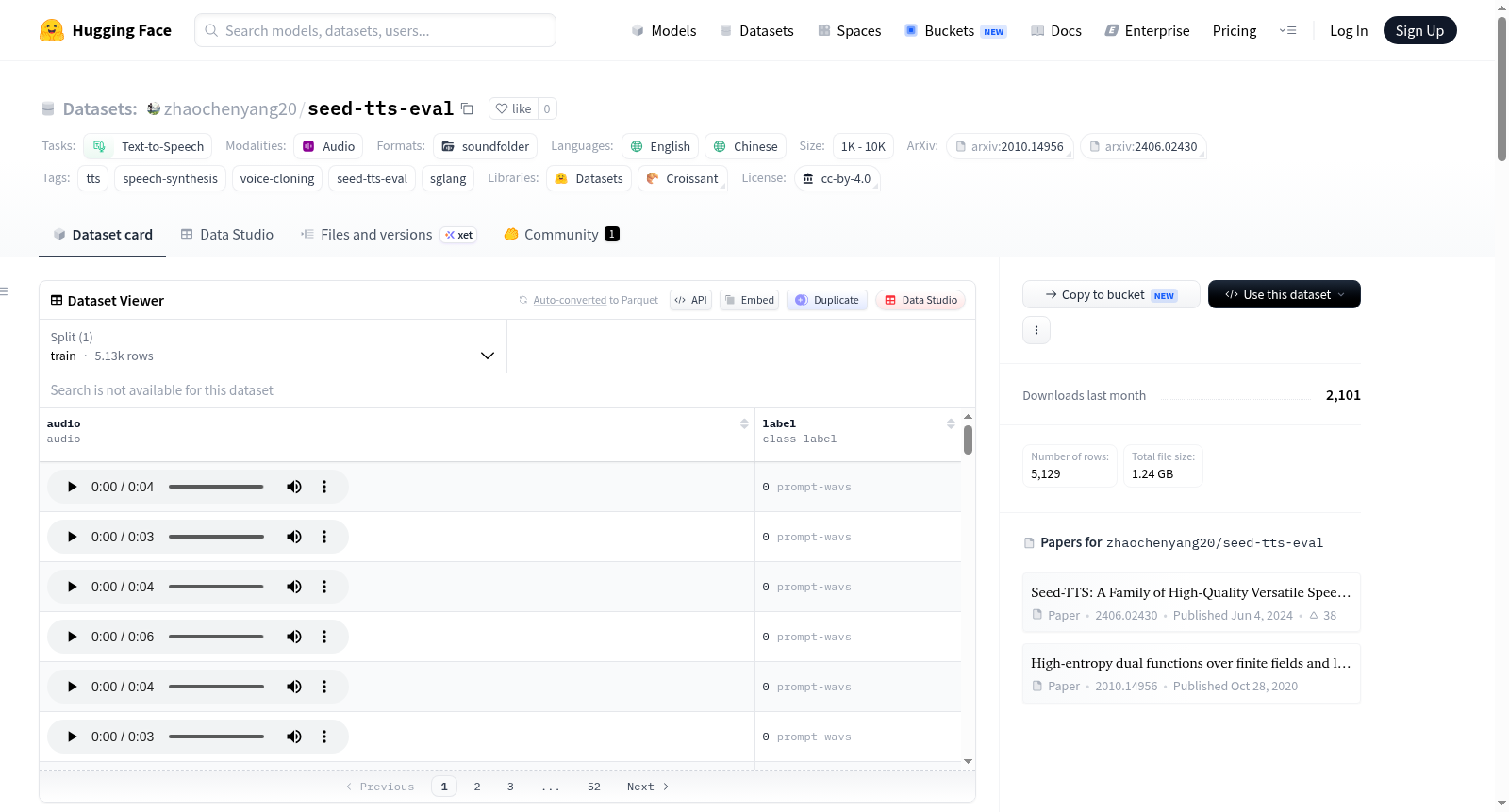
zhaochenyang20/seed-tts-eval
收藏资源简介:
--- license: cc-by-4.0 task_categories: - text-to-speech language: - en - zh tags: - tts - speech-synthesis - voice-cloning - seed-tts-eval - sglang pretty_name: seed-tts-eval size_categories: - 1K<n<10K --- # seed-tts-eval A preprocessed copy of the [seed-tts-eval](https://github.com/BytedanceSpeech/seed-tts-eval) test set, used by [SGLang Omni](https://github.com/sgl-project/sglang-omni) for TTS benchmarking (WER and speed evaluation). We thank the researchers of ByteDance for releasing the original evaluation data and methodology. This dataset simply reorganizes their test sets into a single Hugging Face repository for convenience. ## Evaluation Sets This dataset contains 5 evaluation sets across English and Chinese: | # | File | Language | Samples | Columns | Difficulty | Description | |---|---|---|---|---|---|---| | 1 | `en/meta.lst` | English | 1,088 | 4 | Standard | Same-speaker voice cloning (CommonVoice) | | 2 | `zh/meta.lst` | Chinese | 2,020 | 4 | Standard | Same-speaker voice cloning (DiDiSpeech-2) | | 3 | `en/non_para_reconstruct_meta.lst` | English | 1,086 | 5 | Hard | Cross-speaker voice cloning | | 4 | `zh/non_para_reconstruct_meta.lst` | Chinese | 2,018 | 5 | Hard | Cross-speaker voice cloning | | 5 | `zh/hardcase.lst` | Chinese | 400 | 4 | Hard | Tongue twisters and repetition patterns | Sets 1 and 2 (`en/meta.lst` and `zh/meta.lst`) are the standard evaluation sets used by SGLang Omni benchmarks. Note: Hugging Face may display ~5K samples on this page. That number comes from the auto-detected `audiofolder` format counting every `.wav` file (both prompt wavs and target wavs) individually. The actual evaluation sample counts are listed in the table above. ## File Format ### Standard sets (4 columns) In `en/meta.lst`, `zh/meta.lst`, and `zh/hardcase.lst`, each line contains the following columns: ``` utterance_id | prompt_text | prompt_wav_path | target_text ``` | Column | Description | |---|---| | `utterance_id` | Unique sample identifier | | `prompt_text` | Transcript of the prompt (reference) audio | | `prompt_wav_path` | Relative path to the prompt audio file (e.g., `prompt-wavs/xxx.wav`) | | `target_text` | Text to be synthesized by the TTS model | ``` common_voice_en_10119832-common_voice_en_10119840|We asked over twenty different people, and they all said it was his.|prompt-wavs/common_voice_en_10119832.wav|Get the trust fund to the bank early. ``` ### Cross-speaker sets (5 columns) In `en/non_para_reconstruct_meta.lst` and `zh/non_para_reconstruct_meta.lst`, each line contains the following columns: ``` utterance_id | prompt_text | prompt_wav_path | target_text | target_wav_path ``` In addition to the 4 columns, these files have an additional 5th column: | Column | Description | |---|---| | `target_wav_path` | Relative path to the ground-truth target audio (for reconstruction-based evaluation) | In cross-speaker sets, the prompt speaker and the target speaker are different people, making voice cloning significantly harder. ## Set Details ### English Standard (`en/meta.lst`) 1,088 samples from [CommonVoice](https://commonvoice.mozilla.org/). The prompt audio and the target text come from the same speaker, testing parallel (same-speaker) voice cloning. ### Chinese Standard (`zh/meta.lst`) 2,020 samples from [DiDiSpeech-2](https://arxiv.org/abs/2010.14956). Same-speaker voice cloning, analogous to the English set. ### English Cross-Speaker (`en/non_para_reconstruct_meta.lst`) 1,086 samples. The prompt and target are from different speakers -- the model must synthesize the target text in the prompt speaker's voice, without having heard that speaker say anything similar. Shares the same target texts as set 1. ### Chinese Cross-Speaker (`zh/non_para_reconstruct_meta.lst`) 2,018 samples. Cross-speaker Chinese evaluation, analogous to set 3. Shares the same target texts as set 2. ### Chinese Hard Cases (`zh/hardcase.lst`) 400 samples split into two categories: - Tongue twisters (绕口令, `raokouling-*`): 200 samples with phonetically challenging sentences designed to stress-test pronunciation accuracy. - Repetition patterns: 200 samples with repetitive or stutter-prone text patterns. ## Usage ```bash # Download the full dataset huggingface-cli download zhaochenyang20/seed-tts-eval \ --repo-type dataset --local-dir seedtts_testset ``` For CI testing, a minimal subset is available at [`zhaochenyang20/seed-tts-eval-mini`](https://huggingface.co/datasets/zhaochenyang20/seed-tts-eval-mini). ## Directory Structure ``` seed-tts-eval/ ├── en/ │ ├── meta.lst # Standard English eval (1,088 samples) │ ├── non_para_reconstruct_meta.lst # Cross-speaker English eval (1,086 samples) │ ├── prompt-wavs/ # Reference audio clips (1,007 files) │ └── wavs/ # Ground-truth target audio (1,092 files) └── zh/ ├── meta.lst # Standard Chinese eval (2,020 samples) ├── non_para_reconstruct_meta.lst # Cross-speaker Chinese eval (2,018 samples) ├── hardcase.lst # Tongue twisters + repetition (400 samples) ├── prompt-wavs/ # Reference audio clips (1,010 files) └── wavs/ # Ground-truth target audio (2,020 files) ``` ## Citation If you use this dataset, please cite the original seed-tts-eval work: ```bibtex @article{anastassiou2024seed, title={Seed-TTS: A Family of High-Quality Versatile Speech Generation Models}, author={Anastassiou, Philip and others}, journal={arXiv preprint arXiv:2406.02430}, year={2024} } ```
license: cc-by-4.0 任务类别: - 文本转语音(text-to-speech) 语言: - 英语 - 汉语 标签: - tts - 语音合成(speech-synthesis) - 语音克隆(voice-cloning) - seed-tts-eval - sglang 展示名称:seed-tts-eval 样本量级: - 1K<n<10K --- # seed-tts-eval 本数据集为[seed-tts-eval](https://github.com/BytedanceSpeech/seed-tts-eval)测试集的预处理副本,由[SGLang Omni](https://github.com/sgl-project/sglang-omni)用于文本转语音(TTS)基准测试(词错误率(WER)与速度评估)。 我们感谢字节跳动的研究者发布原始评估数据与评估方法,本数据集仅将其测试集整合至单个Hugging Face仓库以方便使用。 ## 评估集 本数据集包含覆盖英语与汉语的5个评估集: | 序号 | 文件路径 | 语言 | 样本数 | 列数 | 难度等级 | 描述 | |---|---|---|---|---|---|---| | 1 | `en/meta.lst` | 英语 | 1,088 | 4 | 标准 | 同说话人语音克隆(源自CommonVoice) | | 2 | `zh/meta.lst` | 汉语 | 2,020 | 4 | 标准 | 同说话人语音克隆(源自DiDiSpeech-2) | | 3 | `en/non_para_reconstruct_meta.lst` | 英语 | 1,086 | 5 | 困难 | 跨说话人语音克隆 | | 4 | `zh/non_para_reconstruct_meta.lst` | 汉语 | 2,018 | 5 | 困难 | 跨说话人语音克隆 | | 5 | `zh/hardcase.lst` | 汉语 | 400 | 4 | 困难 | 绕口令与重复模式文本 | 评估集1与2(`en/meta.lst`与`zh/meta.lst`)为SGLang Omni基准测试所使用的标准评估集。 注:Hugging Face在此页面显示的样本数约为5000,该数值来自自动检测的`audiofolder`格式对每个.wav文件(包括提示音频与目标音频)的单独计数。实际评估样本数详见上表。 ## 文件格式 ### 标准评估集(4列) 在`en/meta.lst`、`zh/meta.lst`与`zh/hardcase.lst`中,每行包含以下列: utterance_id | prompt_text | prompt_wav_path | target_text | 列名 | 描述 | |---|---| | `utterance_id` | 唯一样本标识符 | | `prompt_text` | 提示(参考)音频的转录文本 | | `prompt_wav_path` | 提示音频文件的相对路径(例如`prompt-wavs/xxx.wav`) | | `target_text` | 待TTS模型合成的目标文本 | 示例行: common_voice_en_10119832-common_voice_en_10119840|We asked over twenty different people, and they all said it was his.|prompt-wavs/common_voice_en_10119832.wav|Get the trust fund to the bank early. ### 跨说话人评估集(5列) 在`en/non_para_reconstruct_meta.lst`与`zh/non_para_reconstruct_meta.lst`中,每行包含以下列: utterance_id | prompt_text | prompt_wav_path | target_text | target_wav_path 相较于4列标准集,此类文件新增第5列: | 列名 | 描述 | |---|---| | `target_wav_path` | 真实目标音频的相对路径(用于基于重构的评估) | 在跨说话人评估集中,提示说话人与目标说话人为不同个体,大幅提升了语音克隆的任务难度。 ## 集详细说明 ### 英语标准集(`en/meta.lst`) 1,088个样本源自[CommonVoice](https://commonvoice.mozilla.org/)。提示音频与目标文本来自同一说话人,用于测试同说话人语音克隆任务。 ### 汉语标准集(`zh/meta.lst`) 2,020个样本源自[DiDiSpeech-2](https://arxiv.org/abs/2010.14956),与英语标准集类似,为同说话人语音克隆任务。 ### 英语跨说话人集(`en/non_para_reconstruct_meta.lst`) 1,086个样本。提示与目标文本来自不同说话人——模型需以提示说话人的音色合成目标文本,且未听过该说话人说出类似内容。与评估集1共享相同的目标文本。 ### 汉语跨说话人集(`zh/non_para_reconstruct_meta.lst`) 2,018个样本,为汉语跨说话人评估任务,与评估集3类似。与评估集2共享相同的目标文本。 ### 汉语困难案例集(`zh/hardcase.lst`) 400个样本分为两类: - 绕口令(`raokouling-*`):200个语音复杂度较高的句子,用于压力测试发音准确率; - 重复模式文本:200个带有重复或易卡顿文本模式的样本。 ## 使用方法 bash # 下载完整数据集 huggingface-cli download zhaochenyang20/seed-tts-eval --repo-type dataset --local-dir seedtts_testset 对于CI测试,可使用位于[`zhaochenyang20/seed-tts-eval-mini`](https://huggingface.co/datasets/zhaochenyang20/seed-tts-eval-mini)的精简子集。 ## 目录结构 seed-tts-eval/ ├── en/ │ ├── meta.lst # 英语标准评估集(1,088个样本) │ ├── non_para_reconstruct_meta.lst # 英语跨说话人评估集(1,086个样本) │ ├── prompt-wavs/ # 参考音频片段(1,007个文件) │ └── wavs/ # 真实目标音频(1,092个文件) └── zh/ ├── meta.lst # 汉语标准评估集(2,020个样本) ├── non_para_reconstruct_meta.lst # 汉语跨说话人评估集(2,018个样本) ├── hardcase.lst # 绕口令与重复模式文本集(400个样本) ├── prompt-wavs/ # 参考音频片段(1,010个文件) └── wavs/ # 真实目标音频(2,020个文件) ## 引用 若使用本数据集,请引用原始seed-tts-eval相关工作: bibtex @article{anastassiou2024seed, title={Seed-TTS: A Family of High-Quality Versatile Speech Generation Models}, author={Anastassiou, Philip and others}, journal={arXiv preprint arXiv:2406.02430}, year={2024} }