
Defense spending as share of GDP in the UK 1980-2024
收藏www.statista.com2024-07-31 更新2025-03-26 收录
下载链接:
https://www.statista.com/statistics/298527/defense-spending-as-share-of-gdp-united-kingdom-uk/
下载链接
链接失效反馈官方服务:
资源简介:
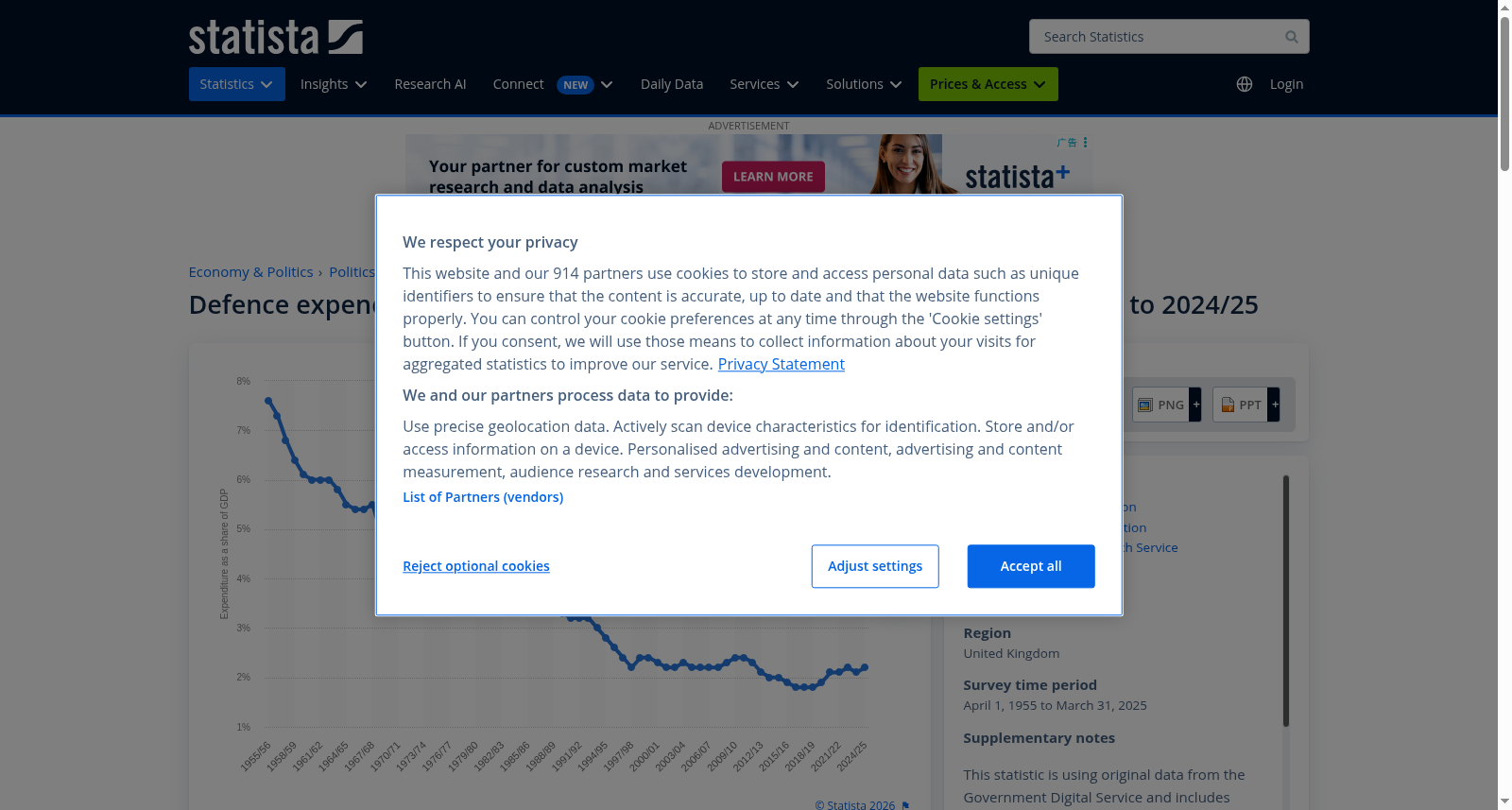
In 2024, the United Kingdom's defence spending as a share of Gross Domestic Product is estimated to be 2.3 percent. Between 1980 and 2024, the UK's defence spending was at its highest in 1984 when 5.5 percent of the UK's GDP was spent on the military. After 1984, defence spending declined gradually, and then at a much faster pace after the end of the Cold War in 1991. It is estimated that defence spending as a share of GDP fell to its lowest level in 2015 when it was two percent.Armed forces fall to record lows in 2024Since the early 1950s, there has been a consistent reduction in the size of the UK's armed forces. The importance of Britain maintaining a large standing army declined following the collapse of the British Empire by the late 1970s, and the end of the Cold War around a decade later. At the start of the 1990s, there were approximately 300,000 personnel in the armed forces, with this falling to 200,000 by 2005. Following a further strategic review of the army's capabilities in 2010, additional cuts to personnel were implemented, with cuts of approximately 50,000 throughout the 2010s. As of 2024, there were 75,320 personnel in the Army, 30,800 in the Royal Air Force, and 32,000 in the Royal Navy and Marines, a total of 138,120 active personnel.The UK and NATOThe UK is one of the 12 founding members of the North Atlantic Treaty Organization (NATO), a military alliance formed in 1949. NATO's initial purpose was to defend Western Europe against the Soviet Union, with its role evolving to include peacekeeping and counter-terrorism after the end of the Cold War. As of 2024, the alliance includes 32 nations, with just two of these (Canada and the United States) outside of Europe. The United States is by far the largest military power in the alliance, dominating in terms of manpower, equipment, and military spending. A return of Donald Trump to the White House in 2025, a well-known skeptic of NATO, could therefore prove difficult for the alliance should he distance the U.S. from Europe's security challenges.
在2024年,英国国防开支占国内生产总值的比例预计将达到2.3%。自1980年至2024年,英国的国防开支在1984年达到峰值,当年军事开支占英国国内生产总值的5.5%。1984年之后,国防开支逐渐减少,在1991年冷战结束之后下降速度更是显著加快。据估计,2015年国防开支占国内生产总值的比例降至最低,当时仅为2%。至2024年,武装力量规模降至历史新低。自1950年代初以来,英国武装力量的规模持续减少。随着20世纪70年代末英国帝国的崩溃以及十年后冷战的结束,维持一支庞大的常备军的重要性逐渐降低。1990年代初,武装力量人员约为30万,到2005年减少至20万。2010年对军队能力进行的进一步战略审查后,实施了额外的裁员,2010年代裁员约5万人。截至2024年,陆军人员为75,320人,皇家空军为30,800人,皇家海军和海军陆战队为32,000人,共计现役人员138,120人。英国与北约:英国是北大西洋公约组织(NATO)的12个创始成员国之一,该军事联盟成立于1949年。北约最初的宗旨是防御西欧免受苏联的威胁,冷战结束后其角色演变为包括维和和反恐。截至2024年,该联盟包括32个国家,其中只有加拿大和美国这两个国家位于欧洲之外。美国是该联盟中军事力量最为强大的国家,在人力、装备和军事开支方面占据主导地位。2025年唐纳德·特朗普重返白宫,作为一个知名的北约怀疑论者,如果他使美国远离欧洲的安全挑战,这可能对联盟构成困难。
提供机构:
Statista
搜集汇总
数据集介绍
背景与挑战
背景概述
该数据集统计了英国从1955/56到2024/25年国防支出占GDP的百分比,展示了长期变化趋势。数据显示,支出比例从1955/56年的最高点7.6%下降到近年来的约2%左右,其中2016/17至2018/19年达到最低点1.8%,反映了冷战后国防开支的显著减少。数据集还包括武装部队规模变化和北约成员背景的补充信息,提供了更全面的国防支出分析视角。
以上内容由遇见数据集搜集并总结生成



