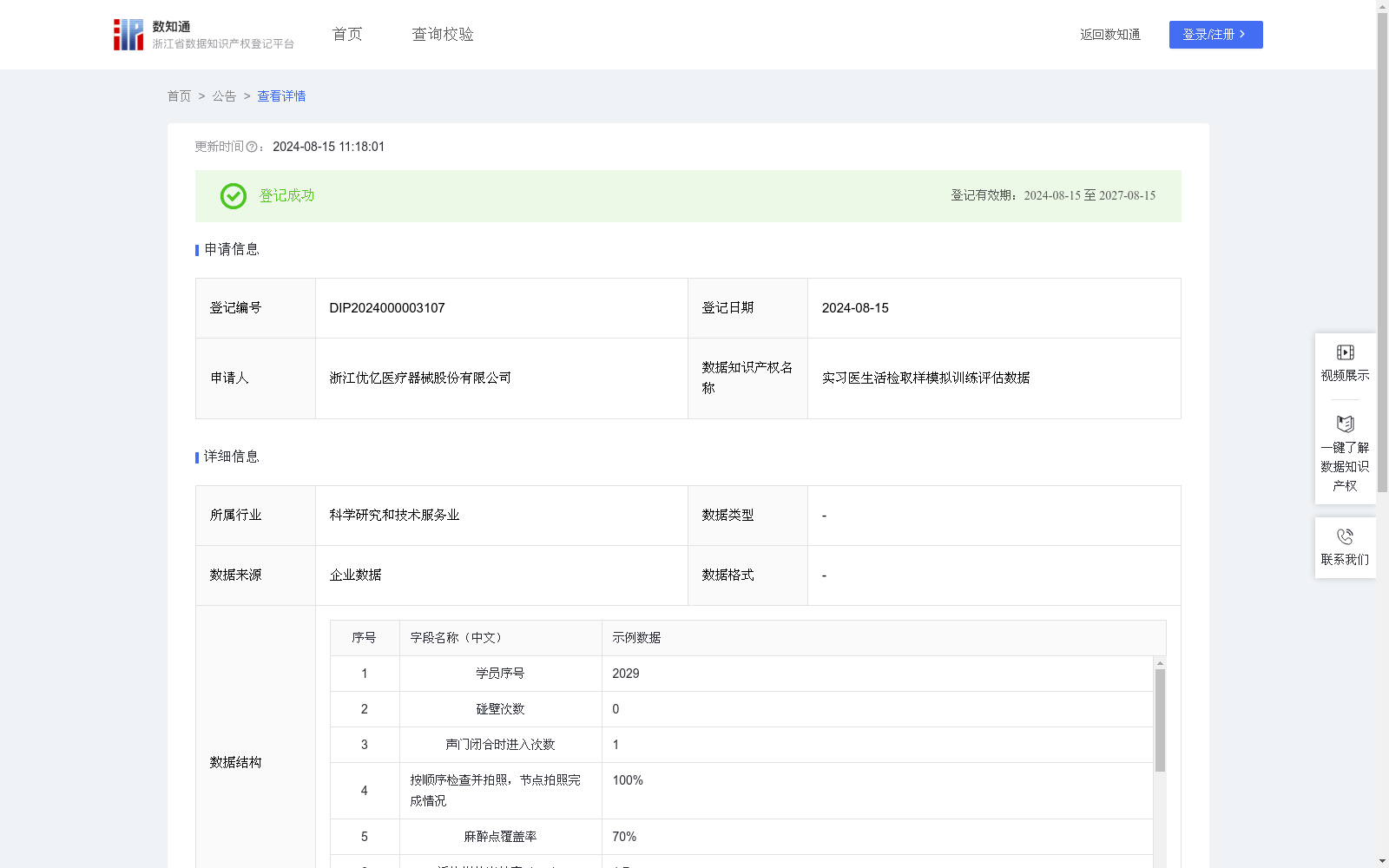
实习医生活检取样模拟训练评估数据
收藏资源简介:
实习医生理论知识足够,但缺乏实际动手操作能力,对医疗器械的掌握程度有限,因此在手术实习医生上岗前,需要对其实操能力进行测试和评估。本数据为实习医生在模拟活检取样中的实训操作数据,体现了包括实习医生的操作情况和各个关键指标参数,如碰壁次数、声门闭合时进入次数、麻醉点覆盖率、采样位置、采样有效位置等等。对以上数据进行不同权重的计算,可以对实习医生在模拟活检取样中的必要操作达标情况和熟练度进行模拟和测试评估,计算出总得分,对应不同的能力等级,从而对该实习医生是否可以上岗进行考核评价,有效把关实习医生的能力。实习医生在实训教学系统中进入活检取样界面,进行个人操作,系统将对其中的关键数据进行提取和计算,该数据中无个人信息或隐私显示。关键数据包括:碰壁次数、声门闭合时进入次数、按顺序检查并拍照,节点拍照完成情况、麻醉点覆盖率、活检钳伸出长度、采样位置、有效采样(取得标本并撤出活检钳)次数、有效采样深度、采样次数、采样成功率、操作用时,对上述数据进行不同权重的计算评分,如:碰壁总分10分,碰壁一次扣2分;麻醉完成情况总分10分,麻醉点梨状隐窝、气管、隆突、病灶,麻醉点覆盖90%得10分,麻醉点覆盖50%-90%得5分,麻醉点覆盖低于50%得0分等。叠加上述评分得出总得分,再对总得分进行等级划分,分别有:总得分>=110,为等级A可以上岗;总得分>=90,为等级B针对性训练后可以上岗;总得分>=75,为等级C多次训练后再测试评估;总得分<75,为等级F无法上岗。
Medical interns possess adequate theoretical knowledge but lack practical operative skills and have limited proficiency in medical devices. Thus, it is imperative to conduct tests and evaluations on their practical operation capabilities prior to their assuming posts in surgical rotations. This dataset comprises practical training operation data collected from medical interns during simulated biopsy sampling procedures, which records the interns' operational performance and a range of key indicator parameters, including the number of collision incidents, the count of entries when the glottis is closed, the coverage rate of anesthesia points, sampling position, valid sampling position, and more. By assigning different weight coefficients to these data, we can simulate and assess the compliance with necessary operations and the proficiency level of interns during simulated biopsy sampling, calculate the total score corresponding to different ability tiers, and thus perform assessment and evaluation on whether the intern is eligible to take up their post, effectively verifying the interns' competence. When medical interns access the biopsy sampling interface in the practical training teaching system and conduct individual operations, the system extracts and computes the key data, and no personal information or privacy data is included in this dataset. The key data covers: number of collision incidents, number of entries when the glottis is closed, sequential inspection and photography, completion status of node photography, coverage rate of anesthesia points, extension length of biopsy forceps, sampling position, number of valid samplings (obtaining specimens and withdrawing biopsy forceps), valid sampling depth, number of sampling attempts, sampling success rate, and operation duration. Scoring with different weight coefficients is implemented for the aforementioned data: for instance, the total score for collision incidents is 10 points, with 2 points deducted per collision; the total score for anesthesia completion is 10 points, where 10 points are awarded if 90% of the target anesthesia points (piriform recess, trachea, carina, lesion) are covered, 5 points are given for coverage ranging from 50% to 90%, and 0 points are granted for coverage below 50%, etc. The total score is derived by summing up the above individual scores, and then the total scores are categorized into tiers: total score ≥110 corresponds to Level A (eligible to take up post); total score ≥90 corresponds to Level B (eligible to take up post after targeted training); total score ≥75 corresponds to Level C (requiring multiple training sessions followed by re-test and evaluation); total score <75 corresponds to Level F (ineligible to take up post).