
QCircuitNet
收藏arXiv2024-10-10 更新2024-10-15 收录
下载链接:
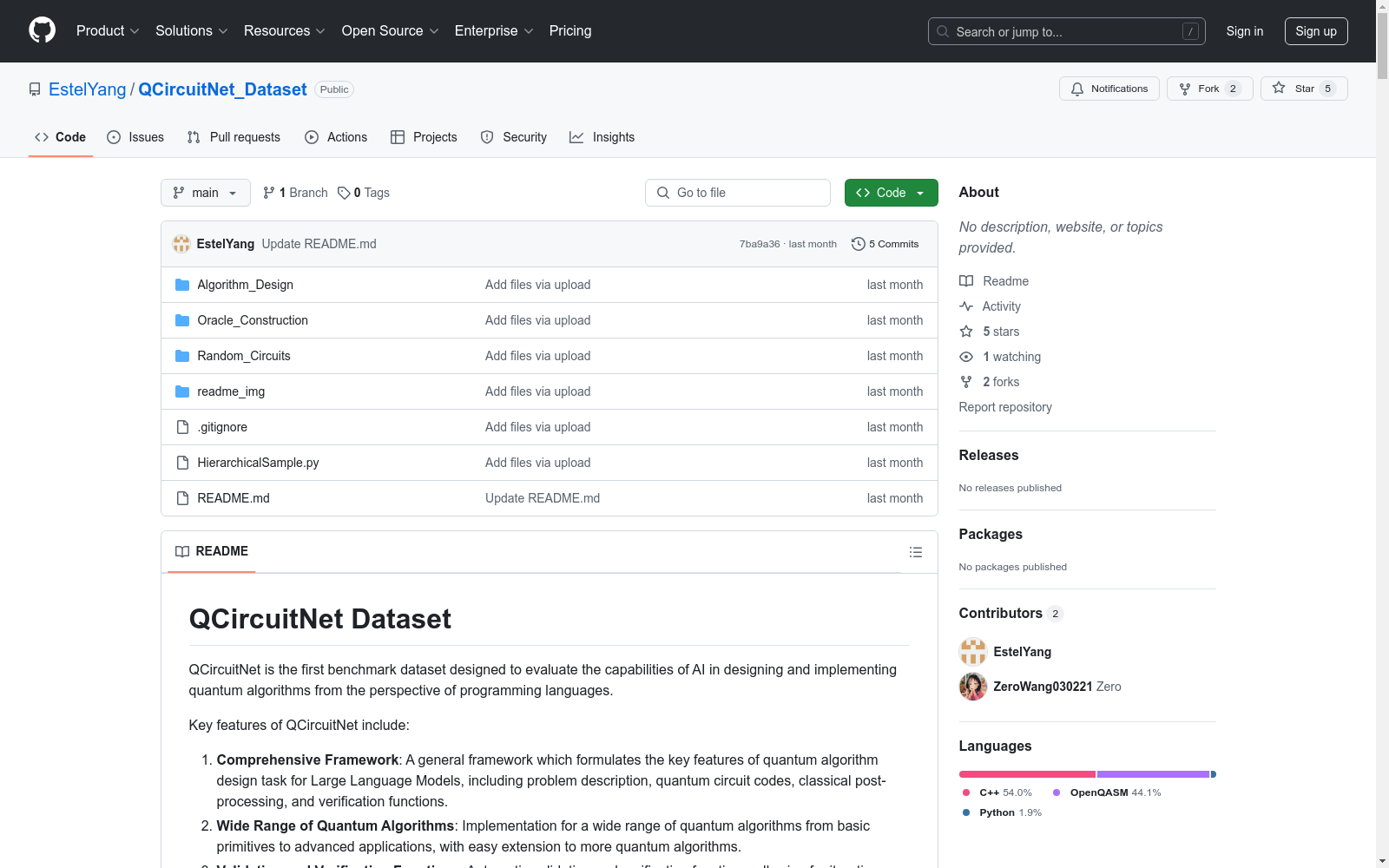
https://github.com/EstelYang/QCircuitNet_Dataset
下载链接
链接失效反馈官方服务:
资源简介:
QCircuitNet是由北京大学计算机科学学院和前沿计算研究中心联合创建的量子算法设计大型分层数据集。该数据集旨在评估人工智能在设计和实现量子算法方面的能力,涵盖从基本原语到高级应用的广泛量子算法。数据集通过将量子算法公式化为编程语言,实现了精确的表示和自动验证过程,从而弥合理论设计与电路实现之间的差距。QCircuitNet的应用领域主要集中在量子算法设计,旨在解决量子计算中的复杂算法设计和实现问题。
QCircuitNet is a large-scale hierarchical dataset for quantum algorithm design jointly created by the School of Computer Science and the Center for Frontier Computing of Peking University. This dataset aims to evaluate the capability of artificial intelligence in designing and implementing quantum algorithms, covering a broad spectrum of quantum algorithms ranging from basic primitives to advanced applications. By formalizing quantum algorithms into programming languages, the dataset realizes precise representation and automatic verification processes, thereby bridging the gap between theoretical design and circuit implementation. The application domains of QCircuitNet mainly focus on quantum algorithm design, aiming to solve complex algorithm design and implementation problems in quantum computing.
提供机构:
北京大学
创建时间:
2024-10-10
搜集汇总
数据集介绍
构建方式
QCircuitNet is meticulously crafted to encompass a wide array of quantum algorithms, ranging from fundamental primitives to advanced applications. The dataset is structured to facilitate both the design and implementation of quantum algorithms, with a focus on quantum circuit codes. The construction process involves a comprehensive framework that encapsulates key features of quantum algorithm design, including problem descriptions, quantum circuit codes, classical post-processing, and verification functions. This framework ensures that the dataset remains scalable and adaptable to various quantum algorithms, providing a robust foundation for evaluating AI's capabilities in this domain.
使用方法
QCircuitNet is designed to be a versatile tool for both benchmarking and training AI models in the field of quantum algorithm design. Researchers and practitioners can utilize the dataset to evaluate the performance of large language models (LLMs) in generating quantum circuits and designing quantum algorithms. The dataset's structure, which includes problem descriptions, quantum circuit codes, and verification functions, allows for a systematic approach to model evaluation and improvement. Furthermore, QCircuitNet's potential as a training dataset is demonstrated through primitive fine-tuning results, indicating its suitability for enhancing AI models' capabilities in quantum computing. The dataset's comprehensive framework and detailed documentation also facilitate easy extension and adaptation for future research and applications.
背景与挑战
背景概述
QCircuitNet, introduced by researchers from Peking University and Beijing Institute of Technology, is the first large-scale hierarchical dataset designed for quantum algorithm design. Developed in response to the growing field of quantum computing, QCircuitNet aims to address the challenges in designing and implementing quantum algorithms due to the complex nature of quantum mechanics and the need for precise control over quantum states. The dataset was created to evaluate the capability of AI in designing and implementing quantum algorithms through quantum circuit codes, offering a comprehensive benchmark for AI-driven quantum algorithm design. The key contributions of QCircuitNet include a general framework for large language models, implementation of a wide range of quantum algorithms, automatic validation and verification functions, and promising potential as a training dataset.
当前挑战
The primary challenge addressed by QCircuitNet is the lack of datasets tailored for quantum algorithm design, which is crucial for training AI models in this domain. The dataset also faces the challenge of accurately representing quantum algorithms in a form that can be automatically verified, as descriptions in natural language can be verbose and vague, while mathematical formulas are precise but difficult to verify automatically. Additionally, the highly flexible design space and intricate manipulation of qubits in quantum algorithms pose significant challenges for AI models. The dataset must also contend with the scalability of quantum algorithms and the potential for data contamination in AI learning, where models may rely on memorization rather than genuine algorithm design.
常用场景
经典使用场景
QCircuitNet 数据集的经典使用场景主要集中在量子算法设计的评估和实现上。该数据集通过提供大量量子电路代码和相关任务描述,使得人工智能模型能够学习和生成量子算法。具体应用包括量子电路的自动生成、验证和优化,以及量子算法在不同量子硬件平台上的性能评估。通过这些任务,QCircuitNet 为研究人员提供了一个标准化的基准,用于测试和改进人工智能在量子计算领域的应用。
解决学术问题
QCircuitNet 数据集解决了量子算法设计中的多个学术研究问题。首先,它填补了量子计算与人工智能结合领域的数据集空白,为研究人员提供了一个大规模、层次化的数据资源。其次,通过自动验证和迭代评估功能,QCircuitNet 能够帮助研究人员快速验证量子算法的正确性和性能,从而加速量子算法的研究和开发。此外,该数据集还揭示了大型语言模型在量子算法设计中的局限性,为未来的研究指明了方向。
实际应用
QCircuitNet 数据集在实际应用中具有广泛的前景。它可以帮助量子计算硬件制造商和软件开发者测试和优化他们的产品,确保量子算法在实际硬件上的高效运行。此外,QCircuitNet 还可以用于教育和培训,帮助学生和研究人员更好地理解和设计量子算法。在工业界,该数据集可以用于开发新的量子应用,如量子机器学习和量子优化算法,推动量子计算技术的商业化应用。
数据集最近研究
最新研究方向
在量子计算领域,QCircuitNet数据集的最新研究方向主要集中在利用人工智能(AI)辅助量子算法的设计与实现。该数据集通过提供大规模的分层量子电路代码,旨在评估AI在量子算法设计中的能力。研究者们致力于开发通用框架,将量子算法设计任务的关键特征形式化,并实现从基础原语到高级应用的广泛量子算法。此外,自动验证和验证功能使得迭代评估和交互推理成为可能,无需人工检查。这些研究不仅揭示了AI在量子算法设计中的潜力,还暴露了大型语言模型(LLMs)在该领域的一些局限性。
相关研究论文
- 1QCircuitNet: A Large-Scale Hierarchical Dataset for Quantum Algorithm Design北京大学 · 2024年
以上内容由遇见数据集搜集并总结生成



