
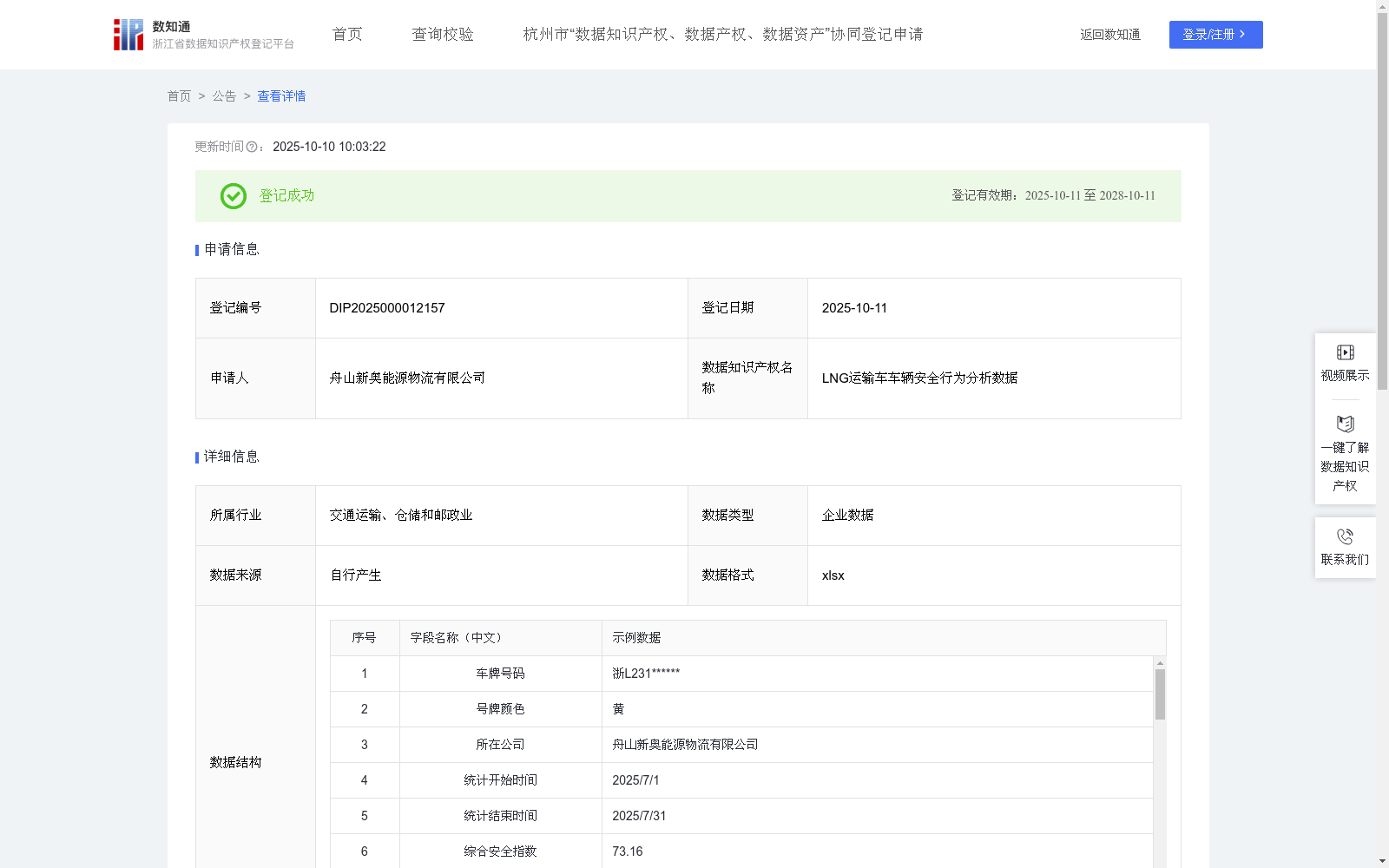
LNG运输车车辆安全行为分析数据
收藏浙江省数据知识产权登记平台2025-10-10 更新2025-10-11 收录
下载链接:
https://www.zjip.org.cn/home/announce/trends/777381
下载链接
链接失效反馈官方服务:
资源简介:
一、数据适用条件、范围与对象:
适用于配备智能车载终端(TBox、DVR、ADAS/DSM)的LNG等危化品运输车辆,覆盖驾驶员行为、车辆状态、实时定位及外部环境等多源数据,主要面向企业安全管理人员、车队运营者及驾驶员。
二、解决的问题:
实现对高风险驾驶行为的实时识别,有效防范交通事故及LNG泄漏;自动完成电子运单与合规报表,满足危化品运输强监管要求;通过驾驶行为与油耗关联分析降低运营成本。
三、核心价值点:
构建“实时监测–动态评估–主动干预–闭环优化”的全流程安全管理机制,显著提升本质安全水平,降低事故率和保险成本,同时强化驾驶员安全意识与车队运营效能。
四、外部复用价值:
该数据应用模型可推广至普货运输、客运、环卫等高危运营场景,为跨行业安全监管体系建设与标准化提供实践参考。1、数据采集:通过车辆传感器、ADAS、DSM采集基础行驶数据和驾驶员行为。车辆传感器采集的基础行驶数据会传输至TBox,由TBox直接执行行为计算。涉及驾驶员行为的数据由ADAS和DSM捕捉的视频流提供,数据首先传输至DVR,由DVR进行视频分析计算,识别出特定的行为事件后,再将计算结果上传至云平台。
2、数据处理:以LNG运输车车辆号牌为唯一字段,对一个月内LNG运输车车辆安全行为进行统计分析,得出综合安全指数、驾驶经济性指数、驾驶安全性指数、驾驶车损指数。
3、算法规则:驾驶经济性指数、驾驶安全性指数、驾驶车损指数满分各100分。
在经济性指数中,共有7个扣分点,分别为:过长怠速发生1次扣1分最高扣20分;急加速发生1次扣0.05分最高扣10分;超转行驶发生1次扣0.2分最高扣15分;离合器粘连发生1次扣0.5分最高扣10分;停车状态踩踏油门发生1次扣5分最高扣20分;猛踩油门(大油门行驶)发生1次扣0.05分最高扣20分;带手刹行驶发生1次扣5分最高扣5分。
在安全性指数中,共有14个扣分点,分别为:普通超速发生1次扣10分最高扣20分;严重超速发生1次扣20分最高扣20分;过长怠速发生1次扣0.1分最高扣2分;急刹车发生1次扣0.1分最高扣10分;急加速发生1次扣0.01分最高扣2分;空档滑行发生1次扣0.02分最高扣10分;长时间刹车发生1次扣0.05分最高扣6分;离合器粘连发生1次扣0.1分最高扣2分;安全带未系发生1次扣13分最高扣13分;疲劳驾驶发生1次扣10分最高扣20分;带手刹行驶发生1次扣1分最高扣3分;打电话发生1次扣12分最高扣12分;摄像头遮挡发生1次扣100分最高扣100分;吸烟发生1次扣100分最高扣100分。
在车损性指数中,共有9个扣分点,分别为:严重超速发生1次扣1分最高扣20分;急刹车发生1次扣0.1分最高扣10分;急加速发生1次扣0.05分最高扣10分;超转行驶发生1次扣0.1分最高扣10分;停车立即熄火发生1次扣0.2分最高扣8分;冷车行驶发生1次扣5分最高扣15分;长时间刹车发生1次扣0.1分最高扣15分;离合器粘连发生1次扣0.5分最高扣12分;带手刹行驶发生1次扣5分最高扣10分。
综合安全指数根据权重计算,综合安全指数=驾驶经济性指数*0.2+驾驶安全性指数*0.5+驾驶车损指数*0.3。
I. Application Conditions, Scope and Target Audience:
This dataset is applicable to liquefied natural gas (LNG) and other hazardous chemicals transport vehicles equipped with intelligent vehicle-mounted terminals (TBox, DVR, ADAS/DSM). It covers multi-source data including driver behavior, vehicle status, real-time positioning and external environment, and is primarily targeted at enterprise safety managers, fleet operators and drivers.
II. Problems Solved:
1. Real-time identification of high-risk driving behaviors to effectively prevent traffic accidents and LNG leakage;
2. Automatic generation of electronic waybills and compliant reports to meet the strict supervision requirements for hazardous chemicals transportation;
3. Reducing operational costs via correlation analysis between driving behaviors and fuel consumption.
III. Core Value:
This framework establishes a full-process safety management mechanism of "real-time monitoring – dynamic assessment – active intervention – closed-loop optimization", which significantly improves intrinsic safety levels, reduces accident rates and insurance costs, and simultaneously enhances drivers' safety awareness and fleet operational efficiency.
IV. External Reusability Value:
The data application model can be extended to high-risk operation scenarios such as general cargo transportation, passenger transport and sanitation services, providing practical references for the construction and standardization of cross-industry safety supervision systems.
1. Data Collection
Basic driving data and driver behavior data are collected through vehicle sensors, ADAS and DSM. Basic driving data collected by vehicle sensors is transmitted to the TBox, which directly performs behavioral calculations. Driver behavior-related data is provided by video streams captured by ADAS and DSM. The data is first sent to the DVR for video analysis and calculation. After identifying specific behavioral events, the calculation results are uploaded to the cloud platform.
2. Data Processing
Taking the license plate number of LNG transport vehicles as the unique identifier, statistical analysis is conducted on the safety behaviors of LNG transport vehicles within one month to derive four core indicators: comprehensive safety index, driving economy index, driving safety index and driving vehicle damage index.
3. Algorithm Rules
The driving economy index, driving safety index and driving vehicle damage index are all scored out of 100 points.
For the driving economy index, there are 7 deduction points in total:
- 1 point deducted per occurrence of prolonged idling, maximum deduction of 20 points;
- 0.05 points deducted per occurrence of rapid acceleration, maximum deduction of 10 points;
- 0.2 points deducted per occurrence of over-revving driving, maximum deduction of 15 points;
- 0.5 points deducted per occurrence of clutch sticking, maximum deduction of 10 points;
- 5 points deducted per occurrence of depressing the accelerator pedal while the vehicle is stationary, maximum deduction of 20 points;
- 0.05 points deducted per occurrence of hard acceleration (large-throttle driving), maximum deduction of 20 points;
- 5 points deducted per occurrence of driving with the parking brake engaged, maximum deduction of 5 points.
For the driving safety index, there are 14 deduction points in total:
- 10 points deducted per occurrence of ordinary overspeed, maximum deduction of 20 points;
- 20 points deducted per occurrence of severe overspeed, maximum deduction of 20 points;
- 0.1 points deducted per occurrence of prolonged idling, maximum deduction of 2 points;
- 0.1 points deducted per occurrence of hard braking, maximum deduction of 10 points;
- 0.01 points deducted per occurrence of rapid acceleration, maximum deduction of 2 points;
- 0.02 points deducted per occurrence of coasting in neutral gear, maximum deduction of 10 points;
- 0.05 points deducted per occurrence of prolonged braking, maximum deduction of 6 points;
- 0.1 points deducted per occurrence of clutch sticking, maximum deduction of 2 points;
- 13 points deducted per occurrence of not wearing a seatbelt, maximum deduction of 13 points;
- 10 points deducted per occurrence of fatigued driving, maximum deduction of 20 points;
- 1 point deducted per occurrence of driving with the parking brake engaged, maximum deduction of 3 points;
- 12 points deducted per occurrence of making phone calls, maximum deduction of 12 points;
- 100 points deducted per occurrence of camera occlusion, maximum deduction of 100 points;
- 100 points deducted per occurrence of smoking, maximum deduction of 100 points.
For the driving vehicle damage index, there are 9 deduction points in total:
- 1 point deducted per occurrence of severe overspeed, maximum deduction of 20 points;
- 0.1 points deducted per occurrence of hard braking, maximum deduction of 10 points;
- 0.05 points deducted per occurrence of rapid acceleration, maximum deduction of 10 points;
- 0.1 points deducted per occurrence of over-revving driving, maximum deduction of 10 points;
- 0.2 points deducted per occurrence of immediate engine shutdown after parking, maximum deduction of 8 points;
- 5 points deducted per occurrence of driving with a cold engine, maximum deduction of 15 points;
- 0.1 points deducted per occurrence of prolonged braking, maximum deduction of 15 points;
- 0.5 points deducted per occurrence of clutch sticking, maximum deduction of 12 points;
- 5 points deducted per occurrence of driving with the parking brake engaged, maximum deduction of 10 points.
The comprehensive safety index is calculated using weighted coefficients, with the formula:
Comprehensive Safety Index = Driving Economy Index * 0.2 + Driving Safety Index * 0.5 + Driving Vehicle Damage Index * 0.3.
提供机构:
舟山新奥能源物流有限公司
创建时间:
2025-07-23
搜集汇总
数据集介绍
背景与挑战
背景概述
该数据集聚焦LNG运输车的车辆安全行为分析,包含566条记录,每月更新,涵盖车牌、安全指数和多种驾驶行为指标,用于实时识别高风险行为并提升安全管理。数据通过算法计算综合安全指数,适用于危化品运输监管,并可推广至其他高危行业,具有实际应用价值。
以上内容由遇见数据集搜集并总结生成



