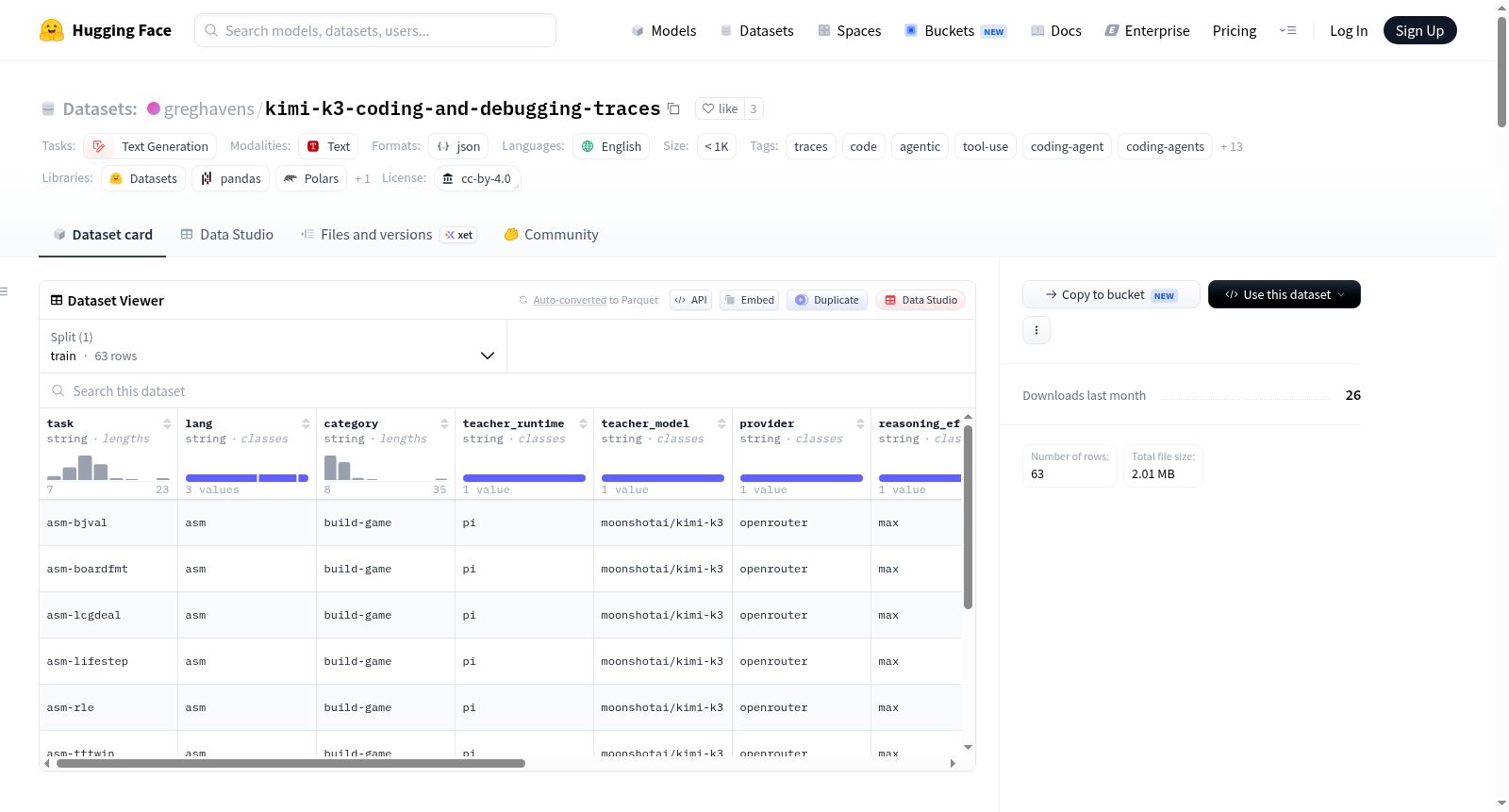
kimi-k3-coding-and-debugging-traces
收藏资源简介:
Kimi K3 编码与调试代理轨迹数据集是一个包含端到端代理编码轨迹的集合,专为代码生成、调试和工具使用任务设计。该数据集由 moonshotai/kimi-k3 模型通过 pi 编码代理运行时在 openrouter 平台上生成,采用最大推理强度。每个轨迹代表一个完整的会话,旨在解决真实代码仓库中的具体修复或构建任务,涉及代码的读取、编辑和运行。数据集包含 28 个已验证的轨迹(基于 883 个可验证修复种子),每个轨迹的助手交互轮次在 4 到 11 次之间(中位数为 8 次)。任务类别多样,涵盖构建游戏(build-game,占 29%)、修复 Bash 警告(warnfix-bash,占 11%)、构建报告(build-report,占 7%)以及调试 CLI、重构参数、构建配置、构建文本等多种类型,所有任务均属于编码(coding)领域。涉及的主要编程语言是 Bash 和汇编语言(asm)。在数据生成过程中,代理被提供了统一的工具集(包括 read、write、edit、bash、grep、find、ls),并在实际轨迹中主要使用了 bash、edit、read 和 write 等工具。原始运行时轨迹被标准化为 OpenAI 风格的 messages 和 tools 模式,确保其与具体代理运行时无关。数据模式包括任务ID、语言、类别、教师运行时、教师模型、提供商、推理努力程度、模型认证状态、观察到的模型列表、轨迹格式、消息数量以及完整的会话消息列表等字段。数据集以单个 traces.jsonl 文件发布,每行包含一个完整轨迹的会话数据。在最终发布版本中,该文件将被替换为累积的下一步前缀导出格式,该格式将每个轨迹拆分为每个助手轮次的独立训练行,并确保精确前缀连续性和轨迹不相交的训练/验证分割。该数据集的主要用途包括:用于代理编码模型的监督微调(SFT)或知识蒸馏,研究真实仓库环境中的下一步规划和工具使用行为,以及对在确定性验证下表现强大的教师模型进行行为分析。数据集在发布前经过独立评审模型(claude-fable-5)的筛选,并进行了隐私擦除处理(如主机路径、运行时临时目录和凭证模式)。数据集采用 CC-BY-4.0 许可证发布。
The Kimi K3 Coding and Debugging Agent Trajectory Dataset is a collection of end-to-end agent coding trajectories, designed for code generation, debugging, and tool usage tasks. It is generated by the moonshotai/kimi-k3 model via the pi coding agent runtime on the openrouter platform, using maximum inference strength. Each trajectory represents a complete session aimed at solving specific repair or build tasks in real code repositories, involving code reading, editing, and execution. The dataset contains 28 verified trajectories (based on 883 verifiable repair seeds), with assistant interaction rounds per trajectory ranging from 4 to 11 (median 8). Task categories are diverse, including build-game (29%), warnfix-bash (11%), build-report (7%), as well as debugging CLI, refactoring parameters, build configuration, build text, and other types, all belonging to the coding domain. The primary programming languages involved are Bash and assembly language (asm). During data generation, agents were provided with a unified toolset (including read, write, edit, bash, grep, find, ls), with bash, edit, read, and write being the main tools used in actual trajectories. Original runtime trajectories are standardized into OpenAI-style messages and tools format, ensuring independence from specific agent runtimes. The data schema includes fields such as task ID, language, category, teacher runtime, teacher model, provider, inference effort, model certification status, observed model list, trajectory format, message count, and a complete session message list. The dataset is released as a single traces.jsonl file, with each line containing session data for a complete trajectory. In the final release version, this file will be replaced by a cumulative next-step prefix export format, which splits each trajectory into independent training rows for each assistant round, ensuring precise prefix continuity and trajectory-disjoint training/validation splits. The main uses of the dataset include supervised fine-tuning (SFT) or knowledge distillation for agent coding models, studying next-step planning and tool usage behaviors in real repository environments, and behavioral analysis of teacher models that perform robustly under deterministic verification. Before release, the dataset is filtered by an independent review model (claude-fable-5) and undergoes privacy erasure (e.g., host paths, runtime temporary directories, and credential patterns). The dataset is released under the CC-BY-4.0 license.
数据集概述
数据集名称:Kimi K3 Coding & Debugging Agent Traces
许可证:CC-BY-4.0
语言:英语
任务类别:文本生成
数据集规模:n<1K(当前含57条已验证轨迹)
标签:traces, code, agentic, tool-use, coding-agent, SFT, distillation, reasoning, chain-of-thought, moonshotai, kimi, k3
核心特点
- 真实端到端智能体编程轨迹:由
moonshotai/kimi-k3模型在pi编码智能体运行环境上通过openrouter服务生成,使用max推理级别。 - 每个轨迹均已通过可验证的测试:所有轨迹通过验收测试,且受保护的测试/规范文件未经修改(基于哈希校验),非自我声称的成功。
- 独立审查:最终发布前由独立的
claude-fable-5审查器筛选每个轨迹,教师模型不自我评分。 - 模型可验证溯源:100%的行经过模型验证,智能体事件流和宿主机侧环回代理均确认上游应答来自声明的模型。
- 运行时归一化:原始运行时轨迹被转换为统一的OpenAI样式
messages+tools模式,轨迹格式无关。 - 统一工具集:每个任务均使用相同的行动空间(
read, write, edit, bash, grep, find, ls)。 - 隐私清理:宿主路径、运行时临时目录和凭证模式已被擦除。
任务类型分布
| 任务类别 | 轨迹数量 | 占比 |
|---|---|---|
| 构建游戏(build-game) | 12 | 21% |
| 构建CLI工具(build-cli) | 4 | 7% |
| 构建库(build-lib) | 4 | 7% |
| 构建报告(build-report) | 3 | 5% |
| bash警告修复(warnfix-bash) | 3 | 5% |
| 全蒸馏棕地导向(full-distill-brownfield-orientation) | 2 | 4% |
| 构建文件系统(build-fs) | 2 | 4% |
| bash语法修复(syntax-bash) | 2 | 4% |
| C语言警告修复(warnfix-c) | 2 | 4% |
| 构建解析(build-parsing) | 2 | 4% |
| 其他各类(调试CLI、构建配置、重构、构建文本等,各1条) | 各1 | 各2% |
领域覆盖:全部57条轨迹(100%)属于编程领域。
多步深度:每条轨迹的助手交互轮次范围为4–17轮,中位数为8轮。
编程语言
- bash
- C
- asm(汇编)
工具集
- 全部任务提供的工具:
read,write,edit,bash,grep,find,ls - 轨迹中实际使用的工具:
bash,edit,read,write
数据模式
当前版本(发布前)为单文件traces.jsonl,每行一条完整轨迹(全会话消息)。
当前模式字段:
| 列名 | 类型 | 描述 |
|---|---|---|
task |
string | 轨迹所解决的种子/任务ID |
lang |
string | 主要编程语言 |
category |
string | 任务种类(构建、调试、特性、重构等) |
teacher_runtime |
string | 产生轨迹的编码智能体运行环境 |
teacher_model |
string | 教师模型ID |
provider |
string | 教师模型的推理服务提供商 |
reasoning_effort |
string | 教师模型的推理水平 |
model_attested |
bool | 智能体流和上游代理是否均确认模型身份 |
observed_models |
list[string] | 验证流中实际观察到的模型ID |
trace_format |
string | 归一化前的原始运行时轨迹格式 |
n_messages |
int | 轨迹中的消息数量 |
messages |
list[object] | OpenAI聊天格式的完整会话(系统/用户/助手/工具) |
发布后模式:切换为累积下一步前缀模式(包含source_trajectory_id, split, assistant_step, target_message_index, JSON编码的tools等字段),每行对应一条助手轮次。
数据溯源与可复现性
- 种子来源:任务基于真实的修复fixture(提示、验证命令、受保护测试文件、参考修复),参考修复仅用于证明可解性,不被导出。
- 教师:
moonshotai/kimi-k3通过pi环境在openrouter上以max推理级别运行。 - 筛选:确定性子门(验收测试 + 受保护文件哈希)已应用于每条已发布轨迹;独立审查最终发布。
- 导出方式:整条轨迹 → 发布时导出为累积下一步前缀,确保精确的前缀连续性和轨迹分离的分割。
局限性
- 仅包含成功轨迹:数据仅反映成功的问题解决行为,不包含全部尝试或失败恢复的分布。
- 审查者偏见:筛选结果反映审查模型自身的偏好和盲点。
- 发布前筛选:每行通过确定性验证,但独立审查在发布时进行,最终导出中可能有少量删除或替换。
- 推理仅限表面内容:仅包含教师在流中暴露的推理,不重构隐藏的思维链。
预期用途
- 用于智能体编码模型的监督微调(SFT)与知识蒸馏,基于经过验证的多步、工具使用轨迹。
- 研究实际仓库中的下一步规划和工具使用行为。
- 对在确定性验证下强教师模型的行为分析。