
KBLab/rixvox
收藏Hugging Face2024-10-28 更新2024-03-04 收录
下载链接:
https://hf-mirror.com/datasets/KBLab/rixvox
下载链接
链接失效反馈官方服务:
资源简介:
---
language: sv
license: cc-by-4.0
tags:
- audio
- speech-recognition
task_categories:
- automatic-speech-recognition
size_categories:
- 100K<n<1M
multilinguality:
- monolingual
---
# Dataset Card for RixVox
## Dataset Description
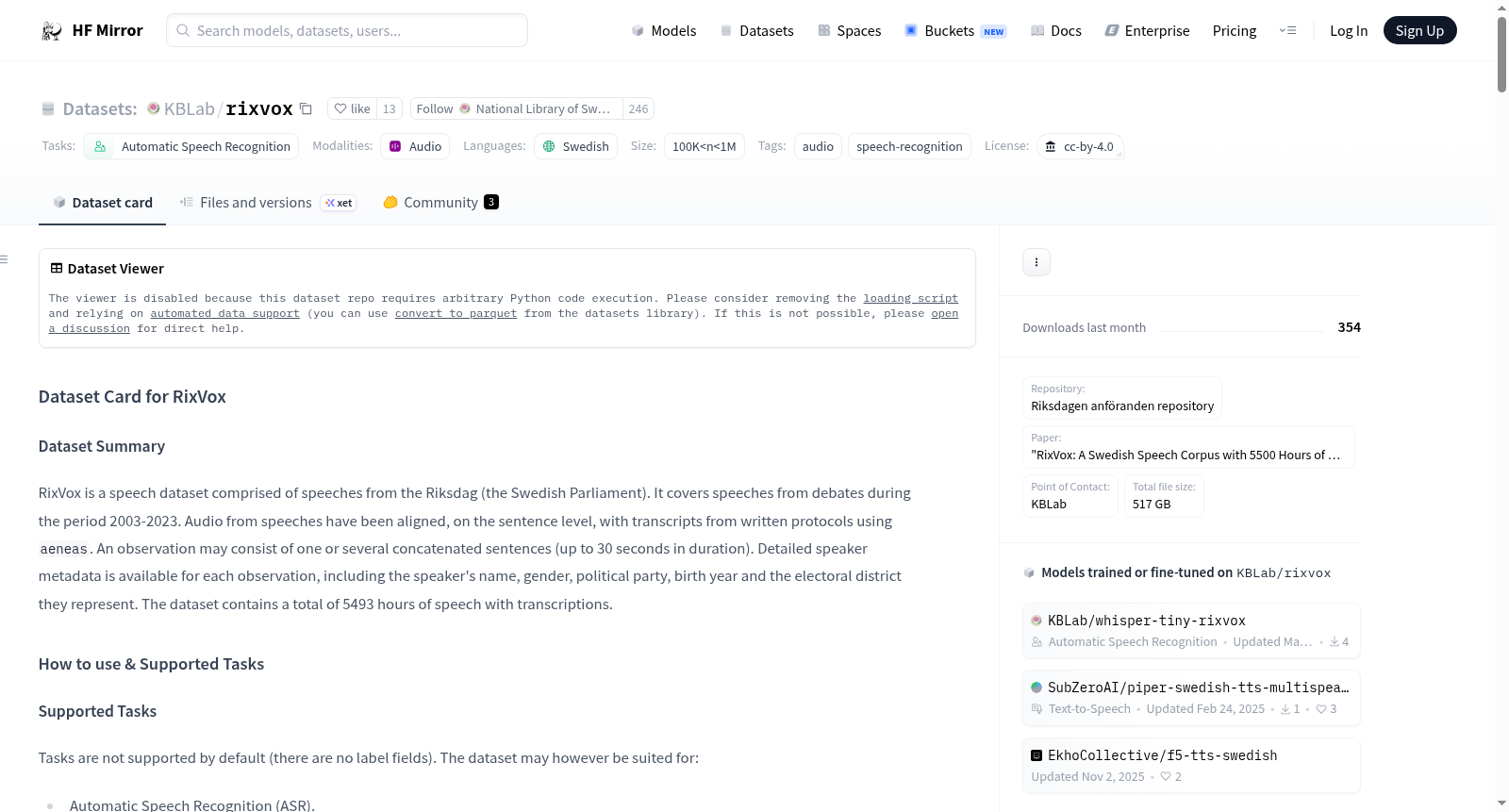
- **Repository:** [Riksdagen anföranden repository](https://github.com/kb-labb/riksdagen_anforanden)
- **Paper:** ["RixVox: A Swedish Speech Corpus with 5500 Hours of Speech from Parliamentary Debates"](https://kb-labb.github.io/posts/2023-03-09-rixvox-a-swedish-speech-corpus/)
- **Point of Contact:** [KBLab](mailto:kblabb@kb.se)
- **Total amount of disk used:** ca. 1.2 TB
### Dataset Summary
RixVox is a speech dataset comprised of speeches from the Riksdag (the Swedish Parliament). It covers speeches from debates during the period 2003-2023. Audio from speeches have been aligned, on the sentence level, with transcripts from written protocols using `aeneas`. An observation may consist of one or several concatenated sentences (up to 30 seconds in duration). Detailed speaker metadata is available for each observation, including the speaker's name, gender, political party, birth year and the electoral district they represent. The dataset contains a total of 5493 hours of speech with transcriptions.
## How to use & Supported Tasks
### Supported Tasks
Tasks are not supported by default (there are no label fields). The dataset may however be suited for:
- Automatic Speech Recognition (ASR).
- Speaker identification and verification.
- Creation of synthetic diarization datasets.
- Research on bias in ASR systems.
### How to use
> [!IMPORTANT] **Downgrade to `datasets` major version 2.\*.\* to load this dataset**.
To download and extract the files locally you can use `load_dataset()`. We recommend you set the `cache_dir` argument to point to a location that has plenty of disk space (1.2TB+). Here's how to download the `train` split:
```python
from datasets import load_dataset
# To download/load all splits at once, don't specify a split
rixvox = load_dataset("KBLab/rixvox", split="train", cache_dir="data_rixvox")
```
You can also stream the dataset. This is useful if you want to explore the dataset or if you don't have enough disk space to download the entire dataset. Here's how to stream the `train` split:
```python
from datasets import load_dataset
rixvox = load_dataset("KBLab/rixvox", cache_dir="data_rixvox", split="train", streaming=True)
print(next(iter(rixvox)))
# Grab 5 observations
rixvox_subset = rixvox.take(5)
for example in rixvox_subset:
print(example)
```
**Create a [PyTorch dataloader](https://huggingface.co/docs/datasets/use_with_pytorch)** with your dataset.
Local mode:
```python
from datasets import load_dataset
from torch.utils.data.sampler import BatchSampler, RandomSampler
# Dataset is not pre-shuffled, recommend shuffling it before training.
rixvox = load_dataset("KBLab/rixvox", split="train", cache_dir="data_rixvox")
batch_sampler = BatchSampler(RandomSampler(rixvox), batch_size=32, drop_last=False)
dataloader = DataLoader(rixvox, batch_sampler=batch_sampler)
```
Streaming mode:
```python
from datasets import load_dataset
from torch.utils.data import DataLoader
rixvox = load_dataset("KBLab/rixvox", split="train", cache_dir="data_rixvox")
dataloader = DataLoader(rixvox, batch_size=32)
```
See Huggingface's guide on [streaming datasets](https://huggingface.co/docs/datasets/v1.11.0/dataset_streaming.html) for more information on how to shuffle in streaming mode.
### Languages
- Swedish. The BCP 47 language tag for Swedish is `sv`.
## Dataset Structure
### Data Instances
There are a total of `835044` observations from `1194` different speakers. Each observation can be up to 30 seconds in duration. An observation belongs to a debate (`dokid`), is extratected from a speech (`anforande_nummer`), and is numbered according to its order within the speech (`observation_nr`). Here is an example of an observation:
```
{'dokid': 'GR01BOU3',
'anforande_nummer': 191,
'observation_nr': 0,
'audio': {'path': 'GR01BOU3/2442210220028601121_anf191_1_25.wav',
'array': array([0.01171875, 0.01242065, 0.01071167, ..., 0.00689697, 0.00918579,
0.00650024]),
'sampling_rate': 16000},
'text': 'Kristdemokraterna står bakom alla reservationer med kristdemokratiska förtecken, men jag nöjer mig med att yrka bifall till reservation 1. Jag ska i det här inlägget beröra några av de åtta punkter som är föremål för reservationer från kristdemokratiskt håll, i vissa fall tillsammans med andra partier.',
'debatedate': datetime.datetime(2003, 12, 4, 0, 0),
'speaker': 'Göran Hägglund',
'party': 'KD',
'gender': 'male',
'birth_year': 1959,
'electoral_district': 'Hallands län',
'intressent_id': '0584659199514',
'speaker_from_id': True,
'speaker_audio_meta': 'Göran Hägglund (Kd)',
'start': 1.4,
'end': 24.96,
'duration': 23.560000000000002,
'bleu_score': 0.7212783273624307,
'filename': 'GR01BOU3/2442210220028601121_anf191_1_25.wav',
'path': 'GR01BOU3/2442210220028601121_anf191_1_25.wav',
'speaker_total_hours': 30.621333333333332}
```
See more examples in the [dataset viewer](https://huggingface.co/datasets/KBLab/rixvox/viewer/default/train).
### Data Fields
* `dokid`: Document id for the debate used by the Riksdag. This is the same for all speeches in a debate.
* `anforande_nummer`: Speech number within the debate, or within the debate sessions on a particular day. Should create a unique primary key for a speech in combination with `dokid` (sometimes there are duplicates, but we removed them from this dataset).
* `observation_nr`: Observation number within the speech. Creates a unique identifier for an observation in combination with `dokid` and `anforande_nummer`.
* `text`: The text transcript from written protocols. The transcripts are not always verbatim. Transcribers have to different degrees adjusted sentence ordering, words and phrasing when they deemed it appropriate.
* `debatedate`: The date of the debate.
* `start`: The start time of the observation within a speech (in seconds).
* `end`: The end time of the observation within a speech (in seconds).
* `duration`: The duration of the observation (`end` subtracted with `start`).
* `intressent_id`: Unique id for the speaker within the Riksdag's database (see [person.csv.zip](https://data.riksdagen.se/dataset/person/person.csv.zip) from the Riksdag).
* `speaker`: The speaker's name retrieved via the `intressent_id`.
* `party`: The speaker's party retrieved via the `intressent_id`.
* `gender`: The speaker's gender retrieved via the `intressent_id`.
* `birth_year`: The speaker's bith year retrieved via the `intressent_id`.
* `electoral_district`: The electoral district which the speaker represents if they are/were a member of parliament (retrieved via the `intressent_id`).
* `speaker_audio_meta`: The speaker's name and title as listed in the Riksdag's oroginal text format metadata (sometimes wrong and mismatched against `intressent_id`).
* `speaker_from_id`: Whether the speaker metadata was retrieved via the `intressent_id` or via the Riksdag's original metadata (for those speeches with a missing `intressent_id`).
* `bleu_score`: The BLEU score of the automatic speech recognition (ASR) transcript against the Riksdag's written protocol. Calculated on the entirity of the speech that an observation (30s snippet) is extracted from. A low number for a speech may indicate that either i) the ASR model had trouble transcribing the speaker's accent or dialect, or ii) the transcription took certain liberties in editing and rephrasing the speech.
* `speaker_total_hours`: The total number of hours of speech from the speaker in the RixVox dataset.
* `filename`: The filename of the observation in the compressed tar.gz files. Useful if you don't want to use Huggingface `datasets`, but would rather manually download and extract the files from the data shards.
* `path`: Dynamically created variable. Contains the local path to the observation's audio file after you download and extract the files via `load_dataset()` in the `datasets` library.
### Data Splits
Dataset splits were randomly sampled on the speaker level. That is, a speaker is only present in a single split. We sample speakers for each split until the following conditions are met:
- 98% of the total number of hours of speech are included in the train split.
- 1% of the total number of hours of speech are included in the validation split.
- 1% of the total number of hours of speech are included in the test split.
| Dataset Split | Observations | Total duration of speech (hours) | Average duration obs. (seconds) | Number of speakers |
| ------------- | ----------------: | -------------------------------: | ------------------------------: | -----------------: |
| Train | 818227 | 5383 | 23.69 | 1165 |
| Validation | 7933 | 52 | 23.50 | 18 |
| Test | 8884 | 59 | 23.74 | 11 |
## Dataset Creation
For more information about the creation of this dataset, see the article ["Finding Speeches in the Riksdag's Debates"](https://kb-labb.github.io/posts/2023-02-15-finding-speeches-in-the-riksdags-debates/) from our blog.
### Curation Rationale
Before RixVox, there was only a couple of hundred hours of transcribed speech available to train ASR models for Swedish. ASR models such as Whisper have shown that the performance of models can benefit significantly from adding more supervised data during pretraining or finetuning. Media from debates in the Riksdag are published openly on the web together with transcripts and other metadata. The open data initiatives of the Riksdag presented an opportunity to create a high quality open speech corpus for Swedish.
### Source Data
The Swedish Parliament.
- [Transcripts of speeches](https://data.riksdagen.se/data/anforanden/).
- Use the `rel_dok_id` of transcripts of speeches to query the Riksdag's media API (e.g. https://data.riksdagen.se/api/mhs-vodapi?H901FiU1 ) for available media and metadata.
#### Initial Data Collection and Normalization
For information on how the speeches were segmented and identified in debate audio files, see the article ["Finding Speeches in the Riksdag's Debates"](https://kb-labb.github.io/posts/2023-02-15-finding-speeches-in-the-riksdags-debates/).
For information on how the speech segmentations were used to create the final RixVox dataset, see the article ["RixVox: A Swedish Speech Corpus with 5500 Hours of Speech from Parliamentary Debates"](https://kb-labb.github.io/posts/2023-03-09-rixvox-a-swedish-speech-corpus/).
The code to replicate the creation of the dataset is open and available at the GitHub repository [KBLab/riksdagen_anforanden](https://github.com/kb-labb/riksdagen_anforanden). Processing everything can take 1-3 weeks on a workstation with consumer grade GPU.
#### Who are the source language producers?
The written protocols of speeches are manually produced by the Riksdag. Transcription is not always verbatim, but rather catches the intent of the speaker.
Segmenting speeches to determine when they start and end in a debate was done automatically. Sentence level alignment of the written protocols to the audio files was also done automatically using `aeneas`. See the articles in citation information for more details.
### Annotations
#### Annotation process
The process of aligning speech to written protocols was automatic. It followed the following general steps:
1. We used ASR to automatically transcribe the debate audio files and get word timestamps for the machine generated transcription.
2. We used fuzzy string matching to determine approximate start/end of a speech, matching the official written protocol of the speech to the machine generated transcription of the debate.
3. We perform speaker diarization using pyannote.audio.
4. We assign speaker diarization segments to speeches by the degree of overlap between approximate start/end from fuzzy string matching and the speaker diarization segments. The start and end of the diarization segment is used as our new adjusted start and end metadata of the speech.
5. Based on adjusted metadata of start/end of as speech, we split and extract the audio of speeches from the debates and then align the segmented speeches to the written protocol using `aeneas` (sentence-level alignment).
#### Who are the annotators?
No manual annotations.
### Personal and Sensitive Information
The speakers are members of parliament or ministers speaking publicly in the Riksdag. The Riksdag is a public institution and the speeches are publicly available on the web as open data.
## Considerations for Using the Data
### Social Impact of Dataset
We except the dataset primarily to be used in training ASR models for Swedish. The performance of Swedish text-to-speech in multillingual ASR models may also benefit from the availability of a large Swedish speech corpus. In turn, improved ASR models can serve to help increase accessibility of audio and video media content for people with hearing impairments.
The dataset can also be used to train models for other audio tasks such as speaker diarization, speaker verification, and speaker recognition.
Since metadata regarding the age, gender, and electoral district of the speaker is included, the dataset can possibly also be used to study bias in ASR models.
### Discussion of Biases
The dataset includes parliamentary speeches, which are often more formal than everyday speech.
During the creation of the dataset, we found that speech segmentations based on speaker diarization were more likely to fail when a preceding speaker, the speaker of the house, and the speaker of the following speech were all of the same gender. However, all in all, only a small number of speeches were filtered out of the final RixVox dataset. After quality filtering of the dataset, 5500 out of 5858 hours remained. We do not believe any significant systematic bias was introduced by this filtering.
Only minimal deduplication was performed to weed out commonly repeated phrases. For example, certain phrases such as "Fru talman!", "Herr Talman!", tend to be used a lot as a matter of formality. These phrases tend to be present at the beginning of most transcripts regardless whether it was uttered by the speaker or not. For this reason we have removed the first aligned sentence of each speech when creating RixVox. The aforementioned phrases are repeated frequently in speeches as well, though. As such it might be beneficial to perform more aggressive deduplication of the dataset before training models.
### Other Known Limitations
## Additional Information
### Dataset Curators
KBLab at the the National Library of Sweden.
### Future updates
There is a possiblity RixVox will be periodically, and irregularly, updated by including both older and newer speeches. Older recordings of parliamentary debates from 1966 to 2002 do exist, but they are not yet part of the Riksdag's open data. KBLab are exploring the possibility of adding metadata to these recordings by applying the existing speech segmentation and alignment pipeline to them.
Each year also brings new parliamentary debates, with recent years adding 400-500 hours of speech per year.
### Licensing Information
[CC-BY 4.0](https://creativecommons.org/licenses/by/4.0/)
Cite the Swedish Parliament.
To reference RixVox, feel free to cite KBLab blog posts in the citation information below.
### Citation Information
```
@misc{rekathati2023rixvox:,
author = {Rekathati, Faton},
title = {The KBLab Blog: RixVox: A Swedish Speech Corpus with 5500 Hours of Speech from Parliamentary Debates},
url = {https://kb-labb.github.io/posts/2023-03-09-rixvox-a-swedish-speech-corpus/},
year = {2023}
}
```
```
@misc{rekathati2023finding,
author = {Rekathati, Faton},
title = {The KBLab Blog: Finding Speeches in the Riksdag's Debates},
url = {https://kb-labb.github.io/posts/2023-02-15-finding-speeches-in-the-riksdags-debates/},
year = {2023}
}
```
The Swedish Parliament.
### Contributions
Thanks to [@lhoestq](https://huggingface.co/lhoestq) for reviewing the dataset script.
提供机构:
KBLab
原始信息汇总
数据集概述
数据集名称
RixVox
数据集描述
RixVox是一个包含瑞典议会(Riksdag)辩论中演讲的语音数据集。该数据集覆盖了2003年至2023年间的辩论演讲,总时长为5493小时。演讲音频与书面协议的转录文本在句子级别上进行了对齐。每个观察可能包含一个或多个连续的句子(最长30秒)。每个观察都提供了详细的演讲者元数据,包括演讲者的姓名、性别、政治党派、出生年份以及他们代表的选区。
数据集用途
- 自动语音识别(ASR)
- 说话人识别和验证
- 合成分割数据集的创建
- ASR系统中的偏差研究
数据集结构
- 数据实例:共有835044个观察,来自1194个不同的演讲者。每个观察最长可达30秒。
- 数据字段:包括文档ID、演讲编号、观察编号、文本、辩论日期、开始时间、结束时间、持续时间、演讲者ID、演讲者姓名、党派、性别、出生年份、选区等。
- 数据分割:数据集被随机分割为训练、验证和测试集,每个分割包含的演讲时长分别为总时长的98%、1%和1%。
语言
瑞典语(BCP 47语言标签:sv)
许可证
CC-BY 4.0
联系信息
- 联系人:KBLab(邮箱:kblabb@kb.se)
数据集创建
数据集的创建涉及自动化的演讲分割和对齐过程,使用了ASR技术和aeneas工具进行句子级别的对齐。详细信息可参考相关文章和GitHub仓库。
注意事项
- 数据集主要用于训练瑞典语的ASR模型,可能有助于提高多语言ASR模型中瑞典语的表现。
- 数据集包含的演讲较为正式,可能不完全代表日常口语。
- 数据集的分割和处理过程中可能存在一些技术挑战,如性别相同的演讲者之间的分割问题。
搜集汇总
数据集介绍
构建方式
RixVox数据集源自瑞典议会2003至2023年间辩论录音的公开资源,旨在为瑞典语自动语音识别(ASR)研究提供大规模监督数据。其构建过程融合了自动化流水线:首先利用ASR模型对辩论音频进行初步转录,并通过模糊字符串匹配定位书面协议中每段演讲的起止点;随后借助pyannote.audio执行说话人日记化,依据重叠程度调整演讲边界;最后基于调整后的元数据切分音频,并采用aeneas工具在句子级别将演讲内容与书面协议对齐,形成时长不超过30秒的观测样本。整个流程依托开源代码实现,确保了可复现性。
使用方法
用户可通过HuggingFace的`datasets`库便捷加载RixVox,推荐指定`cache_dir`至具备1.2TB以上空间的存储位置。支持完整下载或流式模式,后者适用于探索性分析或磁盘受限场景。加载后可直接使用PyTorch的`DataLoader`构建训练迭代器,需注意数据未预打乱,建议在训练前通过随机采样器进行洗牌。数据集支持ASR、说话人识别及合成日记化任务,其元数据字段如`audio`(含16kHz采样率的音频数组)和`text`(转录文本)可直接用于模型输入。用户亦可手动从分片压缩包中提取文件,通过`filename`字段定位特定观测。
背景与挑战
背景概述
RixVox是由瑞典国家图书馆下属的KBLab于2023年创建的大规模瑞典语语音语料库,其核心研究问题在于弥补瑞典语自动语音识别(ASR)领域高质量标注数据的匮乏。该数据集汇集了瑞典议会2003至2023年间近5500小时的辩论录音,通过自动化流水线将音频与书面议会议事录进行句子级对齐,并附有发言人的详细元数据,包括姓名、性别、政党、出生年份及选区等信息。作为目前规模最大的开源瑞典语语音数据集,RixVox不仅为瑞典语ASR模型的预训练与微调提供了关键资源,还推动了多语言语音技术中低资源语言公平性的研究,其影响力辐射至说话人识别、语种识别及ASR系统偏差分析等多个音频处理子领域。
当前挑战
RixVox所解决的领域挑战在于:瑞典语ASR此前仅有数百小时标注语音可用,严重制约了模型性能的提升,而议会公开数据虽体量庞大却缺乏精准的语音-文本对齐与说话人分割。在构建过程中,该数据集面临多重技术挑战:首先,需从长达数小时的辩论录音中自动检测并分割每位议员的发言片段,这依赖说话人日志(diarization)与模糊文本匹配的协同,然而当连续三位说话人性别相同时,分割准确率显著下降。其次,书面议事录并非逐字记录,转录员常对语序、措辞进行润色,导致ASR转录与官方文本间存在系统性偏差,需通过BLEU评分进行质量筛选。此外,音频与文本的句子级对齐工具aeneas在议会辩论这种多说话人、高语速场景下易产生时间偏移,最终约6%的原始数据因对齐质量不达标而被过滤。数据去重亦是一大难题——议会中诸如“Fru talman!”等程式化用语高频重复,若仅做简单去重会损失语义多样性,而过度保留则可能引入模型对特定句式的过拟合风险。
常用场景
经典使用场景
RixVox数据集最经典的使用场景是训练和评估瑞典语自动语音识别(ASR)模型。该数据集提供了超过5500小时的议会辩论语音及对应文本转录,覆盖2003至2023年的广泛时间跨度,包含1194位发言人的丰富语音样本。研究者常利用其句子级别的对齐标注和详细的说话人元数据(如性别、党派、出生年份)来微调诸如Whisper等预训练模型,以提升瑞典语ASR系统的识别精度。数据集的规模和质量使其成为构建高性能瑞典语语音识别系统的基石,尤其在处理正式口语场景时表现卓越。
解决学术问题
该数据集解决了瑞典语语音研究领域长期面临的数据匮乏问题,此前仅有数百小时标注语音可用。RixVox的发布使研究者能够系统性地探索ASR模型在低资源语言中的泛化能力,并深入分析说话人特征(如年龄、性别、地域口音)对识别性能的影响。通过提供BLEU评分等质量指标,数据集支持对转录偏差的量化研究,有助于揭示ASR系统在不同人群中的表现差异,从而推动公平性评估与去偏算法的学术进展。
实际应用
在实际应用中,RixVox训练的ASR模型可直接服务于瑞典议会会议的自动转录与归档,提高政务透明度与可访问性。此外,改进的语音识别技术可集成至字幕生成系统、语音助手及听力辅助工具,帮助听障人士获取议会辩论内容。数据集还支持说话人识别与验证系统的开发,适用于安全认证和个性化语音交互场景,例如基于说话人特征的智能会议室管理或定制化语音服务。
数据集最近研究
最新研究方向
在低资源语言语音识别领域,RixVox数据集的问世为瑞典语自动语音识别(ASR)研究注入了强劲动力。该语料库囊括瑞典议会二十年间近5500小时的辩论演讲,其规模较此前可用数据提升了一个数量级,有效填补了北欧语种在大型监督式语音资源上的空白。当前前沿方向聚焦于利用这一海量数据微调多语言预训练模型(如Whisper),探索议会正式语体对识别鲁棒性的增益,同时结合丰富的说话人元数据(性别、党派、选区等)系统性地剖析ASR系统中的偏差问题。此外,研究者正借助其细粒度的句子级对齐与说话人标签,推进端到端说话人日志与验证技术的跨场景泛化。这一资源不仅催化了瑞典语语音技术的工业化落地,更为多语种公平性研究提供了珍贵的实证基石。
以上内容由遇见数据集搜集并总结生成



