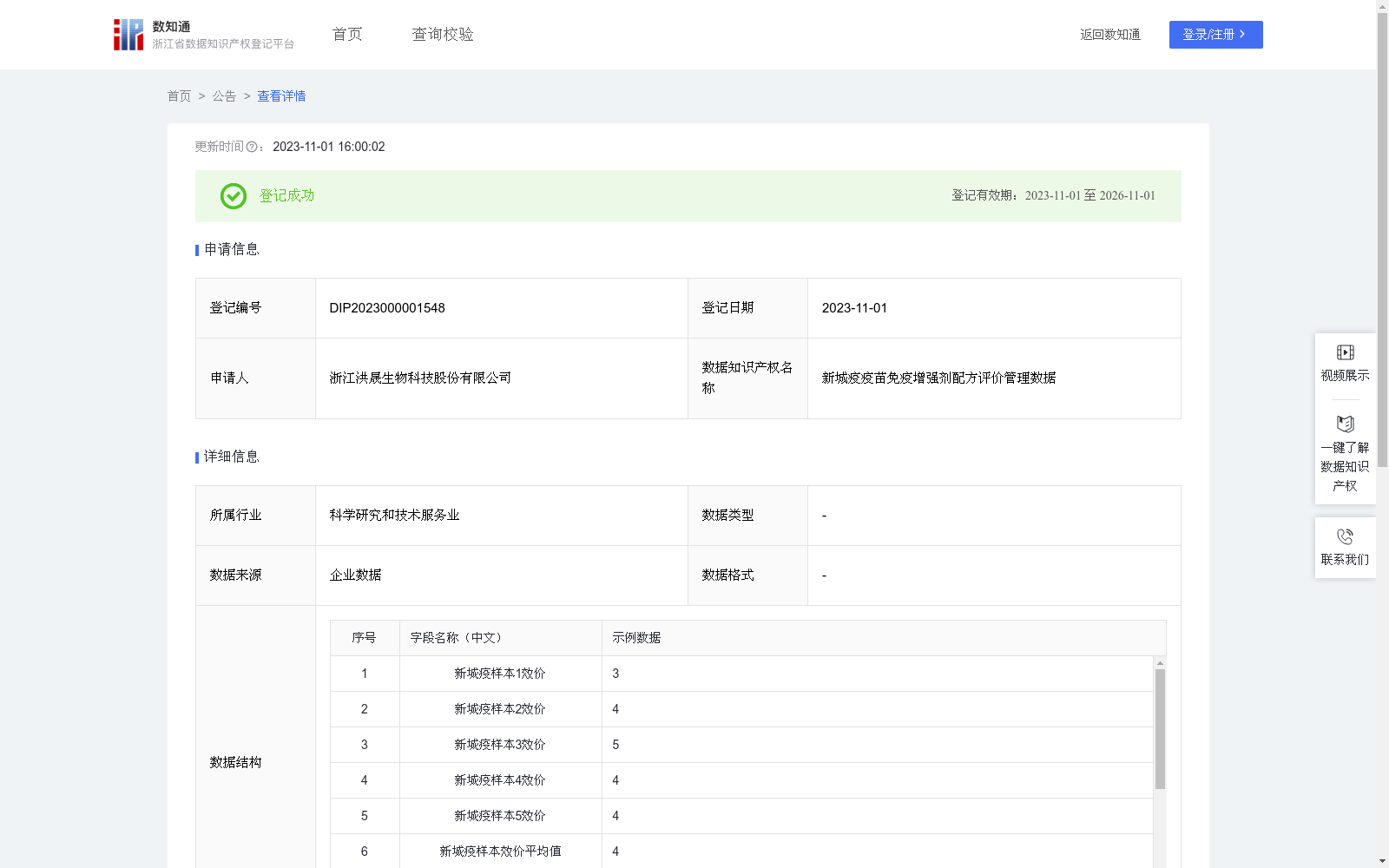
新城疫疫苗免疫增强剂配方评价管理数据
收藏资源简介:
通过收集不同增强剂成分配制的新城疫疫苗免疫鸡后血清抗体效价数据,经过计算比较不同增强剂成分配置疫苗效价的高低以及稳定性,得到相对最优成分配比方案,指导后期选取合适的成分作为新城疫疫苗免疫增强剂配方。一、根据不同增强剂成分配制的新城疫疫苗按疫苗编号进行分组,形成对比组,每组为5个样本数量。二、每免疫一周后、二周后、三周后、四周后、五周后分别取得每一样本的效价数据;效价的计算:通过2倍、4倍、6倍、8倍、16倍…N倍稀释样本在免疫一周后、二周后、三周后、四周后、五周后的新城疫抗原抽样,进而得到不同梯度浓度抗原抽样,上述抽样与1%的血红细胞反应,从而可观察获得红细胞完全凝集的抗原最大稀释倍数,进而通过对数公式y=log2x计算获得效价值,其中y为效价值,X为观察获得的最大稀释倍数,举例:如观察获得红细胞完全凝集的抗原最大稀释倍数X值为8,则通过公式计算y值为3,则相应效价值即为3。三、按对比组分别计算每组免疫一周后、二周后、三周后、四周后、五周后组内所有样本的平均效价(如组别一内5个样本在免疫一周后的效价分别为4、5、2、6、2,则该组样本在免疫一周后的平均效价为3.8)。四、以上述经过计算得到的平均效价为依据绘制相应对比折线图,通过数据和图形对比判断不同配比方案疫苗之间的效价高低及稳定性,综合衡量得到相对最优成分配比方案,指导后期选取合适的成分作为新城疫疫苗配方。
This dataset collects serum antibody titer data from chickens immunized with Newcastle disease vaccines formulated with different adjuvant components. By calculating and comparing the titer levels and stability of vaccines formulated with various adjuvant components, a relatively optimal component ratio scheme is obtained to guide the selection of suitable components for Newcastle disease vaccine immune adjuvant formulas in subsequent studies. 1. Newcastle disease vaccines formulated with different adjuvant components are grouped by vaccine ID to form comparative groups, with 5 samples per group. 2. Titer data of each sample is collected at 1, 2, 3, 4, and 5 weeks post-immunization respectively. The titer calculation method is as follows: Samples are diluted at 2-fold, 4-fold, 6-fold, 8-fold, 16-fold ... N-fold, and tested against Newcastle disease antigen samples collected at 1, 2, 3, 4, and 5 weeks post-immunization, to obtain antigen samples with different gradient concentrations. These samples are reacted with 1% red blood cells (RBCs), and the maximum dilution factor of the antigen that causes complete agglutination of RBCs is observed. The titer value is then calculated using the logarithmic formula y = log₂x, where y is the titer value and X is the observed maximum dilution factor. For example, if the observed maximum dilution factor X is 8, then y = 3, and the corresponding titer value is 3. 3. For each comparative group, calculate the average titer of all samples in the group at 1, 2, 3, 4, and 5 weeks post-immunization respectively. For example, if the titers of 5 samples in Group 1 at 1 week post-immunization are 4, 5, 2, 6, and 2, then the average titer of this group at 1 week post-immunization is 3.8. 4. Corresponding comparative line charts are drawn based on the calculated average titers. The titer levels and stability of vaccines with different formulation schemes are compared through data and graphical analysis, and a relatively optimal component ratio scheme is obtained through comprehensive evaluation, to guide the selection of suitable components for Newcastle disease vaccine formulas in subsequent studies.