
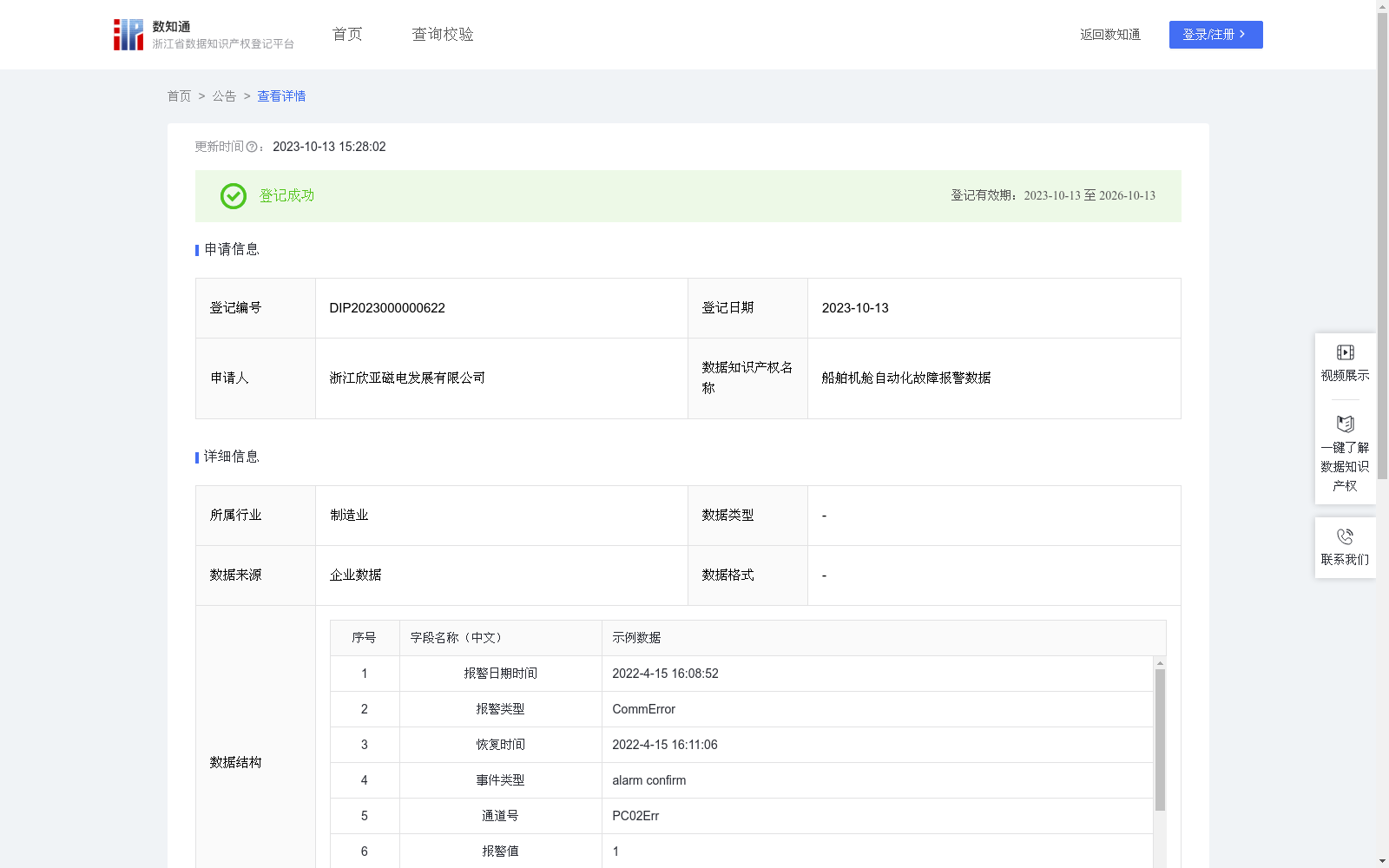
船舶机舱自动化故障报警数据
收藏浙江省数据知识产权登记平台2023-10-13 更新2024-05-08 收录
下载链接:
https://www.zjip.org.cn/home/announce/trends/4921
下载链接
链接失效反馈官方服务:
资源简介:
1)船舶机舱监测和控制:船舶机舱自动化数据可以用于实时监测机舱内各种参数的变化,并通过自动化控制系统对机舱进行自动化控制,以确保船舶在航行过程中的安全性和稳定性。例如,当机舱内的液位或温度超出预设范围时,控制系统可以自动调节液位或温度,以保证船舶正常运行。 2)船舶维护和故障诊断报警:船舶机舱自动化数据可以用于监测船舶的各种设备和部件的状态,预测并及时报警提示处理故障。例如,当系统判定机舱内某个设备的参数异常或可能异常时,系统可以自动发出警报,并提供相关的诊断信息,以便维修人员及时处理。1)数据准备: 针对接收到的主机数据工作负载、主机转速等原始数据,首先进行去噪处理,移除任何异常值或噪声。然后,对于缺失的数据,采用插值或其他方法进行填充。此外,对数据进行标准化或归一化,以确保所有数据都在相同的尺度上。 2)特征提取和选择: 基于预处理后的数据,进行特征提取和选择。选择与船舶机舱性能和状态量最相关的特征(主机转数、各位置压力温度等),这些特征可以提供最大的信息量。另外,利用特征工程模型,例如主成分分析(PAC)或特征重要性评估模型,来进一步优化特征选择。 3)数据训练:利用人工智能网络神经算法模型来处理系统产生的时序数据,在投喂典型故障数据的基础上,训练模型产生故障预测报警功能,当模型预测到某个阈值以上的故障概率时,可以触发报警。4)通过对原始数据进行监控,用过模型训练、阈值设置等方式,最终通过字段报警日期时间、报警类型、恢复时间、事件类型、通道号、报警值、限值、恢复值、操作者,分组名称等字段对数据按照时序进行记录,并得出VarComme结果来描述报警具体属性。
1) Marine Engine Room Monitoring and Control:
Automation data collected from marine engine rooms enables real-time monitoring of changes in various internal parameters, as well as automated control of the engine room via a dedicated automated control system, thereby ensuring the safety and stability of the vessel during navigation. For instance, when the liquid level or temperature in the engine room exceeds the preset thresholds, the control system will automatically adjust these parameters to maintain the normal operation of the ship.
2) Ship Maintenance and Fault Diagnosis Alarm:
Marine engine room automation data can be utilized to monitor the status of various equipment and components onboard the vessel, predict potential faults, and issue timely alarms for prompt troubleshooting. For example, if the system detects that the parameters of a certain engine room equipment are abnormal or at risk of becoming abnormal, it will automatically trigger an alarm and provide relevant diagnostic information to enable maintenance personnel to address the issue in a timely manner.
1) Data Preparation:
For the received raw data including main engine workload, main engine speed and other related metrics, denoising processing is first conducted to eliminate any outliers or noise. Next, missing data is filled using interpolation or other suitable methods. Additionally, standardization or normalization is applied to the dataset to ensure all data fall within the same scale range.
2) Feature Extraction and Selection:
Based on the preprocessed dataset, feature extraction and selection are performed. Features most closely correlated with the performance and status indicators of the marine engine room are selected, including main engine speed, pressure and temperature at various locations, as these features carry the most informative value. Furthermore, feature engineering models such as Principal Component Analysis (PCA) or feature importance evaluation models are employed to further optimize the feature selection process.
3) Data Training:
Artificial neural network (ANN) algorithm models are used to process the time-series data generated by the system. By feeding typical fault data into the model, the model is trained to implement a fault prediction and alarm function. When the model predicts a fault probability exceeding a predefined threshold, an alarm will be triggered.
4) By monitoring the raw data and adopting methods such as model training and threshold setting, the data is finally recorded chronologically using fields including alarm date and time, alarm type, recovery time, event type, channel number, alarm value, limit value, recovery value, operator, and group name. The VarComme result is then derived to describe the specific attributes of each alarm.
提供机构:
浙江欣亚磁电发展有限公司
创建时间:
2023-09-01
搜集汇总
数据集介绍
特点
船舶机舱自动化故障报警数据集包含65535条记录,记录了船舶机舱自动化系统的故障报警信息,用于实时监测、控制和故障诊断。数据通过人工智能算法处理,支持故障预测和报警功能。
以上内容由遇见数据集搜集并总结生成



