
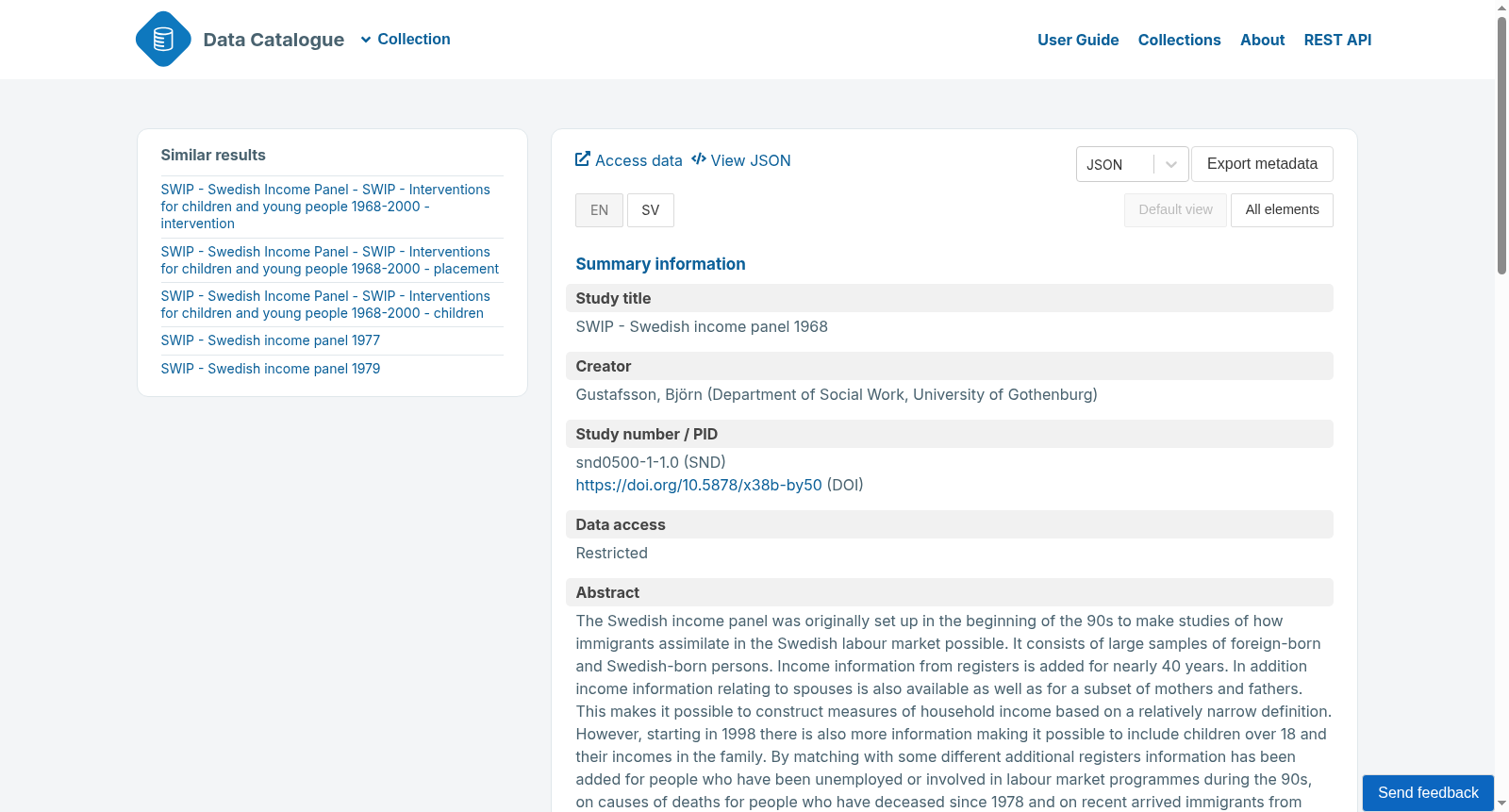
SWIP - Swedish income panel 1968
收藏CESSDA2024-11-14 更新2024-08-03 收录
下载链接:
https://datacatalogue.cessda.eu/detail/ba677c952c1b8317881d64b3c571f5b9fb442dfa8e24cb68c3e143b48da1b296/?lang=en
下载链接
链接失效反馈官方服务:
资源简介:
The Swedish income panel was originally set up in the beginning of the 90s to make studies of how immigrants assimilate in the Swedish labour market possible. It consists of large samples of foreign-born and Swedish-born persons. Income information from registers is added for nearly 40 years. In addition income information relating to spouses is also available as well as for a subset of mothers and fathers. This makes it possible to construct measures of household income based on a relatively narrow definition. However, starting in 1998 there is also more information making it possible to include children over 18 and their incomes in the family. By matching with some different additional registers information has been added for people who have been unemployed or involved in labour market programmes during the 90s, on causes of deaths for people who have deceased since 1978 and on recent arrived immigrants from various origins.
It has turned out that the data-base is quite useful for analysing research-questions other than originally motivating construction of the panel. The panel has been used for cross country comparisons of immigrants in the labour market and to analyse income mobility for different breakdowns of the population, and analyses the development in cohort income. There have been analyses of social assistance receipt among immigrants as well as studies of intergeneration mobility of income, the labour market situation of young immigrants and the second generation of immigrants. On-going work includes evaluation of labour market training programmes and studies of early retirement among immigrants. Planned work includes studies of the economic transition from child to adulthood during the 80s and 90s as well as studies of how frequent immigrant children are subject to measures under the Social Service Act and the Care of Youth Persons Act.
The potentials of the Swedish Income Panel can be understood if one compares it with better known income-panels in other countries. For example SWIP covers more years and has a larger sample than the German Socio-Economic Panel (GSOEP). On the other hand, the fact that information is obtained from registers only makes this Swedish panel less rich in variables. There are striking parallels between the Gothenburg Income Panel and the labour market panel at the Centre for Labour Market and Social Research in Aarhus for the Danish population.
瑞典收入面板(Swedish Income Panel,SWIP)最初于20世纪90年代初搭建,旨在支持关于移民在瑞典劳动力市场同化情况的研究。数据集包含大量外国出生人口与瑞典本土出生人口的样本,配套纳入了近40年的登记收入信息。此外,还包含配偶及部分父母的收入信息,这使得基于相对狭义定义构建家庭收入指标成为可能。不过自1998年起,新增的更多信息可将18岁以上子女及其收入纳入家庭收入统计范畴。通过与多类补充登记库匹配,数据集补充了以下信息:20世纪90年代曾失业或参与劳动力市场项目的群体相关记录、1978年以来已故人群的死亡原因信息,以及来自不同地区的新近入境移民的相关数据。
后续研究发现,该数据库不仅可用于原设计初衷的研究,还能有效支撑诸多其他科研问题的分析。该面板已被用于开展移民劳动力市场的跨国比较研究,针对不同人口分组分析收入流动性,以及探究同期群收入的发展趋势。相关研究已覆盖移民社会救助申领情况、代际收入流动性、青年移民及第二代移民的劳动力市场境遇等主题。当前正在开展的研究包括劳动力市场培训项目评估以及移民提前退休情况研究。未来计划开展的研究则包括20世纪80、90年代儿童向成年群体的经济转型历程,以及移民子女受《社会服务法》(Social Service Act)与《青少年照料法》(Care of Youth Persons Act)相关措施规制的频次研究。
若将瑞典收入面板与其他国家知名度更高的收入面板进行对比,便可明晰其研究潜力。例如,与德国社会经济面板(German Socio-Economic Panel, GSOEP)相比,瑞典收入面板的观测年限更长、样本规模更大。但另一方面,由于所有信息均仅来自登记库,该瑞典面板的变量丰富度相对不足。奥胡斯劳动力市场与社会研究中心针对丹麦人口搭建的劳动力市场面板,与哥德堡收入面板存在诸多显著的相似之处。
创建时间:
2001-01-01
搜集汇总
数据集介绍
背景与挑战
背景概述
SWIP - Swedish income panel 1968是一个纵向面板数据集,最初旨在研究移民在瑞典劳动力市场的融合情况。它包含外国出生和瑞典出生人口的样本,覆盖1968年至2003年的收入登记信息,并扩展至配偶和部分父母的收入数据,支持家庭收入分析和移民相关研究。数据访问受限,适用于社会科学和收入分配等领域。
以上内容由遇见数据集搜集并总结生成


