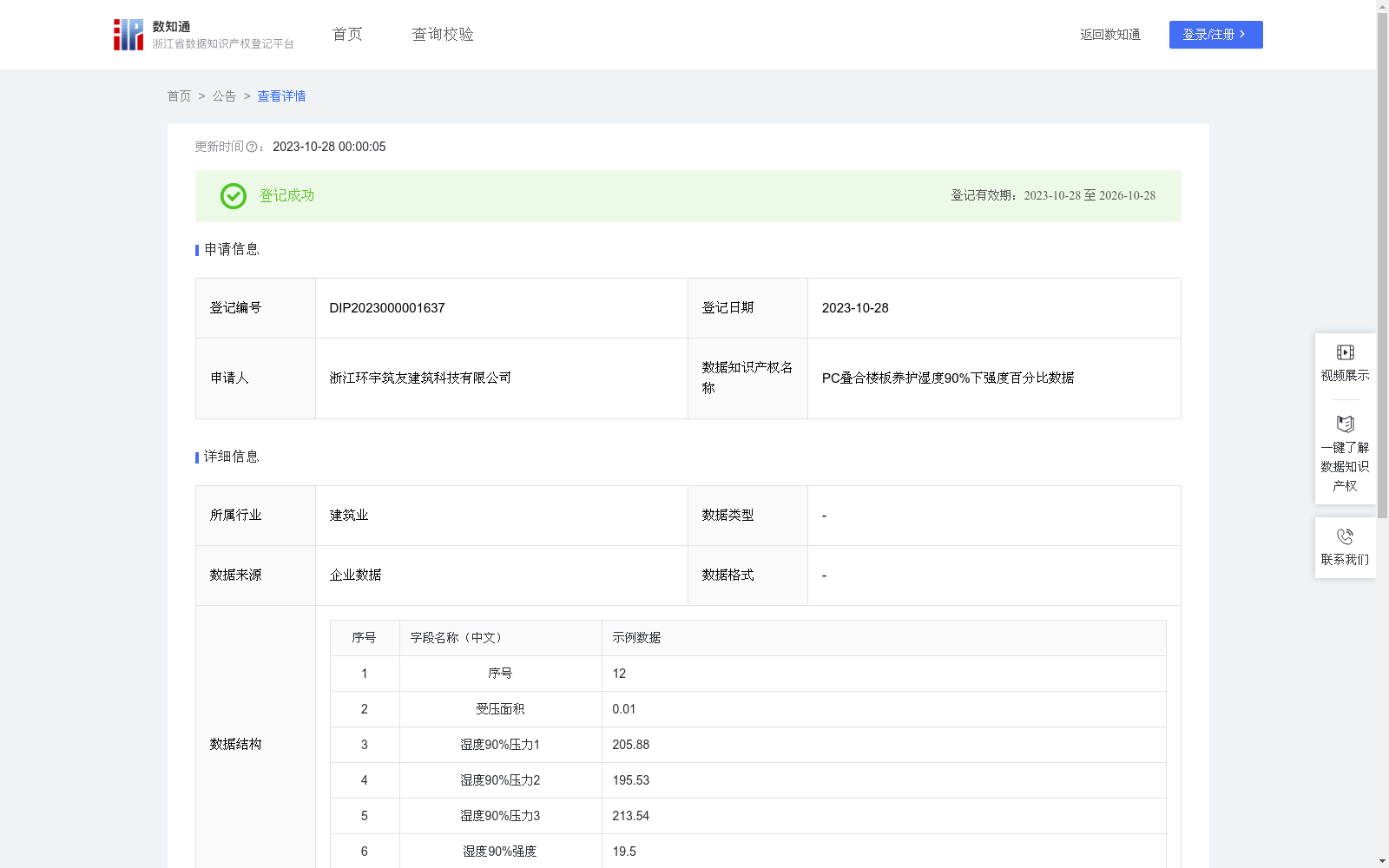
PC叠合楼板养护湿度90%下强度百分比数据
收藏资源简介:
混凝土硬化过程中,水泥与水发生水化反应,形成水化产物,使混凝土逐渐硬化。而水分是水泥水化反应的必要条件之一,缺水会影响水泥水化反应的进行,进而影响混凝土的强度。通过采集养护窑内湿度90%下数据,并由同条件养护的混凝土试块检测其出窑强度,从而可以分析出湿度90%条件下PC混凝土构件出窑时的强度,为准确的找到该湿度下最合适的养护窑数据提供有效支持。有利于制定合理的湿度下提高PC混凝土强度的控制方案。1、数据采集:在温度相同的条件下,制作同条件混凝土试块与PC构件一同送入养护窑,采集养护窑内湿度数据,构件出窑时将随同的混凝土试块送至试验室进行多抗压测试。同湿度下范围获取一百组试验数据,减小试验误差。 2、数据分析:改变窑内湿度为S1,100mm*100mm*100mm的非标准试块的受压面积为A,强度P=F/A,其中:F为每组试验试块测得的压力的平均值,即F=(F1+F2+F3)/3。根据计算得到的数据需乘以换算系数0.95。完整的计算公式为P={(F1+F2+F3)/3}/A*0.95 测出试块出窑强度。 3、数据应用:通过以上数据,可以分析出同湿度不同压力下PC混凝土构件出窑时的强度,为下步准确的找到最合适的养护窑湿度数据提供有效支持。有利于制定合理的湿度下提高PC混凝土强度的控制方案。
During the hardening process of concrete, cement undergoes hydration reaction with water to form hydration products, which gradually hardens the concrete. Water is one of the necessary conditions for cement hydration; insufficient water will hinder the cement hydration reaction and thus affect the strength of concrete. By collecting data when the humidity inside the curing kiln is maintained at 90%, and testing the kiln-out strength of concrete test cubes cured under the same conditions as the PC components, the kiln-out strength of PC concrete components under 90% humidity can be analyzed, providing effective support for accurately identifying the optimal curing kiln operating parameters under this humidity condition. This helps to formulate reasonable control schemes to improve the strength of PC concrete at the corresponding humidity. 1. Data Collection: Under the same temperature condition, concrete test cubes are prepared and sent into the curing kiln together with PC components. The humidity data inside the curing kiln is collected. When the components are taken out of the kiln, the accompanying concrete test cubes are sent to the laboratory for multiple compressive strength tests. 100 sets of test data are obtained under the same humidity to reduce test errors. 2. Data Analysis: Adjust the humidity inside the kiln to S1. The compressive area of the non-standard test cube with dimensions of 100mm×100mm×100mm is A, and the strength P = F/A, where F is the average value of the measured pressures of each group of test cubes, i.e., F = (F₁ + F₂ + F₃)/3. The calculated data needs to be multiplied by the conversion factor 0.95. The complete calculation formula is P = [(F₁ + F₂ + F₃)/3]/A × 0.95 to determine the kiln-out strength of the test cubes. 3. Data Application: Based on the above data, the kiln-out strength of PC concrete components under the same humidity but different pressures can be analyzed, providing effective support for accurately identifying the optimal curing kiln humidity parameters in the subsequent work. This helps to formulate reasonable control schemes to improve the strength of PC concrete at the corresponding humidity.