The effect of digital detox using the MinimalistPhone app on the behavior of young users and their emotional experience.
收藏资源简介:
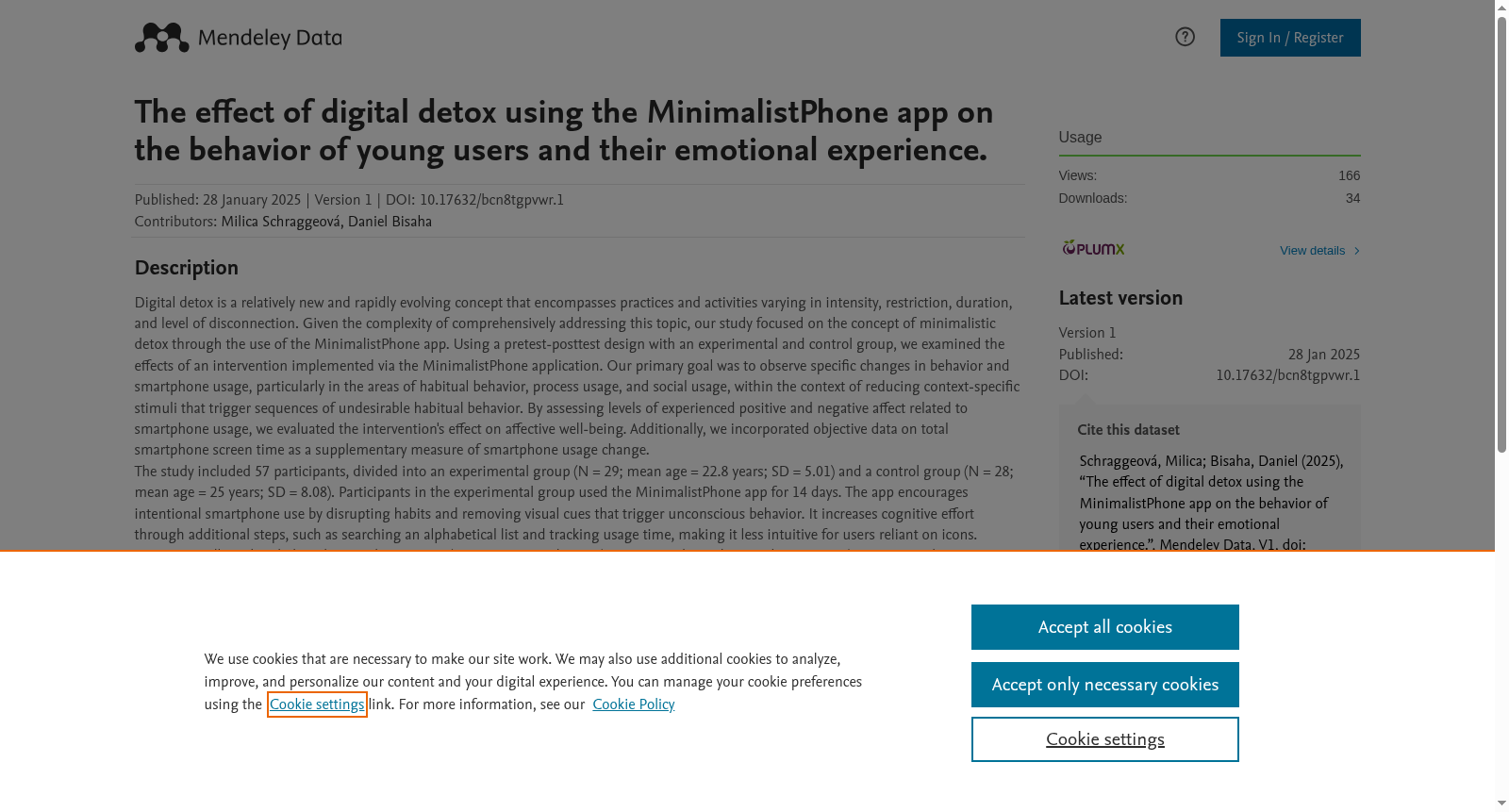
Digital detox is a relatively new and rapidly evolving concept that encompasses practices and activities varying in intensity, restriction, duration, and level of disconnection. Given the complexity of comprehensively addressing this topic, our study focused on the concept of minimalistic detox through the use of the MinimalistPhone app. Using a pretest-posttest design with an experimental and control group, we examined the effects of an intervention implemented via the MinimalistPhone application. Our primary goal was to observe specific changes in behavior and smartphone usage, particularly in the areas of habitual behavior, process usage, and social usage, within the context of reducing context-specific stimuli that trigger sequences of undesirable habitual behavior. By assessing levels of experienced positive and negative affect related to smartphone usage, we evaluated the intervention's effect on affective well-being. Additionally, we incorporated objective data on total smartphone screen time as a supplementary measure of smartphone usage change. The study included 57 participants, divided into an experimental group (N = 29; mean age = 22.8 years; SD = 5.01) and a control group (N = 28; mean age = 25 years; SD = 8.08). Participants in the experimental group used the MinimalistPhone app for 14 days. The app encourages intentional smartphone use by disrupting habits and removing visual cues that trigger unconscious behavior. It increases cognitive effort through additional steps, such as searching an alphabetical list and tracking usage time, making it less intuitive for users reliant on icons. Data were collected on habitual smartphone usage (van Deursen et al., 2015), process and social smartphone usage (Limayem et al., 2003; van Deursen et al., 2015), affective states (via PANAS; Watson et al., 1988), and objectively measured screen time before and after the intervention. Our findings supported the hypothesis that the MinimalistPhone application reduces habitual behavior and total screen time. However, these results should be interpreted cautiously due to notable pretest differences between the groups. In terms of procedural smartphone use, the experimental group exhibited greater variability in pretest-to-posttest change compared to the control group. Conversely, social smartphone use remained relatively stable in the experimental group, with only small differences between pretest and posttest. The intervention did not significantly affect affective states. The dataset includes pretest and posttest data on habitual behavior, procedural and social smartphone use, screen time, and positive and negative affect related to smartphone usage, along with a detailed data description.
数字戒断(Digital detox)是一个相对新兴且快速发展的概念,涵盖了强度、限制程度、持续时长以及脱离程度各不相同的各类实践与活动。鉴于全面探讨该主题的复杂性,本研究借助极简手机应用(MinimalistPhone)聚焦于极简式戒断这一细分概念。本研究采用实验组-对照组前后测设计,探究了通过该应用实施的干预措施的效果。本研究的核心目标是,在减少触发不良习惯性行为序列的特定情境刺激物的背景下,观测行为与智能手机使用的具体变化,尤其是习惯性行为、程序性使用以及社交性使用这三个维度的变化。通过评估与智能手机使用相关的积极与消极情感体验水平,本研究评估了该干预对情感幸福感的影响。此外,本研究纳入了智能手机总屏幕时长的客观数据,作为智能手机使用变化的补充衡量指标。 本研究共招募57名参与者,分为实验组(N=29;平均年龄=22.8岁;标准差SD=5.01)与对照组(N=28;平均年龄=25岁;标准差SD=8.08)。实验组参与者需连续14天使用极简手机应用。该应用通过打破原有使用习惯、移除触发无意识行为的视觉提示,引导用户进行有意识的智能手机使用。它通过增设额外步骤(例如按字母列表搜索应用、追踪使用时长)提升认知负荷,使得依赖应用图标的用户操作难度有所提升。 本研究收集了多维度数据:智能手机习惯性使用行为(改编自van Deursen等,2015)、智能手机程序性与社交性使用行为(改编自Limayem等,2003;van Deursen等,2015)、情感状态(通过积极与消极情感量表PANAS;Watson等,1988),以及干预前后的客观屏幕时长数据。研究结果验证了极简手机应用可降低习惯性使用行为与总屏幕时长的假说。但由于两组前测数据存在显著差异,对该结果的解读需保持谨慎。在智能手机程序性使用维度上,实验组的前后测变化幅度相较于对照组更为显著。与之相反,实验组的智能手机社交性使用行为相对稳定,前后测仅存在微小差异。该干预对参与者的情感状态未产生显著影响。 本数据集包含习惯性行为、智能手机程序性与社交性使用、屏幕时长以及与智能手机使用相关的积极与消极情感的前测与后测数据,同时附带详细的数据说明文档。