
Hipnotalamusz/AI_Assisted_Self_Images_With_Prompts_And_Personality_Tests
收藏Hugging Face2024-04-18 更新2024-06-11 收录
下载链接:
https://hf-mirror.com/datasets/Hipnotalamusz/AI_Assisted_Self_Images_With_Prompts_And_Personality_Tests
下载链接
链接失效反馈官方服务:
资源简介:
---
task_categories:
- image-classification
- text-classification
language:
- en
tags:
- psychology
- art
pretty_name: Digital mirror of the soul
---
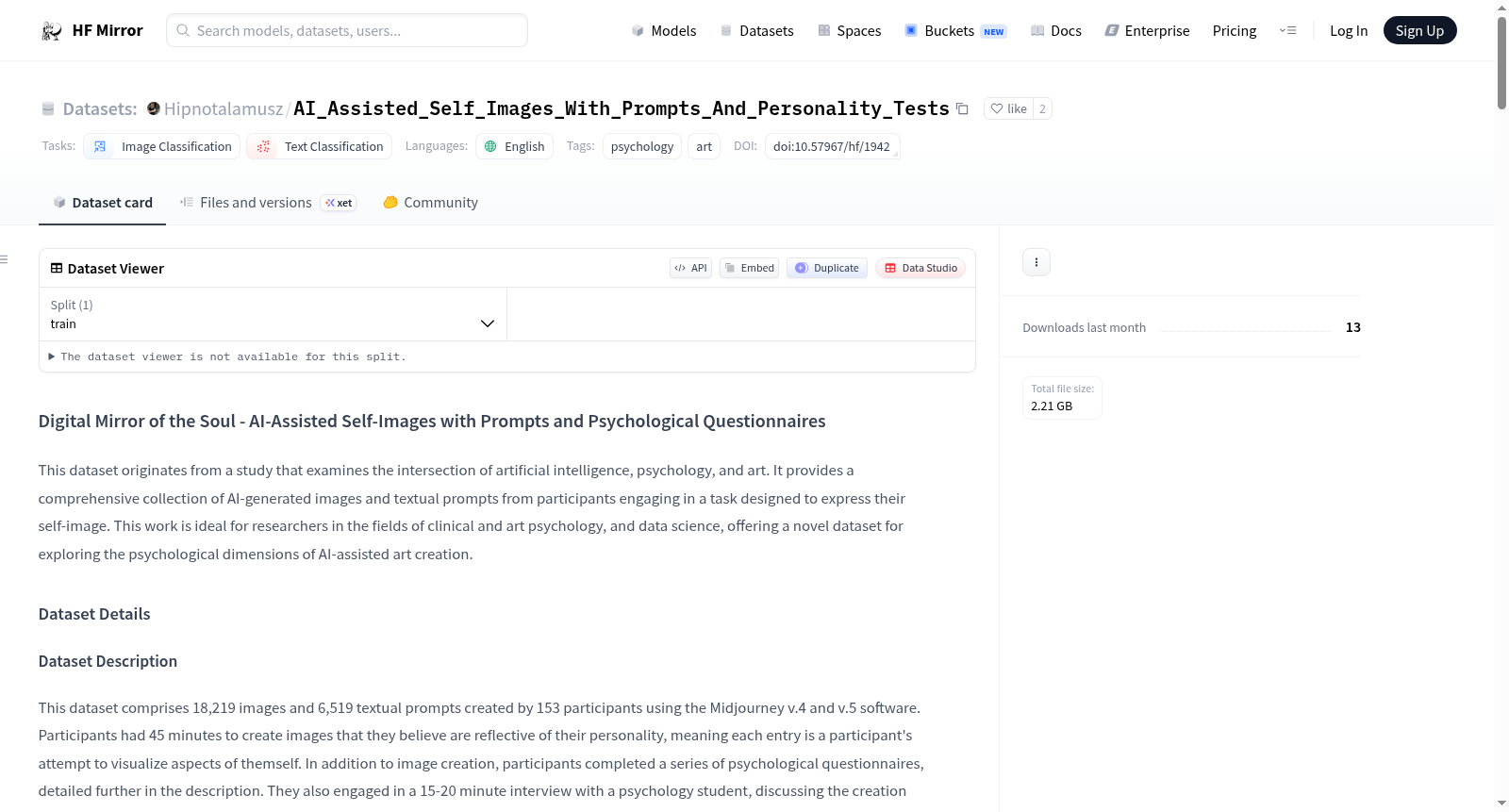
# Digital Mirror of the Soul - AI-Assisted Self-Images with Prompts and Psychological Questionnaires
This dataset originates from a study that examines the intersection of artificial intelligence, psychology, and art. It provides a comprehensive collection of AI-generated images and textual prompts from participants engaging in a task designed to express their self-image. This work is ideal for researchers in the fields of psychology, artificial intelligence, and art therapy, offering a novel dataset for exploring self-representation and the psychological dimensions of AI-assisted art creation.
## Dataset Details
### Dataset Description
This dataset comprises 18,219 images and 6,519 textual prompts created by 153 participants using the Midjourney v.4 and subsequently upgraded to v.5 AI software. Participants were tasked to create images that they believe are reflective of their personality, with a creation window limited to 45 minutes, meaning each entry is a participant's attempt to visualize aspects of their self-perception. In addition to image creation, participants completed a series of psychological questionnaires, detailed further in the description. They also engaged in a 15-20 minute interview with a psychology student, discussing the creation process, their images, and along with any thoughts, feelings, or memories evoked during the procedure. This dataset, containing the images, prompts, and results of various psychological questionnaires, supports a variety of research objectives, including the development of models to analyze visual and verbal self-expression, their development and temporal changes over the image creating session, and their potential use in inferring relevant psychological constructs ranging from body image, perfectionism, self-esteem, stability of identity, and BIG5 personality traits.
- **Curated by:** Klaus Kellerwessel (0009-0005-6420-5691) and Lilla Juhász
- **Funded by:** ÚNKP-23-2 New National Excellence Program of the Ministry for Culture and Innovation from the source of the Hungarian National Research, Development, and Innovation Fund.
- **Language(s) (NLP):** English
### Dataset Sources [Optional]
- **Repository:** [https://huggingface.co/datasets/Hipnotalamusz/AI_Assisted_Self_Images_With_Prompts_And_Personality_Tests](https://huggingface.co/datasets/Hipnotalamusz/AI_Assisted_Self_Images_With_Prompts_And_Personality_Tests)
- **Paper [Optional]:** Under revision - we will add it later
## Uses
The dataset is intended for academic researchers and practitioners interested in the cross-disciplinary areas of AI, psychology, and art therapy. It offers a unique dataset for studying the nuances of self-representation, providing a basis for both quantitative and qualitative analyses. Researchers interested in machine learning, gender studies, and the psychological impact of AI on art creation will find this dataset particularly useful. It facilitates a deeper understanding of the role of AI in art therapy practices and the broader implications for psychological research.
### Direct Use
- Developing AI-driven psychological assessment tools that interpret visual and textual data.
- Investigating the nuances of identity expression through digital art.
- Enhancing art therapy practices with AI technology.
### Out-of-Scope Use
The dataset is designed for scholarly research and is not intended for commercial use or any applications that could compromise the privacy or anonymity of the participants. Ethical guidelines should be strictly followed to ensure respectful and responsible use of the data.
## Dataset Structure
The dataset is structured with comprehensive metadata for each participant's AI-generated images and textual prompts. Here's a guide to navigating and utilizing this rich dataset:
### Overview
The dataset includes multiple rows for each participant, where each row corresponds to an image generated from a single text prompt. The columns encompass demographic information, psychological assessments, and details related to the image creation process.
### Columns Description
- **Participant_ID:** Each participant created a unique identifier for themselves. This was necessary because participants filled in the questionnaires online one day before the image creation procedure, and we needed to connect the questionnaire results to the images and interviews somehow. We opted not to generate an ID from the participants' names due to privacy concerns, and this self-chosen approach seemed to work. Since the participants were all Hungarian, they sometimes used Hungarian words like "kémény" (chimney), "teknős" (turtle), and some in English (e.g., "soviet cat") or seemingly nonsensical (e.g., "t2ki7m") IDs also appear.
- **Image number:** A sequential number indicating the order of the image generated by the participant. Images generated from the same prompt at the same session (see Event type) share their Image number.
- **Text Prompt:** The textual description provided by the participant to generate the image in natural language.
- **Event type:** Describes the nature of the image generation event: "imagine" for initial creations, "variation" for variations of an initial image, and "upscale" for a bigger and more detailed version of an initial image. The Midjourney program generates 4 images per 1 prompt for the initial image type "imagine" and their "variations", resulting in these images sharing image numbers in groups of 4 (see Image numbers).
- **file_name:** The name of the file corresponding to the generated image, encapsulating the participant ID, image number, and the first 40 characters of the text prompt used. We also added some random characters to the end to ensure that every image's file_name is unique.
- **Gender:** Participant's gender (1 indicates female, 0 male - we will add the data of our non-binary participants later).
- **Age:** Participant's age.
- **Highest level of education:** Coded value representing the participant's highest level of education achieved.
And various psychological measures, including:
- **Rosenberg self-esteem** The Rosenberg Self-Esteem Scale is a widely used tool for assessing an individual's self-esteem. It consists of 10 items designed to measure both positive and negative feelings about the self. The scale is scored on a four-point Likert scale, ranging from strongly agree to strongly disagree, with higher scores indicating higher self-esteem. Participants with high self-concept clarity might produce images and prompts that are more consistent and coherent, reflecting a stable and well-defined sense of self. (Rosenberg Self-esteem Scale: Horváth, Zs., Urbán, R., Kökönyei, Gy., Demetrovics, Zs. (2022). Kérdőíves módszerek a klinikai és egészségpszichológiai kutatásban és gyakorlatban I. Budapest: Medicina könyvkiadó.)
- **Extraversion/Big5 to Openness/Big5** This shortened version of the Big Five Personality Test measures five key dimensions of personality: Extraversion, Agreeableness, Conscientiousness, Neuroticism, and Openness. Each dimension is assessed with two items, offering a brief yet effective insight into an individual's personality traits.
The Big Five traits could offer a nuanced understanding of the themes and motifs chosen in the art creation process. For instance, high Openness might be linked to more creative and diverse prompts, while high Extraversion could relate to more socially engaging or dynamic content.
(10-item Personality Inventory (Big5 – shortened version): Chiorri, C., Bracco, F., Piccinno, T., Modafferi, C., & Battini, V. (2015). Psychometric properties of a revised version of the Ten Item Personality Inventory. European Journal of Psychological Assessment.)
- **Self-concept clarity** The Self-Concept Clarity Scale assesses the extent to which an individual's self-concept is clearly and confidently defined, internally consistent, and stable over time. High scores indicate a clear and confident self-concept. Participants with high self-concept clarity might produce images and prompts that are more consistent and coherent, reflecting a stable and well-defined sense of self.
(Self-Concept Clarity Sale: Hargitai, R., Rózsa, S., Hupuczi, E., Birkás, B., Hartung, I., Hartungné Somlai, E., ... & Kállai, J. (2021). Énkép egyértelműség mérése és korrelátumai. Magyar Pszichológiai Szemle, 75(4), 557-580.)
- **Beck depression** The Beck Depression Inventory is a 21-item self-report inventory, one of the most widely used instruments for measuring the severity of depression. Each item is scored on a scale from 0 to 3, with higher total scores indicating more severe depressive symptoms.
Depression scores could influence the emotional tone of the generated images and prompts. Higher scores might be associated with themes of sadness, isolation, or other negative emotional expressions.
(Beck Depression Inventory (BDI): 75 Papír-Ceruza teszt. Pszicho-ped Bt. - https://animula.hu/konyv/75-papir-ceruza-teszt )
- **Interpersonal.../Ego Identity Status to Ideological achieved identity/Ego Identity Status** This assessment tool measures Ego Identity Status across different domains, including interpersonal relations and ideological commitments. It categorizes identity status into diffusion, foreclosure, moratorium, and achievement, providing insight into the individual's identity exploration and commitment processes. Identity status may impact the thematic diversity and depth of participants' creations. Those in the achievement status might exhibit a greater variety of themes, reflecting a well-explored sense of identity.
(Extended Objective Measure of EGO Identity Status II. /EOM-EIS II.: Jámbori, Sz., Kőrössy, J. (2019). A szándékos önsza-bályozás jelentősége serdülő és fiatal felnőttkorban a társas támogatás, az identitásállapotok és a reziliencia tükrében. Alkalma-zott Pszichológia 19(3): 33-52.)
- **Standards/Perfectionism to Discrepancy/Perfectionism** This scale assesses perfectionism by measuring standards and discrepancy aspects. High standards reflect the setting of high personal performance standards, while discrepancy refers to perceived shortcomings in meeting those standards. Perfectionism scores, especially high discrepancy, might relate to how participants critique their own creations or the iterative process of refining their images through variations.
(Almost Perfect Scale (perfectionism): Horváth, Zs., Urbán, R., Kökönyei, Gy., Demetrovics, Zs. (2022). Kérdőíves módszerek a klinikai és egészségpszichológiai kutatásban és gyakorlatban I. Budapest: Medicina könyvkiadó.)
- **Total/Body Image to Rest/Body image** This questionnaire assesses body image across several dimensions, including general satisfaction with one's body, evaluation of body size, knowledge about one's body, and attitudes toward specific body parts or aspects. Body image scores could influence how participants choose to represent themselves or others in their images. Issues with body image might lead to avoiding personal representation or altering aspects of appearance in the generated art.
(Personal body attitudes questionnaire: Horváth, Zs., Urbán, R., Kökönyei, Gy., Demetrovics, Zs. (2022). Kérdőíves módszerek a klinikai és egészségpszichológiai kutatásban és gyakorlatban I. Budapest: Medicina könyvkiadó.)
### Navigating and Utilizing the Dataset
- **Participant Analysis:** Isolate data for individual participants using the Participant_ID column for qualitative case studies or aggregate data across participants for broader analyses.
- **Image Type and Number:** Key to understanding the context of each image. Variations or upscales from an image might reflect a participant's preference for continuing to work on this particular image, assuming that the upscaled and variated images might contain more useful information than the more accidental "imagine" types. The image number enables us to investigate the dynamic processes of image creation, the shifts of focus, and experimentations.
- **Text Prompts:** Explore thematic (categories, topics used in self-description) or formal (linguistic, stylistic) features of the prompts, their changes in the creation process, or correlations with the psychological measures provided.
- **Images:** Analyze thematic (content of the image) or formal (colors, brightness, composition, edge density, etc.) features of the images to infer different psychological and demographic data.
- **Statistical and Machine Learning Analyses:** Use the dataset for both traditional statistical analyses and advanced machine learning models (both supervised and unsupervised) to explore underlying patterns and correlations in how participants express themselves through AI-generated art.
## Dataset Creation
### Curation Rationale
As passive recipients, we often differentiate sharply between AI and human-made artworks. However, studies show that when individuals personally engage with AI art softwares, they tend to view the creative process as collaborative, feeling a sense of ownership over the finished works. This type of involvement and sense of personal connection can serve as a basis for the use of these tools in art therapy and even psychometrics. This dataset primarily investigates how individuals can express complex psychological states through AI-generated art - and whether it is possible to deduce them from only the images and the prompts used.
### Source Data
Data was collected in a controlled study environment, with participants guided through the process of creating AI-assisted art.
#### Data Collection and Processing
The test session, which lasts between 80 and 90 minutes, involves only the examiner and the participant. The procedure begins with a brief tutorial on the image-generation software (Midjourney®), where an example image is generated using a 'Dogs and flowers' prompt. After obtaining informed consent, participants are instructed to take self-portraits for 45 minutes, using natural language prompts as guided by the following standardized instruction:
> "I would like to ask you to try to take pictures of yourself that express who you are and how you feel about yourself. These images do not have to be lifelike, but they can be. They can be based on several basic ideas, embedded in scenes or situations, and can deviate from reality as much as you like. During the image creation process, you can specify artistic styles, play with the format, composition, lighting, and colours. The goal is to produce as many images as possible that you feel capture something of your personality."
During image creation, participants are encouraged to ask technical questions and may use the online DeepL translator to overcome language barriers, given that the participants were Hungarian and the image creation process was conducted in English. However, they receive no further assistance; for example, they cannot use a mirror or a specific image found on their phone as a template. The 45 minutes starts after the first successfully completed image pack is loaded, and the examiner gives a signal five minutes before it runs out. Upon completing the 45-minute period, participants are allowed to finish the prompt they have already started but are not permitted to initiate new ones. The image-making phase was followed by a 15-20 minute semi-structured interview, guided by the following questions:
- How are you feeling now?
- What was it like to go through the task?
- Was the 45-minute duration enough, or did you feel it was too much or too little?
- Did you experience a state of flow? Were you able to settle in?
- What goals did you set for yourself?
- Did you have any strategy or did you simply allow yourself to associate freely?
- How difficult was it for you to try to define yourself for 45 minutes?
- How do you relate to the finished images?
- Which ones do you feel are the most expressive of yourself?
- Which ones the least?
- Which one do you think your best friend would find the most expressive of you?
- How does it feel to look through the pictures now?
- Have you had any realisations in terms of self-knowledge?
- Did you encounter any drawbacks or difficulties in using the program or during the test-taking process?
- What would you change if you could start over?
#### Who are the Source Data Producers?
All of our participants were Hungarian young adults between 18 and 28 years old. They have been anonymized, with their questionnaires, interviews, and images linked solely through the unique ID each participant selected.
## Bias, Risks, and Limitations
The dataset's interpretations should be made with caution, considering the socio-cultural context of the participants and the influence of AI technology on artistic expression. Ethical considerations are paramount, especially concerning participant privacy and the interpretation of artistic expressions.
### Recommendations
Researchers are encouraged to approach the dataset with a multidisciplinary perspective, integrating insights from psychology, artificial intelligence, and art theory. This dataset offers a unique opportunity to explore the boundaries of AI-mediated human expression and its implications for psychological research and practice. Careful, ethical analysis can lead to significant advancements in our understanding of AI as a tool for self-exploration and expression in both clinical and research settings.
## Citation [Optional]
**APA:**
Kellerwessel, K. (2024). AI_Assisted_Self_Images_With_Prompts_And_Personality_Tests (Revision cfbe255) [Adatbázis]. Hugging Face. https://doi.org/10.57967/hf/1942
## Dataset Card Authors [Optional]
Klaus Kellerwessel (Eötvös Loránd Tudományegyetem, Budapest; University of Pannonia, Veszprém)
## Dataset Card Contact
kellerwesselklaus@gmail.com
提供机构:
Hipnotalamusz
原始信息汇总
数据集概述
数据集名称
- 名称: Digital Mirror of the Soul
- 别名: AI-Assisted Self-Images with Prompts and Psychological Questionnaires
数据集描述
- 内容: 包含18,219张AI生成的图像和6,519个文本提示,由153名参与者使用Midjourney v.4和v.5软件创建。参与者在45分钟内根据个人性格特征创作图像,并完成一系列心理问卷。此外,参与者还进行了15-20分钟的访谈,讨论创作过程和图像。
- 目的: 用于研究人工智能、心理学和艺术疗法的交叉领域,探索自我表达和AI辅助艺术创作的心理维度。
数据集构成
- 参与者信息: 包括性别、年龄、最高教育水平等。
- 图像和文本提示: 每个参与者有多行数据,每行对应一个由文本提示生成的图像。
- 心理评估: 包括自我评价、大五人格测试、自我概念清晰度、贝克抑郁量表等。
数据集使用
- 研究领域: 心理学、人工智能、艺术疗法。
- 应用: 开发AI驱动的心理评估工具,研究数字艺术中的身份表达,增强艺术疗法实践。
数据集结构
- 参与者ID: 每个参与者创建的唯一标识符。
- 图像编号: 图像生成的顺序编号。
- 文本提示: 参与者提供的自然语言描述。
- 事件类型: 描述图像生成事件的性质,如初始创作、变体或放大。
- 文件名: 包含参与者ID、图像编号和文本提示前40个字符的文件名。
数据集来源
- 资金支持: ÚNKP-23-2新国家卓越计划,由匈牙利国家研究、发展和创新基金提供。
- 语言: 英语
数据集创建
- 采集环境: 受控研究环境,参与者在指导下使用AI软件创作艺术。
- 数据处理: 包括图像生成、心理问卷填写和访谈。
数据集局限性
- 考虑因素: 应谨慎考虑参与者的社会文化背景和AI技术对艺术表达的影响。
- 伦理考量: 重视参与者隐私和艺术表达的解释。
数据集引用
- APA格式: Kellerwessel, K. (2024). AI_Assisted_Self_Images_With_Prompts_And_Personality_Tests (Revision cfbe255) [Database]. Hugging Face. https://doi.org/10.57967/hf/1942
搜集汇总
数据集介绍
构建方式
在心理学与人工智能交叉领域,该数据集的构建遵循严谨的实验设计。研究者招募了153名匈牙利青年参与者,在受控环境中使用Midjourney图像生成软件,依据标准化指导语在45分钟内创作反映自我认知的图像。每位参与者同时完成一系列心理量表测评,涵盖自尊、大五人格、抑郁、自我概念清晰度、完美主义及身体意象等多个维度。图像创作结束后,研究者还进行了半结构化访谈,深入探讨创作过程与心理体验,从而将视觉表达、文本提示与量化心理指标有机结合。
使用方法
研究者可利用该数据集进行多层面的分析。在技术层面,可通过机器学习模型探索图像特征、文本提示与心理构念之间的预测关系,开发AI驱动的心理评估工具。在心理学层面,可进行质性分析,结合访谈内容深入解读图像与提示背后的自我叙事与身份探索过程。使用时应依据参与者ID进行个案追踪或跨群体聚合分析,并注意区分图像的事件类型以理解创作序列。数据集严格限于学术研究,使用时须恪守伦理规范,避免任何可能损害参与者隐私或数据匿名性的应用。
背景与挑战
背景概述
在人工智能与心理学交叉融合的学术浪潮中,数字心灵镜像数据集应运而生,由Klaus Kellerwessel与Lilla Juhász等学者于2024年主导构建,并得到匈牙利国家研究、发展与创新基金的支持。该数据集聚焦于探索人工智能辅助艺术创作中的心理维度,核心研究问题在于个体如何通过AI生成的图像与文本提示来表达自我认知,并试图从这些数字痕迹中推断出抑郁、大五人格、自尊等心理构念。这一创新性资源为临床心理学、艺术治疗与数据科学领域的跨学科研究提供了珍贵实证基础,有望推动AI在心理评估与自我表达工具开发中的应用。
当前挑战
该数据集致力于应对从AI生成艺术中解析复杂心理状态的领域挑战,其核心在于建立视觉、文本特征与多维心理测量指标之间的稳健关联模型,这要求算法能够捕捉抽象情感与自我概念在数字媒介中的微妙表征。在构建过程中,研究者面临多重挑战:首先,需在严格控制实验环境下引导参与者使用Midjourney软件进行自我画像创作,同时平衡技术指导与创作自主性;其次,数据整合涉及将153名匈牙利年轻成年人的图像、提示文本、多项心理量表结果及访谈内容进行匿名化关联,确保跨模态数据的一致性与隐私保护;此外,文化背景的单一性与AI工具本身的技术特性可能引入表达偏差,对研究结论的普适性构成潜在限制。
常用场景
经典使用场景
在数字艺术与心理学的交叉领域,该数据集为研究者提供了一个独特的实验平台,用于探索个体如何通过AI生成艺术表达自我认知。经典使用场景涉及利用图像分类与文本分类技术,分析参与者基于Midjourney软件创作的图像及对应提示词,从而揭示自我形象可视化过程中的心理动态。这一场景常被应用于艺术心理学研究,通过量化分析视觉与语言表达,深入理解身份建构的复杂机制。
解决学术问题
该数据集有效解决了心理学研究中关于自我表达与心理特质关联的量化难题。通过整合罗森伯格自尊量表、大五人格测试及贝克抑郁量表等多维度心理测量数据,研究者能够系统探讨AI生成艺术内容与抑郁、人格特质、身体意象等心理构念之间的相关性。其意义在于突破了传统自我报告方法的局限,为基于视觉与文本数据的心理评估提供了实证基础,推动了计算心理学与数字艺术治疗的跨学科发展。
实际应用
在实际应用中,该数据集为开发AI辅助的心理评估工具提供了关键资源。临床心理学领域可借助其构建模型,通过分析患者创作的AI图像与提示词,辅助筛查抑郁倾向或人格特征,增强艺术治疗的客观性与可及性。教育机构则可利用该数据集设计创新课程,帮助学生通过数字艺术探索自我认知,促进心理健康素养的提升。
数据集最近研究
最新研究方向
在人工智能与心理学的交叉领域,该数据集为探索AI辅助艺术创作的心理维度提供了独特资源。前沿研究聚焦于利用多模态机器学习模型,从参与者生成的图像和文本提示中推断复杂的心理构念,如抑郁程度、大五人格特质和自我概念清晰度。这些研究不仅深化了对数字自我表达机制的理解,还推动了AI在艺术治疗和心理评估工具开发中的应用,标志着技术与人文科学融合的新趋势。
以上内容由遇见数据集搜集并总结生成



