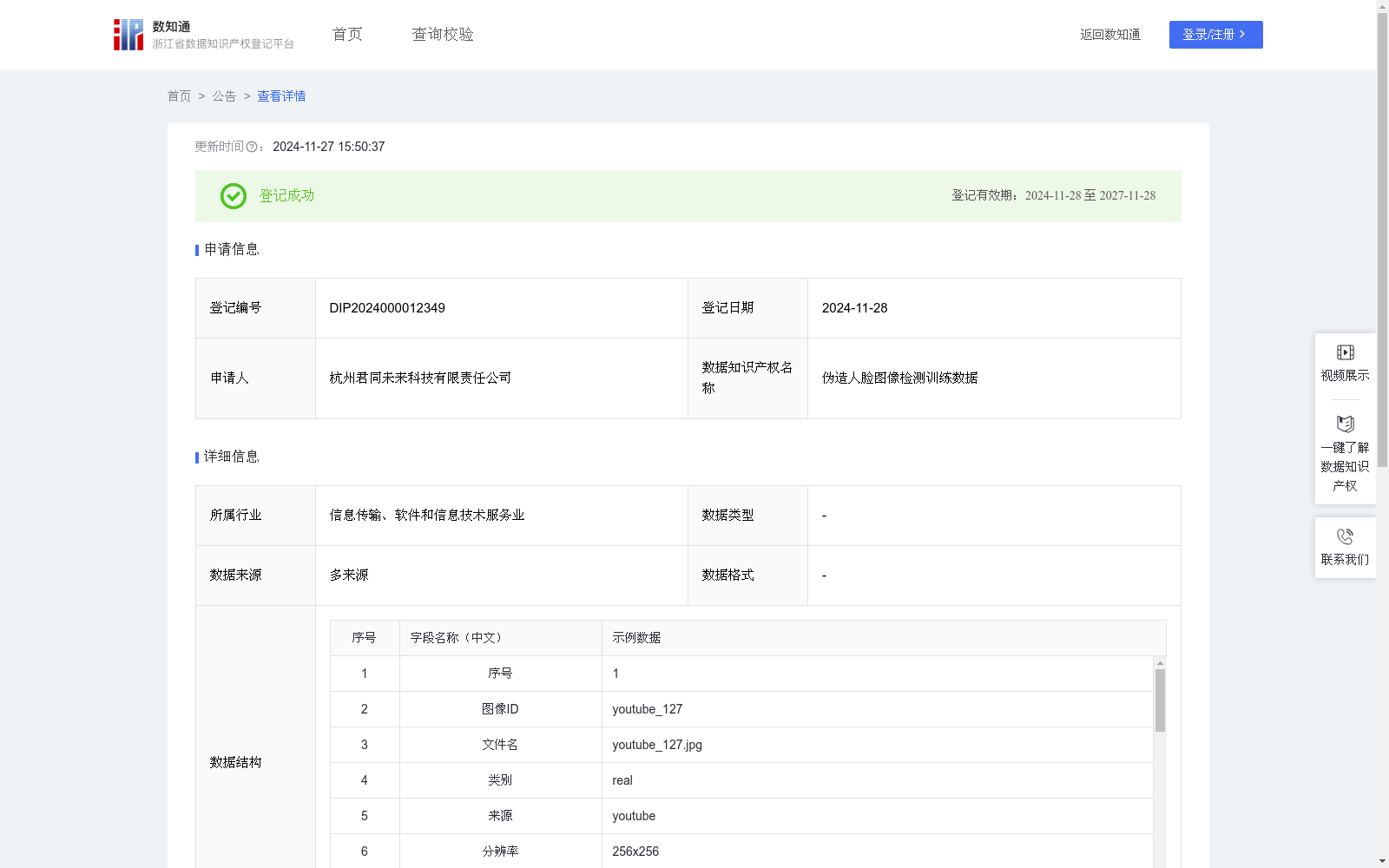
伪造人脸图像检测训练数据
收藏资源简介:
通过系统化数据处理和加工,伪造人脸检测的AI训练数据被转化为高质量、标注精确的训练集。该数据集覆盖了各种伪造人脸图像,伪造技术、面部表情变化、光照条件以及背景复杂度等多样化因素。数据清洗和预处理步骤确保了低质量或无关数据的剔除,并进行了标准化处理,确保数据的高度精确性,从而使模型能全面学习伪造人脸的特征,提升检测准确度。利用标注工具和流程,细化标注伪造类型、伪造区域及其相关特征,确保训练数据的准确性,使AI模型能够深度学习,准确识别伪造人脸图像中的关键特征。模型训练完成后,能够高效识别和分类多种伪造人脸场景,特别适用于视频平台、社交媒体、金融机构及政府部门等,有效预防虚假信息的传播、伪造身份的冒充,以及潜在的安全威胁。在人工智能(AI)安全方面,重点关注虚假场景中的应用,身份冒充、金融诈骗等,引入高精度的伪造人脸检测模型,有效增强系统防御能力,确保平台、用户及数据的安全。算法针对虚假场景中的伪造人脸识别,如深伪技术生成的视频、虚假社交媒体账户和假冒身份验证等,这些场景威胁信息安全,可能破坏社会信任体系,而精准的检测技术能够识别并防止这些伪造行为,保护平台和用户免受虚假信息的侵害。1. 数据获取:我们从公共图像库中获取原始图像数据,结合伪造检测算法扩展数据库。 2. 图像预处理:对采集的图像进行标准化处理,包括调整尺寸和进行归一化,确保数据的一致性。 3. 数据增强策略:为提高模型泛化能力,对图像进行多种数据增强技术,添加高斯噪声、应用浮雕效果、直方图均衡化、以及执行图像的旋转、翻转和缩放操作。 4. 关键特征提取:从图像提取关键的视觉特征,包括颜色直方图、时域和频域特征、局部二值模式、方向梯度直方图,面部几何结构和光照变化等与伪造人脸检测相关的特征。 5. 模型架构选择:选择视觉Transformer(VIT)作为深度学习模型架构,处理面部识别任务。 6. 训练与评估:在标注好的数据集上,通过监督学习训练VIT模型,使用交叉验证和多种性能指标(如准确率和召回率)来评估模型的性能。 7. 超参数调整:我们对模型的超参数进行了细致的调整,包括学习率、批量大小、网络层数和神经元数量,以寻找最优模型配置。 8. 模型细化与验证:根据评估结果,对模型进行正则化处理和其他优化措施,在独立的测试集上进行验证,确保模型在处理未知数据时表现出较好的的鲁棒性和准确性。
Through systematic data processing and refinement, AI training data for deepfake face detection is converted into a high-quality, accurately annotated training dataset. This dataset covers a diverse range of deepfake face images, incorporating varied factors including forgery techniques, facial expression variations, lighting conditions, and background complexity. Data cleaning and preprocessing steps ensure the removal of low-quality or irrelevant data, as well as standardization to guarantee high data accuracy, enabling the model to comprehensively learn the features of deepfake faces and improve detection accuracy. By utilizing annotation tools and workflows, we refine the labeling of forgery types, forgery regions and their associated features, ensuring the accuracy of training data and allowing AI models to conduct deep learning to accurately identify key features in deepfake face images. After training, the model can efficiently identify and classify various deepfake face scenarios, making it particularly suitable for video platforms, social media, financial institutions, government departments and other scenarios, effectively preventing the spread of disinformation, identity impersonation via forgeries, and potential security threats. In terms of artificial intelligence (AI) security, with a focus on applications in deceptive scenarios such as identity impersonation and financial fraud, introducing high-precision deepfake face detection models effectively enhances system defense capabilities and ensures the security of platforms, users and data. The algorithm targets deepfake face recognition in deceptive scenarios, such as deepfake-generated videos, fake social media accounts and fraudulent identity verification. These scenarios pose threats to information security and may undermine social trust systems, while accurate detection technologies can identify and prevent such forgery behaviors, protecting platforms and users from harm caused by disinformation. 1. Data Acquisition: We obtain raw image data from public image libraries and expand the database by integrating deepfake detection algorithms. 2. Image Preprocessing: The collected images undergo standardization processing, including size adjustment and normalization, to ensure data consistency. 3. Data Augmentation Strategy: To improve the model's generalization ability, various data augmentation techniques are applied to the images, including adding Gaussian noise, applying emboss effects, histogram equalization, and performing image rotation, flipping and scaling operations. 4. Key Feature Extraction: Key visual features related to deepfake face detection are extracted from the images, including color histograms, time-domain and frequency-domain features, Local Binary Patterns (LBP), Histogram of Oriented Gradients (HOG), facial geometric structures and lighting variations. 5. Model Architecture Selection: Vision Transformer (ViT) is selected as the deep learning model architecture for the face recognition task. 6. Training and Evaluation: The ViT model is trained via supervised learning on the annotated dataset, and its performance is evaluated using cross-validation and multiple performance metrics such as accuracy and recall. 7. Hyperparameter Tuning: We conduct meticulous tuning of the model's hyperparameters, including learning rate, batch size, network layers and number of neurons, to identify the optimal model configuration. 8. Model Refinement and Validation: Based on the evaluation results, the model is subjected to regularization and other optimization measures, and validated on an independent test set to ensure that the model exhibits good robustness and accuracy when handling unseen data.